My Cart
Your Cart 0

    Your cart is empty.

  • Total (Amount) ₹0.00
NCERT · Class 7 · Maths

Chapter 9: Perimeter and Area

Practice each question, then open the answer or worked solution.

Exercise 11.2

Textbook page 216 · 8 questions
Q1Written answer

Find the area of each of the following parallelograms.

(a)
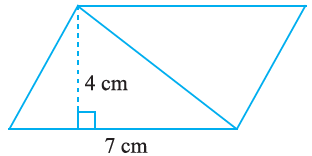
NCERT Solutions for Class 7 Maths Chapter 11 Perimeter and Area Image 2

Show solutionHide solution
Worked solution

Solution:-

From the figure,

Height of parallelogram = 4 cm

Base of parallelogram = 7 cm

Then,

Area of parallelogram = Base × Height

= 7 × 4

= 28 cm2

(b)
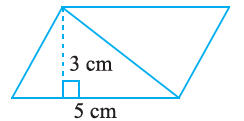
NCERT Solutions for Class 7 Maths Chapter 11 Perimeter and Area Image 3

Solution:-

From the figure,

Height of parallelogram = 3 cm

Base of parallelogram = 5 cm

Then,

Area of parallelogram = Base × Height

= 5 × 3

= 15 cm2

(c)
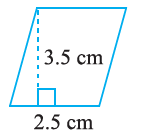
NCERT Solutions for Class 7 Maths Chapter 11 Perimeter and Area Image 4

Solution:-

From the figure,

Height of parallelogram = 3.5 cm

Base of parallelogram = 2.5 cm

Then,

Area of parallelogram = Base × Height

= 2.5 × 3.5

= 8.75 cm2

(d)
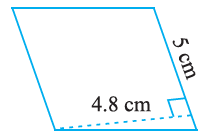
NCERT Solutions for Class 7 Maths Chapter 11 Perimeter and Area Image 5

Solution:-

From the figure,

Height of parallelogram = 4.8 cm

Base of parallelogram = 5 cm

Then,

Area of parallelogram = Base × Height

= 5 × 4.8

= 24 cm2

(e)
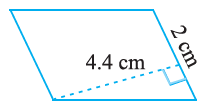
NCERT Solutions for Class 7 Maths Chapter 11 Perimeter and Area Image 6

Solution:-

From the figure,

Height of parallelogram = 4.4 cm

Base of parallelogram = 2 cm

Then,

Area of parallelogram = Base × Height

= 2 × 4.4

= 8.8 cm2
Q2Written answer

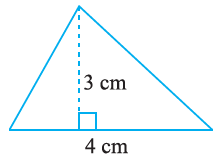
Find the area of each of the following triangles.

(a)

NCERT Solutions for Class 7 Maths Chapter 11 Perimeter and Area Image 7

Show solutionHide solution
Worked solution

Solution:-

From the figure,

Base of triangle = 4 cm

Height of height = 3 cm

Then,

Area of triangle = ½ × Base × Height

= ½ × 4 × 3

= 1 × 2 × 3

= 6 cm2

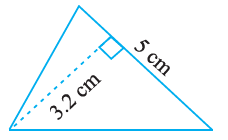
(b)

NCERT Solutions for Class 7 Maths Chapter 11 Perimeter and Area Image 8

Solution:-

From the figure,

Base of triangle = 3.2 cm

Height of height = 5 cm

Then,

Area of triangle = ½ × Base × Height

= ½ × 3.2 × 5

= 1 × 1.6 × 5

= 8 cm2

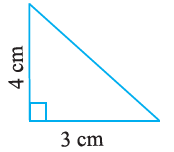
(c)

NCERT Solutions for Class 7 Maths Chapter 11 Perimeter and Area Image 9

Solution:-

From the figure,

Base of triangle = 3 cm

Height of height = 4 cm

Then,

Area of triangle = ½ × Base × Height

= ½ × 3 × 4

= 1 × 3 × 2

= 6 cm2

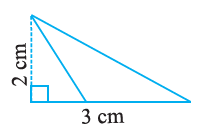
(d)

NCERT Solutions for Class 7 Maths Chapter 11 Perimeter and Area Image 10

Solution:-

From the figure,

Base of triangle = 3 cm

Height of height = 2 cm

Then,

Area of triangle = ½ × Base × Height

= ½ × 3 × 2

= 1 × 3 × 1

= 3 cm2

Q3Written answer

Find the missing values.

S.No. Base Height Area of the Parallelogram
a. 20 cm 246 cm2
b. 15 cm 154.5 cm2
c. 8.4 cm 48.72 cm2
d. 15.6 cm 16.38 cm2
Show solutionHide solution
Worked solution

Solution:-

(a)

From the table,

Base of parallelogram = 20 cm

Height of parallelogram =?

Area of the parallelogram = 246 cm2

Then,

Area of parallelogram = Base × Height

246 = 20 × height

Height = 246/20

Height = 12.3 cm

∴ Height of the parallelogram is 12.3 cm.

(b)

From the table,

Base of parallelogram =?

Height of parallelogram =15 cm

Area of the parallelogram = 154.5 cm2

Then,

Area of parallelogram = Base × Height

154.5 = base × 15

Base = 154.5/15

Base = 10.3 cm

∴ Base of the parallelogram is 10.3 cm.

(c)

From the table,

Base of parallelogram =?

Height of parallelogram =8.4 cm

Area of the parallelogram = 48.72 cm2

Then,

Area of parallelogram = Base × Height

48.72 = base × 8.4

Base = 48.72/8.4

Base = 5.8 cm

∴ Base of the parallelogram is 5.8 cm.

(d)

From the table,

Base of parallelogram = 15.6 cm

Height of parallelogram =?

Area of the parallelogram = 16.38 cm2

Then,

Area of parallelogram = Base × Height

16.38 = 15.6 × height

Height = 16.38/15.6

Height = 1.05 cm

∴ Height of the parallelogram is 1.05 cm.

S.No. Base Height Area of the Parallelogram
a. 20 cm 12.3 cm 246 cm2
b. 10.3 cm 15 cm 154.5 cm2
c. 5.8 cm 8.4 cm 48.72 cm2
d. 15.6 cm 1.05 16.38 cm2
Q4Written answer

Find the missing values.

Base Height Area of Triangle
15 cm 87 cm2
31.4 mm 1256 mm2
22 cm 170.5 cm2
Show solutionHide solution
Worked solution

Solution:-

(a)

From the table,

Height of triangle =?

Base of triangle = 15 cm

Area of the triangle = 16.38 cm2

Then,

Area of triangle = ½ × Base × Height

87 = ½ × 15 × height

Height = (87 × 2)/15

Height = 174/15

Height = 11.6 cm

∴ Height of the triangle is 11.6 cm.

(b)

From the table,

Height of triangle =31.4 mm

Base of triangle =?

Area of the triangle = 1256 mm2

Then,

Area of triangle = ½ × Base × Height

1256 = ½ × base × 31.4

Base = (1256 × 2)/31.4

Base = 2512/31.4

Base = 80 mm = 8 cm

∴ Base of the triangle is 80 mm or 8 cm.

(c)

From the table,

Height of triangle =?

Base of triangle = 22 cm

Area of the triangle = 170.5 cm2

Then,

Area of triangle = ½ × Base × Height

170.5 = ½ × 22 × height

170.5 = 1 × 11 × height

Height = 170.5/11

Height = 15.5 cm

∴ Height of the triangle is 15.5 cm.

Q5Written answer

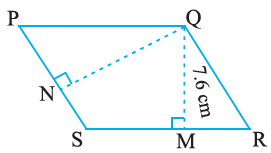
PQRS is a parallelogram (Fig 11.23). QM is the height from Q to SR, and QN is the height from Q to PS. If SR = 12 cm and QM = 7.6 cm. Find:

(a) The area of the parallelogram PQRS (b) QN, if PS = 8 cm

NCERT Solutions for Class 7 Maths Chapter 11 Perimeter and Area Image 11

Fig 11.23

Show solutionHide solution
Worked solution

Solution:-

From the question, it is given that

SR = 12 cm, QM = 7.6 cm

(a) We know that,

Area of the parallelogram = Base × Height

= SR × QM

= 12 × 7.6

= 91.2 cm2

(b) Area of the parallelogram = Base × Height

91.2 = PS × QN

91.2 = 8 × QN

QN = 91.2/8

QN = 11.4 cm

Q6Written answer

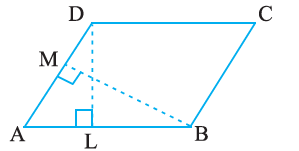
DL and BM are the heights on sides AB and AD, respectively, of parallelogram ABCD (Fig 11.24). If the area of the parallelogram is 1470 cm2, AB = 35 cm and AD = 49 cm, find the length of BM and DL.

NCERT Solutions for Class 7 Maths Chapter 11 Perimeter and Area Image 12

Fig 11.24

Show solutionHide solution
Worked solution

Solution:-

From the question, it is given that

Area of the parallelogram = 1470 cm2

AB = 35 cm

AD = 49 cm

Then,

We know that,

Area of the parallelogram = Base × Height

1470 = AB × BM

1470 = 35 × DL

DL = 1470/35

DL = 42 cm

And,

Area of the parallelogram = Base × Height

1470 = AD × BM

1470 = 49 × BM

BM = 1470/49

BM = 30 cm

Q7Written answer

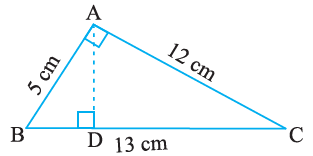
ΔABC is right-angled at A (Fig 11.25). AD is perpendicular to BC. If AB = 5 cm, BC = 13 cm, and AC = 12 cm, find the area of ΔABC. Also, find the length of AD.

NCERT Solutions for Class 7 Maths Chapter 11 Perimeter and Area Image 13

Fig 11.25

Show solutionHide solution
Worked solution

Solution:-

From the question, it is given that

AB = 5 cm, BC = 13 cm, AC = 12 cm

Then,

We know that,

Area of the ΔABC = ½ × Base × Height

= ½ × AB × AC

= ½ × 5 × 12

= 1 × 5 × 6

= 30 cm2

Now,

Area of ΔABC = ½ × Base × Height

30 = ½ × AD × BC

30 = ½ × AD × 13

(30 × 2)/13 = AD

AD = 60/13

AD = 4.6 cm

Q8Written answer

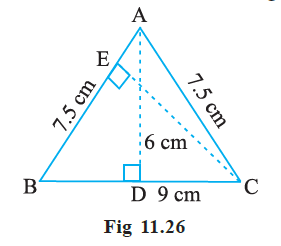
ΔABC is isosceles with AB = AC = 7.5 cm and BC = 9 cm (Fig 11.26). The height AD from A to BC is 6 cm. Find the area of ΔABC. What will be the height from C to AB, i.e., CE?

NCERT Solutions for Class 7 Maths Chapter 11 Perimeter and Area Image 14

Show solutionHide solution
Worked solution

Solution:-

From the question, it is given that

AB = AC = 7.5 cm, BC = 9 cm, AD = 6cm

Then,

Area of ΔABC = ½ × Base × Height

= ½ × BC × AD

= ½ × 9 × 6

= 1 × 9 × 3

= 27 cm2

Now,

Area of ΔABC = ½ × Base × Height

27 = ½ × AB × CE

27 = ½ × 7.5 × CE

(27 × 2)/7.5 = CE

CE = 54/7.5

CE = 7.2 cm