My Cart
Your Cart 0

    Your cart is empty.

  • Total (Amount) ₹0.00
NCERT · Class 6 · Social Science

Chapter 5: Kingdoms, Kings and an Early Republic

Practice each question, then open the answer or worked solution.

Questions

8 questions
Q1Written answer

State whether true or false.

  1. Rajas who led the ashvamedha horse pass through their lands were invited to the sacrifice.
  2. The charioteer sprinkled sacred water on the king.
  3. Archaeologists have found palaces in the settlements of the janapadas.
  4. Pots to store grain were made out of Painted Grey Ware.
  5. Many cities in mahajanapadas were fortified.
Show solutionHide solution
Worked solution

(a) True

The Rajas who allowed the ashvameda horse to pass through their lands showed that they accepted the supremacy of the Raja performing the sacrifice. These Rajas were then invited to attend the sacrifice.

(b) False

The charioteer was the raja’s companion on the battlefield and bore witness to many of his deeds and exploits. Thus, it was the charioteer who sang poems and recounted tales glorifying the deeds of the Raja and Priests performed the rituals, including the sprinkling of sacred water on the king.

(c) False

It has been discovered by archaeologists that people lived in huts and kept cattle and other animals in the many settlements of the janapadas.

(d) False

Plates and bowls are the most common vessels made out of Painted Grey Ware. These were used on special occasions, for important people, and to serve special food.

(e) True

Most mahajanapadas had a capital city, and many of them were fortified.
Q2Written answer

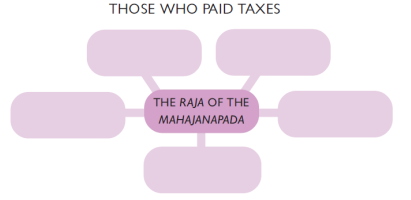
Fill in the chart given below with the terms: hunter-gatherers, farmers, traders, craftspersons, herders.

NCERT Solutions Class 6 Social Science History - Tax Network

Show solutionHide solution
Worked solution

Solution: Farmers – Gave one-sixth of the produce to the state

Craftspersons – Contributed to labour

Herder – Contributed in the form of animal produce

Traders  – Stimulated commercial activity by buying and selling goods

Hunter-gatherers  – Would provide forest produce such as elephants, furs and other items as a tribute

Q3Written answer

Who were the groups who could not participate in the assemblies of the ganas?

Show solutionHide solution
Worked solution

The following groups couldn’t participate in the assemblies of the ganas:

1. Women

2. Dasas, the slaves

3. Kammakaras, the landless labourers

Q4Written answer

Why did the rajas of mahajanapadas build forts?

Show solutionHide solution
Worked solution

Solution: The rajas of mahajanapadas built forts to defend their capital city from attacks by other rajas. It is also said that they wanted to show how rich and powerful they were by building large and powerful walls. The more practical reason could be that it was easier to govern fortified cities.

Q5Written answer

In what ways are present-day elections different from the ways in which rulers were chosen in janapadas?

Show solutionHide solution
Worked solution

Solution: In janapadas, men became ‘rajas’ by performing the Ashvamedha sacrifice. The rajas who let the Ashvamedha horse pass through their lands meant that they accepted the supremacy of the raja who wanted to perform the sacrifice.

In modern times, leaders are elected through a democratic system. Every citizen who is 18 years or older has the right to cast their vote. The candidates who win the majority of votes become the leaders.

Q6Written answer

Were there any janapadas in your state? If yes, name them. If not, name the janapadas that would have been closest to your state, and mention whether they were to the east, west, north or south.

Show solutionHide solution
Worked solution

Solution: The answer is subjective to the region and area you live in. Take the assistance of your subject teacher and the map given on page 57 in the textbook to prepare your answer.

Q7Written answer

Find out whether any of the groups mentioned in answer 2 pay taxes today.

Show solutionHide solution
Worked solution

Solution: Out of the groups mentioned in answer 2, traders are the ones who pay taxes today.

Q8Written answer

Find out whether the groups mentioned in answer 3 have voting rights.

Show solutionHide solution
Worked solution

Solution: Today, voting rights are not decided by gender or profession. Women, ‘kammakaras’ and ‘dasas’ were not entitled to attend assemblies in the older days.