Q1Written answer
What all can vehicles run on?
Show solutionHide solution
Worked solution
Answer: Vehicles can run on petrol, diesel, LPG, solar energy and battery.
Your cart is empty.
Practice each question, then open the answer or worked solution.
What all can vehicles run on?
Answer: Vehicles can run on petrol, diesel, LPG, solar energy and battery.
What kinds of problems will we face, if the number of vehicles keeps on increasing? For example, more traffic on the road. Talk to your elders and write about it.
Answer: If the number of vehicles keeps on increasing, it will lead to many problems, like increased traffic on the road, air pollution, noise pollution and accidents.
Manju said, “Why doesn’t everyone use a bus?” What do you think, why don’t people travel by bus?
Answer: Buses are overcrowded, and hence, people want to avoid them.
Suggest some ways to deal with the problems arising out of the growing number of vehicles.
Answer: People should prefer public transport like buses, trains, etc., and people should use carpools to avoid problems arising out of the growing number of vehicles.
What are the benefits, if we switch off the engine of the vehicles at the red light on the road?
Answer: It will save fuel if we switch off the engine of the vehicles at the red light on the road.
Find OUT and Write:
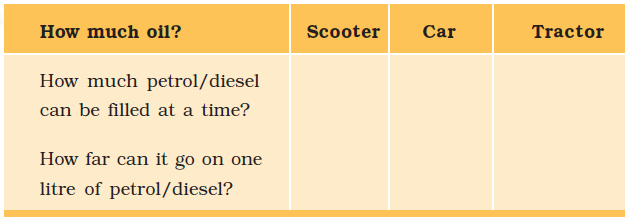
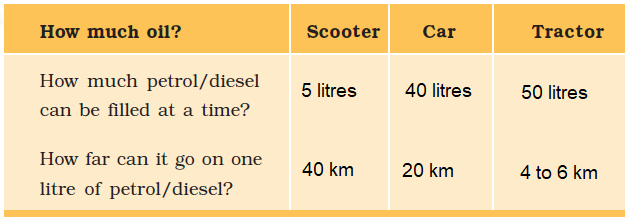
The rates of petrol are different in each city. The rates of petrol and diesel in Delhi are given here. Look at the table and answer the questions.
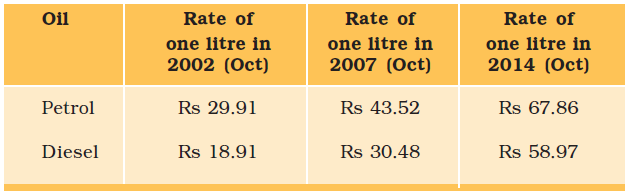
Q1: In 2014, as compared to 2007, the rate of petrol went up by ———rupees. The rate of diesel increased by ————rupees.
In 2014, as compared to 2007, the rate of petrol went up by 23.34 rupees. The rate of diesel increased by 28.49 rupees.
Q2: What was the difference in the rates of petrol and diesel from 2002 to 2007 and 2007 to 2014?
Answer: The difference in the rates of petrol from 2002 to 2007 is 13.61 rupees, and diesel is 11.57 rupees.
The difference in the rates of petrol from 2007 to 2014 is 23.34 rupees, and diesel is 28.49 rupees.