My Cart
Your Cart 0

    Your cart is empty.

  • Total (Amount) ₹0.00
NCERT · Class 12 · Physics

Chapter 9: Ray Optics and Optical Instruments

Practice each question, then open the answer or worked solution.

Questions

38 questions
Q21Written answer


(i) Determine the ‘effective focal length’ of the combination of the two lenses in
Exercise 9.10, if they are placed 8.0 cm apart with their principal axes coincident. Does
the answer depend on which side of the combination a beam of parallel light is incident?
Is the notion of the effective focal length of this system useful at all?

(ii) An object 1.5 cm in size is placed on the side of the convex lens in the arrangement
(a) above. The distance between the object and the convex lens is 40 cm. Determine
the magnification produced by the two-lens system and the size of the image.

Show solutionHide solution
Worked solution


The focal length of the convex lens,

\(\begin{array}{l}f_{1}\end{array} \)

\(\begin{array}{l}f_{2}\end{array} \)


(i)
\(\begin{array}{l}\frac{1}{v_{1}}-\frac{1}{u_{1}}=\frac{1}{f_{1}}\end{array} \)

\(\begin{array}{l}u_{1}\end{array} \)

\(\begin{array}{l}v_{1}\end{array} \)
\(\begin{array}{l}\frac{1}{v_{1}}=\frac{1}{30}-\frac{1}{\infty}=\frac{1}{30}\end{array} \)

Therefore,

\(\begin{array}{l}v_{1}=30cm\end{array} \)

\(\begin{array}{l}\frac{1}{v_{2}}-\frac{1}{u_{2}}=\frac{1}{f_{2}}\end{array} \)

Where,

\(\begin{array}{l}u_{2}\end{array} \)


\(\begin{array}{l}v_{2}\end{array} \)
\(\begin{array}{l}\frac{1}{v_{2}}=\frac{1}{22}-\frac{1}{20}=\frac{10-11}{220}=\frac{-1}{220}\end{array} \)

Therefore,

\(\begin{array}{l}v_{2}=-220cm\end{array} \)

The parallel incident beam appears to diverge from a point that is 

\(\begin{array}{l}(220-\frac{d}{2}=220-4)216cm\end{array} \)


\(\begin{array}{l}\frac{1}{v_{2}}-\frac{1}{u_{2}}=\frac{1}{f_{2}}\end{array} \)


\(\begin{array}{l}\frac{1}{v_{2}}=\frac{1}{f_{2}}+\frac{1}{u_{2}}\end{array} \)

\(\begin{array}{l}u_{2}\end{array} \)


\(\begin{array}{l}v_{2}\end{array} \)


\(\begin{array}{l}\frac{1}{v_{2}}=\frac{1}{-20}+\frac{1}{-\infty}=-\frac{1}{20}\end{array} \)

Therefore,

\(\begin{array}{l}v_{2}=-20cm\end{array} \)

For a convex lens, the image will act as a real object.
Applying the lens formula to the convex lens, we have

\(\begin{array}{l}\frac{1}{v_{1}}-\frac{1}{u_{1}}=\frac{1}{f_{1}}\end{array} \)

\(\begin{array}{l}u_{1}\end{array} \)


\(\begin{array}{l}v_{1}\end{array} \)
\(\begin{array}{l}\frac{1}{v_{1}}=\frac{1}{30}+\frac{1}{-28}=\frac{14-15}{420}=\frac{-1}{420}\end{array} \)

Therefore,

\(\begin{array}{l}v_{2}=-420cm\end{array} \)

The parallel incident beam appears to diverge from (420-4) 416cm. The diversion happens from the left of the centre of the combination of the two lenses. The answer is dependent on the side of the combination where the incident beam of light is parallel.

(ii) Height of the image,

\(\begin{array}{l}h_{1}\end{array} \)

\(\begin{array}{l}u_{1}\end{array} \)

\(\begin{array}{l}|u_{1}|=40cm\end{array} \)

Using the lens formula,

\(\begin{array}{l}\frac{1}{v_{1}}-\frac{1}{u_{1}}=\frac{1}{f_{1}}\end{array} \)
\(\begin{array}{l}v_{1}\end{array} \)
\(\begin{array}{l}\frac{1}{v_{1}}=\frac{1}{30}+\frac{1}{-40}=\frac{4-3}{120}=\frac{1}{120}\end{array} \)

Therefore,

\(\begin{array}{l}v_{1}=120cm\end{array} \)

Magnification, m=

\(\begin{array}{l}\frac{v_{1}}{|u_{1}|}=\frac{120}{40}=3\end{array} \)


\(\begin{array}{l}\frac{1}{v_{2}}-\frac{1}{u_{2}}=\frac{1}{f_{2}}\end{array} \)

\(\begin{array}{l}u_{2}\end{array} \)

\(\begin{array}{l}v_{2}\end{array} \)
\(\begin{array}{l}\frac{1}{v_{2}}=\frac{1}{-20}+\frac{1}{112}=\frac{-112+20}{2240}=\frac{-92}{2240}\end{array} \)

Therefore

\(\begin{array}{l}v_{2}=\frac{-2240}{92}\end{array} \)

Magnification, m’=

\(\begin{array}{l}|\frac{v_{2}}{u_{2}}|=\frac{2240}{92}\times \frac{1}{112}=\frac{20}{92}\end{array} \)

Hence, the magnification due to the concave lens is

\(\begin{array}{l}\frac{20}{92}\end{array} \)

\(\begin{array}{l}m \times m’\end{array} \)

The magnification of the combination is given as

\(\begin{array}{l}\frac{h_{2}}{h_{1}}=0.652\end{array} \)


\(\begin{array}{l}h_{2}=h_{1}\times 0.652\end{array} \)

\(\begin{array}{l}h_{1}\end{array} \)

\(\begin{array}{l}h_{2}\end{array} \)

\(\begin{array}{l}h_{2}=0.652\times1.5=0.98cm\end{array} \)

Hence, the height of the image is 0.98 cm.
Q22Written answer


At what angle should a ray of light be incident on the face of a prism of refracting angle

\(\begin{array}{l}60°\end{array} \)
so that it just suffers total internal reflection at the other face? The refractive index of the material of the prism is 1.524.

Show solutionHide solution
Worked solution


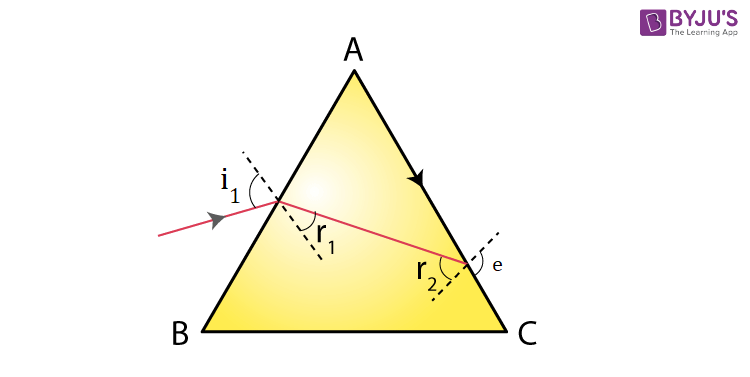
The incident, refracted, and emergent rays associated with a glass prism ABC are shown in the given figure.

NCERT Solutions for Class 12 Physics Chapter 9 Ray Optics and Optical Instruments Question 22 Solution

Angle of prism, A =

\(\begin{array}{l}60°\end{array} \)
\(\begin{array}{l}\mu\end{array} \)

\(\begin{array}{l}i_{1}\end{array} \)

\(\begin{array}{l}r_{1}\end{array} \)

\(\begin{array}{l}r_{2}\end{array} \)

\(\begin{array}{l}90°\end{array} \)
\(\begin{array}{l}\frac{sin e}{sin r_{2}}=\mu\end{array} \)


\(\begin{array}{l}sin r_{2}=\frac{1}{\mu}\times sin\;90°\end{array} \)

=

\(\begin{array}{l}\frac{1}{1.524}=0.6562\end{array} \)

Therefore,

\(\begin{array}{l}r_{2}=sin^{-1}0.6562=41°\end{array} \)

Therefore,

\(\begin{array}{l}r_{1}=A-r_{2}=60-41=19°\end{array} \)
\(\begin{array}{l}r_{1}+r_{2}\end{array} \)
\(\begin{array}{l}\mu=\frac{sin i_{1}}{sin r_{1}}\end{array} \)


\(\begin{array}{l}sin i_{1}=\mu sin r_{1}\end{array} \)

=

\(\begin{array}{l}1.524\times sin 19°\end{array} \)

Therefore,

\(\begin{array}{l}i_{1}=29.75°\end{array} \)

Therefore, the angle of incidence is

\(\begin{array}{l}29.75°\end{array} \)
Q23Written answer


You are given prisms made of crown glass and flint glass with a wide variety of angles.
Suggest a combination of prisms which will
(i) deviate a pencil of white light without much dispersion,
(ii) disperse (and displace) a pencil of white light without much deviation.

Show solutionHide solution
Worked solution


(i) The two prisms must be placed next to each other. The bases of these two prisms must be such that they are on opposite sides of the incident white light. The dispersion of white light first takes place when it is incident on the first prism. The dispersed ray then enters the second prism as an incident ray. The dispersion of light from both prisms emerges as white light.

(ii) Consider the two prisms from (i). The deviations from this combination of prisms become equal by adjusting the angle between them. When the angle is maintained between these two prisms, the pencil of white light will disperse without much deviation.

Q24Written answer


For a normal eye, the far point is at infinity, and the near point of distinct vision is about
25cm in front of the eye. The cornea of the eye provides a converging power of about
40 dioptres, and the least converging power of the eye lens behind the cornea is about
20 dioptres. From this rough data, estimate the range of accommodation (i.e., the
range of converging power of the eye-lens) of a normal eye.

Show solutionHide solution
Worked solution


Least distance of distinct vision, d = 25 cm
The far point of a normal eye, d’ = ∞
The converging power of the cornea,

\(\begin{array}{l}P_{c}=40D\end{array} \)
\(\begin{array}{l}P_{e}=20D\end{array} \)

\(\begin{array}{l}P_{c} + P_{e} = 40 + 20 = 60 D\end{array} \)

The power of the eye lens is given as

P=

\(\begin{array}{l}\frac{1}{Focal\; length \; of \; the\; eye\; lens\;(f)}\end{array} \)


\(\begin{array}{l}f=\frac{1}{P}\end{array} \)


\(\begin{array}{l}\frac{1}{60D}\end{array} \)


\(\begin{array}{l}\frac{100}{60}=\frac{5}{3}cm\end{array} \)


\(\begin{array}{l}v=\frac{5}{3}\end{array} \)
\(\begin{array}{l}\frac{1}{f’}=\frac{1}{v}+\frac{1}{u}\end{array} \)

f’=focal length

\(\begin{array}{l}\frac{1}{f’}=\frac{3}{5}+\frac{1}{25}=\frac{15+1}{25}=\frac{16}{25}cm^{-1}\end{array} \)


Power

\(\begin{array}{l}P’=\frac{1}{f’}\times100\end{array} \)


\(\begin{array}{l}P’=\frac{16}{25}\times100=64D\end{array} \)

Therefore, Power of the eye-lens = 64 − 40 = 24 D
Hence, 20D to 24D is the range of accommodation of the eye lens.

Q25Written answer

Does the human eye partially lose its ability of accommodation when it undergoes short-sightedness (myopia) or long-sightedness (hypermetropia)? If not, what might cause these defects of vision?

Show solutionHide solution
Worked solution

Soln: When a person is suffering from myopia or hypermetropia, eye lenses are used. Myopia is a condition when the eyeballs start to elongate from the front to the back. Hypermetropia is a condition when the eyeballs start to shorten. While presbyopia is a condition where the eyeballs lose their ability to accommodate.

Q26Written answer

Spectacles of power −1.0 dioptre are being used by a person suffering from myopia for distant vision. He also needs to use a separate reading glass of power + 2.0 dioptres when he turns old. Explain what may have happened.

Show solutionHide solution
Worked solution

Soln: The myopic person uses a spectacle of power, P = -1.0 D

Focal length of the given spectacles, f =

\(\begin{array}{l}\frac{1}{P}\end{array} \)
\(\begin{array}{l}\frac{1}{-1\times 10^{-2}}\end{array} \)

= -100 cm

Therefore, 100cm is the far point of the person. The normal near point of the person is 25cm. When the objects are placed at infinity, virtual images are produced at 100cm. This is possible when spectacles are used. When the ability of accommodation of the eye-lens is used, he will be able to see the objects that are placed between 100cm and 25cm.

During old age, the person uses reading glasses of power, P’ = +2 D

As the age increases, the ability to accommodate decreases. This is known as presbyopia. This is the reason why he is finding it difficult to see the objects placed at 25cm.

Q27Written answer

A person looking at a cloth with a pattern consisting of vertical and horizontal lines is able to see the vertical lines more distinctly than the horizontal ones. What is this defect due to? How is such a defect of vision corrected?

Show solutionHide solution
Worked solution

In the given situation, the person is having difficulty seeing the horizontal lines, while the vertical lines are distinctly visible. This occurs when the refracting system of the eye is not working the same for different planes. This is known as astigmatism. For the vertical plane, the curvature of the eye is sufficient. But the same curvature is not sufficient for the horizontal plane. Hence, the formation of sharp images from the vertical line is possible on the retina, and the horizontal lines appear blurred. With the help of cylindrical lenses, this defect can be corrected.

Q28Written answer

A child with a normal near point (25 cm) reads a book with a small size print using a magnifying glass: a thin convex lens of focal length 5 cm.

(a) What would be the shortest and the longest distance at which the lens should be placed from the page so that the book can be read easily when viewed through the magnifying glass?

(b) What is the max and the mini angular magnification (magnifying power) possible using the above given simple microscope?

Show solutionHide solution
Worked solution

Soln: (a) Focal length of the magnifying glass, f = 5 cm

Distance vision has the least distance, d = 25 cm

Closest object distance = u

Image distance, v = -d = -25 cm

According to the lens formula, we have

\(\begin{array}{l}\frac{1}{f}\end{array} \)
\(\begin{array}{l}\frac{1}{v}\end{array} \)
\(\begin{array}{l}\frac{1}{u}\end{array} \)


\(\begin{array}{l}\frac{1}{u}\end{array} \)
\(\begin{array}{l}\frac{1}{v}\end{array} \)
\(\begin{array}{l}\frac{1}{f}\end{array} \)

=

\(\begin{array}{l}\frac{1}{-25}\end{array} \)
\(\begin{array}{l}\frac{1}{5}\end{array} \)

=

\(\begin{array}{l}\frac{-6}{25}\end{array} \)

Therefore, u =

\(\begin{array}{l}\frac{-25}{6}\end{array} \)

= -4.167 cm

Hence, the closest distance at which the person can read the book is 4.167 cm.

For the object at the longest distance (u’), the image distance (v’) = ∞

According to the lens formula, we have

\(\begin{array}{l}\frac{1}{f}\end{array} \)
\(\begin{array}{l}\frac{1}{v’}\end{array} \)
\(\begin{array}{l}\frac{1}{u’}\end{array} \)


\(\begin{array}{l}\frac{1}{u’}\end{array} \)
\(\begin{array}{l}\frac{1}{∞}\end{array} \)
\(\begin{array}{l}\frac{1}{5}\end{array} \)

= –

\(\begin{array}{l}\frac{1}{5}\end{array} \)

Therefore, u’ = -5 cm

Hence, the farthest distance at which the person can read the book is 5 cm.

(b) Maximum angular magnification is given by the relation

\(\begin{array}{l}\alpha _{max}=\frac{d}{\left | u \right |}\end{array} \)

=

\(\begin{array}{l}\frac{25}{\frac{25}{6}}\end{array} \)

= 6

Minimum angular magnification is given by the relation

=

\(\begin{array}{l}\alpha _{max}=\frac{d}{\left | u’ \right |}\end{array} \)

=

\(\begin{array}{l}\frac{25}{5}\end{array} \)

= 5

Q29Written answer

A large card divided into squares, each of size 1 mm2, is being viewed from a distance of 9 cm through a magnifying glass (the converging lens has a focal length of 9 cm) held close to the eye. Determine:

(a) the magnification produced by the lens? How much is the area of each square in the virtual image?

(b) the angular magnification (magnifying power) of the lens?

(c) Is the magnification in (a) equal to the magnifying power in (b)? Explain.

Show solutionHide solution
Worked solution

(a)Area of each square, A = 1 mm2

Object distance, u = −9 cm

The focal length of a converging lens, f = 10 cm

The lens formula for the image distance v can be written as

\(\begin{array}{l}\frac{1}{f}\end{array} \)
\(\begin{array}{l}\frac{1}{v}\end{array} \)
\(\begin{array}{l}\frac{1}{u}\end{array} \)


\(\begin{array}{l}\frac{1}{10}\end{array} \)
\(\begin{array}{l}\frac{1}{v}\end{array} \)
\(\begin{array}{l}\frac{1}{9}\end{array} \)


\(\begin{array}{l}\frac{1}{v}\end{array} \)
\(\begin{array}{l}\frac{1}{90}\end{array} \)

Therefore, v = -90 cm

Magnification, m =

\(\begin{array}{l}\frac{v}{u}\end{array} \)

=

\(\begin{array}{l}\frac{-90}{-9}\end{array} \)

= 10

Therefore, the area of each square in the virtual image = (10)2 A

= 102 x 1 = 100 mm2

= 1 cm2

(b) The lens has a magnifying power of =

\(\begin{array}{l}\frac{d}{\left | u \right |}\end{array} \)

=

\(\begin{array}{l}\frac{25}{9}\end{array} \)

= 2.8

(c) The magnification in (a) is not the same as the magnifying power in (b).

The magnification magnitude is

\(\begin{array}{l}(\left | \frac{v}{u} \right |)\end{array} \)
\(\begin{array}{l}\left ( \frac{d}{\left | u \right |} \right )\end{array} \)

The two quantities will be equal when the image is formed at the near point (25 cm).

Q30Written answer

(a) Determine the distance in which the lens should be held from the figure in Exercise 9.29 in order to view the squares distinctly with the maximum possible magnifying power.

(b) Determine the magnification in the following situation.

(c) Find if the magnifying power is equal to magnification.

Explain.

Show solutionHide solution
Worked solution

(a) When the image is formed at the near point, we get the maximum possible magnification.

So, image distance, v = −d = −25 cm

Focal length, f = 10 cm

Object distance = u

According to the lens formula, we have

\(\begin{array}{l}\frac{1}{f}\end{array} \)
\(\begin{array}{l}\frac{1}{v}\end{array} \)
\(\begin{array}{l}\frac{1}{u}\end{array} \)


\(\begin{array}{l}\frac{1}{u}\end{array} \)
\(\begin{array}{l}\frac{1}{v}\end{array} \)
\(\begin{array}{l}\frac{1}{f}\end{array} \)

=

\(\begin{array}{l}\frac{1}{-25}\end{array} \)
\(\begin{array}{l}\frac{1}{10}\end{array} \)
\(\begin{array}{l}\frac{7}{50}\end{array} \)

Therefore, u =

\(\begin{array}{l}\frac{-50}{7}\end{array} \)

= – 7.14 cm

Hence, the lens should be kept 7.14 cm away in order to view the squares distinctly.

(b) Magnification =

\(\begin{array}{l}\left | \frac{v}{u} \right |\end{array} \)

=

\(\begin{array}{l}\frac{25}{\frac{50}{7}}\end{array} \)

(c) Magnifying power =

\(\begin{array}{l}\frac{d}{u}\end{array} \)

=

\(\begin{array}{l}\frac{25}{\frac{50}{7}}\end{array} \)

= 3.5

Therefore, the magnifying power is equal to the magnitude of magnification since the image is formed at the near point (25 cm).