My Cart
Your Cart 0

    Your cart is empty.

  • Total (Amount) ₹0.00
NCERT · Class 12 · Physics

Chapter 4: Moving Charges and Magnetism

Practice each question, then open the answer or worked solution.

Questions

15 questions
Q4.24Written answer

A uniform magnetic field of 3000 G is established along the positive z-direction. A rectangular loop of sides 10 cm and 5 cm carries a current of 12 A. What is the torque on the loop in the different cases shown in the figure? What is the force in each case? Which case corresponds to stable equilibrium?
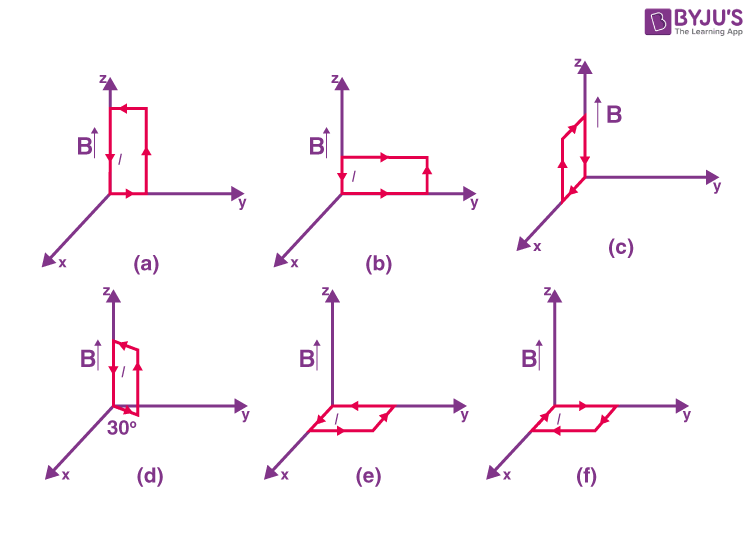
NCERT Class 12 - Chapter 4 - Magnitude of magnetic field- Question 24

Show solutionHide solution
Worked solution

Magnetic field strength, B = 3000 G = 0.3 T

Area of the loop, A = 10 x 5 = 50 cm2 = 50 x 10-4 m2

Current in the loop, I = 12 A

(a) Torque, 

\(\begin{array}{l}\vec{\tau }=I\vec{A}\times \vec{B}\end{array} \)

A is normal to the y-z plane, and B is directed along the z-axis

\(\begin{array}{l}\vec{A}=50\times 10^{-4}\hat{i}\end{array} \)
\(\begin{array}{l}\vec{B}=0.3\hat{k}\end{array} \)
\(\begin{array}{l}\vec{\tau }= 12 \times (50\times 10^{-4})\hat{i}\times 0.3\hat{k}\end{array} \)
\(\begin{array}{l}= -1.8 \times 10^{-2}\hat{j}Nm\end{array} \)

The torque is 1.8 x 10⁻² N m along the negative y-direction. The net force on the loop is zero since the opposite forces acting on the two ends of the loop will cancel each other.

(b) This is the same as (a). Therefore, the torque is 1.8 x 10⁻² N m along the negative y-direction. The net force is zero.

(c) A is normal to the x-z plane, and B is along the z-axis

\(\begin{array}{l}\vec{A}=- 50\times 10^{-4}\hat{j}\end{array} \)
\(\begin{array}{l}\vec{B}=0.3\hat{k}\end{array} \)
\(\begin{array}{l}\vec{\tau }= 12 \times (-50\times 10^{-4})\hat{j}\times 0.3\hat{k}\end{array} \)
\(\begin{array}{l}= -1.8 \times 10^{-2}\hat{i}Nm\end{array} \)

Therefore, the torque is 1.8 x 10⁻² N m along the negative x-direction. The net force is zero.

(d) Torque, 

\(\begin{array}{l}\vec{\tau }=I\vec{A}\times \vec{B}\end{array} \)

From the given figure, it can be observed that A is normal to the coil. Since the coil makes an angle of -30° with the y-axis, A will make an angle of 300 with the positive x-axis in the negative y-direction, and B will be directed along the z-axis. The angle between A and B is θ = 900. Therefore,

Accordingly, the magnitude of torque will be,

τ = 12×50 × 10-4× 0.3

= 1.8×10⁻² N m

The direction of the torque is (90° + 30°) from the negative x-axis or 360°−120° = 240° from the positive x-axis. The net force on the loop is zero.

(e)  From the given figure, we can see that A is normal to the x-y plane in the positive z-direction and B is directed along the z-axis.

\(\begin{array}{l}\vec{A}= 50\times 10^{-4}\hat{k}\end{array} \)
\(\begin{array}{l}\vec{B}= 0.3 \hat{k}\end{array} \)

Accordingly,

\(\begin{array}{l}\vec{\tau }= 12 \times (-50\times 10^{-4})\hat{k}\times 0.3\hat{k}\end{array} \)

= 0

Hence, the torque is zero. The force is also zero.

(f) From the given figure, we can see that A is normal to the x-y plane in the negative z-direction and B is directed along the z-axis. The angle between A and B is θ = 180°. Therefore,

\(\begin{array}{l}\vec{A}= – 50\times 10^{-4}\hat{k}\end{array} \)
\(\begin{array}{l}\vec{B}= 0.3 \hat{k}\end{array} \)
\(\begin{array}{l}\vec{\tau }= 12 \times (-50\times 10^{-4})\hat{k}\times 0.3\hat{k}\end{array} \)

= 0

Therefore, torque and force is zero.

Case (e) corresponds to stable, and case (f ) corresponds to unstable equilibrium.

Q4.25Written answer

A circular coil of 20 turns and a radius of 10 cm is placed in a uniform magnetic field of 0.10 T normal to the plane of the coil. If the current in the coil is 5.0 A, what is 
(a) the total torque on the coil
(b) the total force on the coil
(c) the average force on each electron in the coil due to the magnetic
field? (The coil is made of copper wire of a cross-sectional area of 10–5 m2, and
the free electron density in copper is about 1029 m–3.)

Show solutionHide solution
Worked solution

Number of turns, n = 20 turns

Radius of the coil, r = 10 cm = 0.1 m

Current in the coil, I = 5 A

Magnetic field strength, B = 0.10 T

The cross-sectional area of the wire, a = 10-5 m2

The angle between 

\(\begin{array}{l}\vec{A}\end{array} \)
\(\begin{array}{l}\vec{B}\end{array} \)

(a) Total torque on the coil

\(\begin{array}{l}\vec{\tau }=NI\vec{A}\times \vec{B}\end{array} \)

⇒ τ = NIAB sin 0 = 0

Therefore, the torque is zero.

(b) Equal and opposite forces act on opposite sides of the coil. Therefore, the total force on the coil is zero.

(c) Average force on the moving electron

F = B e vd

vd is the drift velocity of the electrons

vd = I/N e A

Therefore, F = B e I/ N e a

F = B I/n a

= 

\(\begin{array}{l}\frac{0.1\times 5}{10^{29}\times 10^{-5}}= 5\times 10^{-25}N\end{array} \)

The average force on each electron is 5 x 10-25 N


Q4.26Written answer

A solenoid 60 cm long and of radius 4.0 cm has 3 layers of windings of 300 turns each. A 2.0 cm long wire of mass 2.5 g lies inside the solenoid (near its centre) normal to its axis; both the wire and the axis of the solenoid are in the horizontal plane. The wire is connected through two leads parallel to the axis of the solenoid to an external battery which supplies a current of 6.0 A in the wire. What value of current (with an appropriate sense of circulation) in the windings of the solenoid can support the weight of the wire? g = 9.8 m s–2?

Show solutionHide solution
Worked solution

Length of the solenoid, l = 60 cm

Layers of windings = 3

Each layer has 300 turns

Number of turns per unit length, n = (3 x 300)/0.6 = 1500 m-1

The magnetic field inside the solenoid is given by, B = μ0nI

μ0  = 4π x 10-7 T

B =  (4π x 10-7) x 1500 x I

= 6π x 10-4 I———-(1)

Force due to magnetic field, F = I’Bl

I’ = Current in the wire = 6 A

l = length of the wire = 2 cm

The windings of the solenoid would support the weight of the wire when the force due to the magnetic field inside the solenoid balances the weight of the wire.

I’Bl = mg

m = mass of the wire = 2.5 g

B = mg/I’l

From equation (1), we get

6π x 10-4  I= mg/I’l

⇒ I = mg/(6π x 10-4  ) I’l

\(\begin{array}{l}I = \frac{2.5\times 10^{-3}\times 9.8}{6\times 0.02\times 4\pi \times 10^{-7}\times 1500} = 108.37 A\end{array} \)

A current of 108.37 A will support the wire.


Q4.27Written answer

A galvanometer coil has a resistance of 12 Ω, and the metre shows full-scale deflection for a current of 3 mA. How will you convert the metre into a voltmeter of range 0 to 18 V?

Show solutionHide solution
Worked solution

Resistance of the galvanometer coil, G = 12 Ω

Current for which there is full-scale deflection, I = 3mA

A resistor with a resistance R is connected in series with the galvanometer to convert it into a voltmeter. The resistance R is given as

R = (V/Ig) – G

= 

\(\begin{array}{l}\frac{18}{3\times 10^{-3}}-12 = 6000 – 12 = 5988 \Omega\end{array} \)

A galvanometer can be converted into a voltmeter by connecting a resistor of 5988 Ω.


Q4.28Written answer

A galvanometer coil has a resistance of 15 Ω, and the metre shows full-scale deflection for a current of 4 mA. How will you convert the metre into an ammeter of range 0 to 6 A?

Show solutionHide solution
Worked solution

Resistance of the galvanometer, G = 15 Ω

Current through the galvanometer, Ig = 4 mA = 4 x 10⁻³ A

Ammeter range = 0 to 6 A

\(\begin{array}{l}S = \frac{I_{g}G}{I-I_{g}}\end{array} \)

Therefore, S = 

\(\begin{array}{l}S = \frac{4\times 10^{-3}\times 15}{6-0.004}\end{array} \)

= 10 x 10-3 A

S = 10 mA

A 10 mA resistor must be connected in parallel to the galvanometer.


NCERT Class 12 Solutions PDF for Moving Charges and Magnetism provided here has answers to textbook questions and Class 12 Physics Chapter 4 important questions from previous year question papers, exercises and worksheets. These solutions will help you prepare Chapter 4 Physics Class 12 notes, which can be kept handy when the exam nears.

Class 12 Physics NCERT Solutions for Moving Charges and Magnetism

Chapter 4 Moving Charges and Magnetism of Class 12 Physics, is prepared as per the latest CBSE Syllabus 2023-24. The NCERT Solutions of Chapter 4 given here can help the students to clear all their doubts instantly. The NCERT Solutions of this chapter comprise diagrams, graphs, illustrations and day-to-day examples that make your study interesting and help you remember the concepts for a longer period.

The direct derivations of topics like forces between two current-carrying wires and ampere circuital law are frequently asked in exams. Numerical problems are also asked in this chapter. The working and figure of the cyclotron should be studied intensively.

Subtopics of NCERT Class 12 Physics Chapter 4 Moving Charges and Magnetism
Section Number Topic
4.1 Introduction
4.2 Magnetic Force
4.2.1 Sources and Fields
4.2.2 Magnetic Field, Lorentz Force
4.2.3 Magnetic Force on a current-carrying Conductor
4.3 Motion in a Magnetic Field
4.4 Motion in Combined Electric and Magnetic Fields
4.4.1 Velocity Selector
4.4.2 Cyclotron
4.5 Magnetic Field Due to a Current Element, Biot-Savart Law
4.6 Magnetic Field on the Axis of a Circular Current Loop
4.7 Ampere’s Circuital Law
4.8 The Solenoid and the Toroid
4.8.1 The Solenoid
4.8.2 The Toroid
4.9 Force between Two Parallel Currents, The Ampere
4.10 Torque on Current Loop, Magnetic Dipole
4.10.1 Torque on a Rectangular Current Loop in a Uniform Magnetic Field
4.10.2 Circular Current Loop as a Magnetic Dipole
4.10.3 The Magnetic Dipole Moment of a Revolving Electron
4.11 The Moving Coil Galvanometer