My Cart
Your Cart 0

    Your cart is empty.

  • Total (Amount) ₹0.00
NCERT · Class 12 · Physics

Chapter 4: Moving Charges and Magnetism

Practice each question, then open the answer or worked solution.

Questions

15 questions
Q4.13Written answer

(a) A circular coil having a radius of 8.0 cm, the number of turns as 30 and carrying a current of 6.0 A is suspended vertically in a uniform horizontal magnetic field of magnitude 1.0 T. The field lines make an angle of 600 with the normal of the coil. To prevent the coil from turning, determine the magnitude of the counter-torque that must be applied.

(b) Would your answer change, if the circular coil in (a) were replaced by a planar coil of some irregular shape that encloses the same area? (All other particulars are also unaltered.)

Answer 4.13:

(a) Number of turns on the circular coil (n) = 30

Radius of the coil (r) = 8.0 cm = 0.08 m

Area of the coil =

\(\begin{array}{l}\pi r^{2} = \pi (0.08)^{2} = 0.0201 \;m^{2}\end{array} \)

Current flowing in the coil (I) = 6.0 A

Magnetic field strength, B = 1 T

The angle between the field lines and normal with the coil surface,

\(\begin{array}{l}\theta = 60°\end{array} \)

The coil experiences a torque in the magnetic field. Hence, it turns. The counter torque applied to prevent the coil from turning is given by the  relation,

\(\begin{array}{l}\tau = nIBA\; sin\theta\end{array} \)

=

\(\begin{array}{l}30\times 6\times 1\times 0.0201\times sin60°\end{array} \)

= 3.133 N m

(b) It can be inferred from the relation

\(\begin{array}{l}\tau = nIBA\; sin\theta\end{array} \)

Q 4.14) Two concentric circular coils, X and Y, of radii 16 cm and 10 cm, respectively, lie in the same vertical plane containing the north-to-south direction. Coil X has 20 turns and carries a current of 16 A; coil Y has 25 turns and carries a current of 18 A. The sense of the current in X is anticlockwise and clockwise in Y for an observer looking at the coils facing west. Give the magnitude and direction of the net magnetic field due to the coils at their centre.

Show solutionHide solution
Worked solution

Radius of the coil X, r1 = 16 cm = 0.16 m

Number of turns in coil X, n1 = 20

Current in the coil X, I1 = 16 A

Radius of the coil Y, r2 = 10 cm = 0.1 m

Number of turns in coil Y, n2 = 25

Current in the coil Y, I2 = 18 A

The magnetic field due to the coil X at the centre is given as

\(\begin{array}{l}B_{1}=\frac{\mu _{0}N_{1}I_{1}}{2r_{1}}\end{array} \)

Here, μ0 is the permeability of the free space = 4π x 10-7 Tm/A

\(\begin{array}{l}B_{1}=\frac{4\pi \times 10^{-7}\times 20\times 16}{2\times 0.16}\end{array} \)

= 4π x 10-4 T (Towards east)

The magnetic field due to the coil Y at the centre is given as

\(\begin{array}{l}B_{2}=\frac{\mu _{0}N_{2}I_{2}}{2r_{2}}\end{array} \)
\(\begin{array}{l}B_{2}=\frac{4\pi \times 10^{-7}\times 25\times 18}{2\times 0.10}\end{array} \)

= 9π x 10-4 T (Towards west)

Therefore, the net magnetic field is given as

B = B2 – B1 = 9π x 10-4 T – 4π x 10-4 T

= 5π x 10-4 T

= 5 x 3.14 x  10-4 

= 1.57 x 10⁻³ T (Towards west)
Q4.15Written answer

A magnetic field of 100 G (1 G = 10–4 T) is required, which is uniform in a region of linear dimension of about 10 cm and an area of cross-section of about 10–3 m2. The maximum current-carrying capacity of a given coil of wire is 15 A, and the number of turns per unit length that can be wound around a core is, at most, 1000 turns m–1. Suggest some appropriate design particulars of a solenoid for the required purpose. Assume the core is not ferromagnetic.

Show solutionHide solution
Worked solution

Magnetic field strength, B = 100 G = 100 x 10-4 T

Number of turns per unit length, N = 1000 turns/m

Current carrying capacity of the coil = 15 A

Permeability of free space, μ0 = 4π x 10-7 TmA-1

The magnetic field is given as

B = μ0 NI/l

⇒ NI/l = B/μ0 

= (100 x 10-4)/(4π x 10-7)

NI/l = 7961

Now, we can consider a possible combination. Let the current, I = 10 A and the length of the solenoid, l = 0.5 m

So we get

(N x 10)/0.5 =  7961

N = 398 turns ≈ 400 turns

Length about 50 cm, number of turns about 400, current about 10 A. These particulars are not unique. Some adjustment with limits is possible.


Q4.16Written answer

For a circular coil of radius R and N turns carrying current I, the magnitude of the magnetic field at a point on its axis at a distance x from its centre is given by,

\(\begin{array}{l}B=\frac{\mu _{0}IR^{2}N}{2(x^{2}+R^{2})^{3/2}}\end{array} \)

(a) Show that this reduces to the familiar result for the field at the centre of the coil.
(b) Consider two parallel co-axial circular coils of equal radius R and number of turns N, carrying equal currents in the same direction, and separated by a distance R. Show that the field on the axis around the mid-point between the coils is uniform over a distance that is small as compared to R, and is given by,

\(\begin{array}{l}B= 0.72\frac{\mu _{0}NI}{R}\end{array} \)
, approximately.
[Such an arrangement to produce a nearly uniform magnetic field over a small region is known as Helmholtz coils.]

Show solutionHide solution
Worked solution

(a) Given, 

\(\begin{array}{l}B=\frac{\mu _{0}IR^{2}N}{2(x^{2}+R^{2})^{3/2}}\end{array} \)

At the centre of the coil, x = 0

Therefore, the magnetic field at the centre is 

\(\begin{array}{l}B=\frac{\mu _{0}IR^{2}N}{2R^{3}}\end{array} \)
\(\begin{array}{l}B=\frac{\mu _{0}IN}{2R}\end{array} \)

NCERT Class 12 - Chapter 4 - Magnitude of magnetic field- Question 16

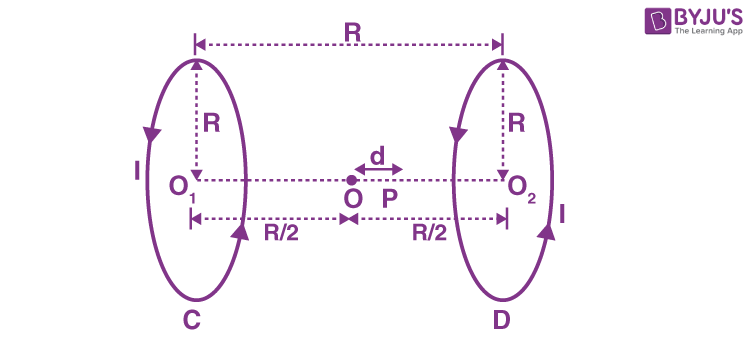
(b) Let the small distance between the points P and O be d.

For the coil C, the distance O1P = x1 = (R/2) +d

For the coil d, the distance O2P = x2 = (R/2) – d

The magnetic field on the axis  at a distance x from the centre of the circular coil having a radius a, with n number of turns and having a current I is given by

\(\begin{array}{l}B = \frac{\mu _{0}}{4\pi }\frac{2\pi nIa^{2}}{(x^{2}+a^{2})^{3/2}}\end{array} \)
\(\begin{array}{l}B = \frac{\mu _{0}}{2 }\frac{nIa^{2}}{(x^{2}+a^{2})^{3/2}}\end{array} \)

The magnetic field at P due to coil C

\(\begin{array}{l}B_{1} = \frac{\mu _{0}}{2 }\frac{NIR^{2}}{(x_{1}^{2}+R^{2})^{3/2}}\end{array} \)
\(\begin{array}{l}B_{1} = \frac{\mu _{0}}{2 }\frac{NIR^{2}}{(\left ( \frac{R}{2}+d \right )^{2}+R^{2})^{3/2}}\end{array} \)
\(\begin{array}{l}B_{1} = \frac{\mu _{0}}{2 }\frac{NIR^{2}}{(\left ( \frac{R^{2}}{4}+d^{2}+Rd\right )+R^{2})^{3/2}}\end{array} \)

d2 can be neglected when compared to R2

\(\begin{array}{l}B_{1} = \frac{\mu _{0}NIR^{2}}{2 }\frac{1}{(\frac{5R^{2}}{4})^{3/2}}\left [ (1+\frac{4d}{5R})^{-3/2} \right ]\end{array} \)

It acts along PO2

The magnetic field at P is given by

\(\begin{array}{l}B_{2} = \frac{\mu _{0}}{2 }\frac{NIa^{2}}{(x_{2}^{2}+R^{2})^{3/2}}\end{array} \)
\(\begin{array}{l}B_{2} = \frac{\mu _{0}}{2 }\frac{NIR^{2}}{(\left ( \frac{R}{2}- d \right )^{2}+R^{2})^{3/2}}\end{array} \)
\(\begin{array}{l}B_{2} = \frac{\mu _{0}NIR^{2}}{2 }\frac{1}{(\frac{5R^{2}}{4})^{3/2}}\left [ (1-\frac{4d}{5R})^{-3/2} \right ]\end{array} \)

It acts along PO2

The total Magnetic field at the point P due to the current through the coils B = B1 + B2

\(\begin{array}{l}B = \frac{\mu _{0}NIR^{2}}{2 }\frac{1}{(\frac{5R^{2}}{4})^{3/2}}\left [ (1+\frac{4d}{5R})^{-3/2} + (1-\frac{4d}{5R})^{-3/2} \right ]\end{array} \)
\(\begin{array}{l}B = \frac{\mu _{0}NIR^{2}}{2\left ( \frac{5R^{2}}{4} \right )^{3/2}}\left [ 1-\frac{6d}{5R}+1+ \frac{6d}{5R} \right ]\end{array} \)
\(\begin{array}{l}B = \frac{\mu _{0}NIR^{2}}{2\left ( \frac{5R^{2}}{4} \right )^{3/2}}\times 2\end{array} \)
\(\begin{array}{l}B = \frac{\mu _{0}NI}{R}\left ( \frac{4}{5} \right )^{3/2}\end{array} \)
\(\begin{array}{l}B= (0.72)\frac{\mu _{0}NI}{R}\end{array} \)


Q4.17Written answer

A toroid has a core (non-ferromagnetic) of inner radius 25 cm and outer radius 26 cm, around which 3500 turns of a wire are wound. If the current in the wire is 11 A, what is the magnetic field?
(a) outside the toroid, (b) inside the core of the toroid, and (c) in the empty space surrounded by the toroid.

Show solutionHide solution
Worked solution

The inner radius of the core, r1= 25 cm = 0.25 m

The outer radius of the core, r2= 26 cm = 0.26 m

Number of turns of the wire, N= 3500 turns

Current in the wire, I = 11 A

(a) The magnetic field outside the toroid is zero.

(b) Inside the core of the toroid, the magnetic field induction is

B = μ0NI/l

Mean length of the toroid,

\(\begin{array}{l}l= 2\pi (\frac{r_{1}+r_{2}}{2})\end{array} \)

= π (r1 + r2)  =  π (0.25 + 0.26) = π x 0.51

So, B = μ0NI/l 

\(\begin{array}{l}B = \frac{(4\pi \times 10^{-7})\times 3500\times 11}{\pi \times 0.51} = 3.02 \times 10^{-2} T\end{array} \)

(c) The magnetic field in the empty space surrounded by the toroid is zero.

Q4.18Written answer

Answer the following questions:
(a) A magnetic field that varies in magnitude from point to point but has a constant direction (east to west) is set up in a chamber. A charged particle enters the chamber and travels undeflected along a straight path with constant speed. What can you say about the initial velocity of the particle?
(b) A charged particle enters an environment of a strong and non-uniform magnetic field varying from point to point both in magnitude and direction and comes out of it following a complicated trajectory. Would its final speed equal the initial speed if it suffered no collisions with the environment?
(c) An electron travelling west to east enters a chamber having a uniform electrostatic field in the north-to-south direction. Specify the direction in which a uniform magnetic field should be set
up to prevent the electron from deflecting from its straight-line path.

Show solutionHide solution
Worked solution

(a) Initial velocity is either parallel or antiparallel to the magnetic field. There is no magnetic force acting on the particle when it is parallel or antiparallel, and it moves undeflected.

(b) Yes, because magnetic force can change the direction of velocity but not its magnitude.

(c) Magnetic field should be in a vertically downward direction.

Q4.19Written answer

An electron emitted by a heated cathode and accelerated through a potential difference of 2.0 kV enters a region with a uniform magnetic field of 0.15 T. Determine the trajectory of the electron if the field
(a) is transverse to its initial velocity, (b) makes an angle of 30º with the initial velocity.

Show solutionHide solution
Worked solution

Magnetic field, B = 0.15 T

Potential difference, V = 2.0 kV

An electron gains kinetic energy, which is given by

E = (1/2) mv2

eV = (1/2) mv2

\(\begin{array}{l}v = \sqrt{\frac{2eV}{m}}\end{array} \)
\(\begin{array}{l}v = \sqrt{\frac{2\times 1.6\times 10^{-19}\times 2\times 10^{3}}{9.1\times 10^{-31}}} = 2.652 \times 10^{7} m/s\end{array} \)

(a) When the field applied is transverse to the initial velocity, the force F1 acting on the electron is perpendicular to the direction of the magnetic field and the direction of motion of the electron.  The perpendicular force provides the centripetal force F2 to the electron and makes it move in a circular path.

The forces F1 and F2 are equal

F1 = evB

F2 = mv2/2

F1 = F2

evB = mv2/2

⇒ r = mv/eB

\(\begin{array}{l}r = \frac{9.1\times 10^{-31}\times 2.652\times 10^{7}}{0.15\times 1.6\times 10^{-19}}\end{array} \)

= 10-3 m = 1 mm

The electron will move in a circular path with a radius of 1 mm in the direction perpendicular to the magnetic field.

(b) The applied force is inclined to the initial velocity. The velocity of the electron is resolved into two components, V cos θ and V sin θ. V cos θ is along the direction of the field, and it causes the electron to move in a straight line. V sin θ is along the normal, and it causes the electron to move in a circular path. Therefore, the electron moves in a helical path. The radius of the helical path is given as,

r = mV sin θ/Be

\(\begin{array}{l}r = \frac{9.1\times 10^{-31}\times 2.652\times 10^{7}\times sin 30^{0}}{0.15\times 1.6\times 10^{-19}}\end{array} \)

= 50.25 x 10⁻⁵ m

r = 0.5 mm

The helical trajectory of radius 0.5 mm along the direction of the magnetic field.


Q4.20Written answer

A magnetic field set up using Helmholtz coils (described in Exercise 4.16) is uniform in a small region and has a magnitude of 0.75 T. In the same region, a uniform electrostatic field is maintained in a direction normal to the common axis of the coils. A narrow beam of (single species) charged particles, all accelerated through 15 kV, enters this region in a direction perpendicular to both the axis of the coils and the electrostatic field. If the beam remains undeflected when the electrostatic field is 9.0 × 10⁻⁵ V m–1, make a simple guess as to what the beam contains. Why is the answer not unique?

Show solutionHide solution
Worked solution

Magnetic field, B = 0.75 T

Accelerating voltage, V = 15 kV = 15 x 103 V

Electrostatic field, E = 9.0 × 10⁻⁵ V m–1

Kinetic energy of the electron, E = (1/2) mv2

eV = (1/2) mv2

Therefore, (e/m) = (v2/2V)

Here,

Mass of the electron = m

Charge of the electron = e

The velocity of the electron = v

The particles are not deflected by the electric field and the magnetic field. So the force on the particle due to the electric field is balanced by force due to the magnetic field.

eE = evB

⇒ v = E/B

Therefore, (1/2) m(E/B)2  = eV

e/m = E2/2VB2

\(\begin{array}{l}=\frac{(9.0\times 10^{5})^{2}}{2\times 15000\times (0.75)^{2}}=4.8 \times 10^{7} C/kg\end{array} \)

The beam contains Deuterium ions or deuterons

The answer is not unique because only the ratio of charge to mass is determined. Other possible answers are He++, Li++, etc.

Q4.21Written answer

A straight horizontal conducting rod of length 0.45 m and mass 60 g is suspended by two vertical wires at its ends. A current of 5.0 A is set up in the rod through the wires.
(a) What magnetic field should be set up normal to the conductor in order that the tension in the wires is zero?
(b) What will be the total tension in the wires if the direction of the current is reversed, keeping the magnetic field the same as before?
(Ignore the mass of the wires.) g = 9.8 m s–2.

Show solutionHide solution
Worked solution

Length of the rod, l = 0.45 m

Mass suspended, m = 60 g = 60 x 10-3 Kg

Current, I = 5 A

(a)  Tension in the wire is zero if the force on the current-carrying wire due to the magnetic field is equal and opposite to the weight on the wire.

BIl = mg

B = mg/Il

\(\begin{array}{l}=\frac{60\times 10^{-3}\times 9.8}{5\times 0.45}\end{array} \)

The magnetic field set up normal to the conductor is 0. 26133 T

(b) When the direction of the current is reversed, BIl and mg will act vertically downwards; the effective tension in the wire is

T = BIl+mg

= (0. 26133 x 5.0 x 0.45) + (60 x 10-3 x 9.8) = 0.587 + (0.588) = 1.176 N

Total tension in the wire =  1.176 N

Q4.22Written answer

The wires which connect the battery of an automobile to its starting motor carry a current of 300 A (for a short time). What is the force per unit length between the wires if they are 70 cm long and 1.5 cm apart? Is the force attractive or repulsive?

Show solutionHide solution
Worked solution

Current in the wires, I = 300 A

Distance between the wires, d = 1.5 cm = 0.015 m

Length of the wires, l = 70 cm = 0.7 m

The force between the two wires, F = μ0I2/2πd

Here,

μ0 = permeability of the free space = 4π x 10-7 Tm/A

\(\begin{array}{l}F =\frac{4\pi \times 10^{-7}\times (300)^{2}}{2\pi \times 0.015}= 1.2 N/m\end{array} \)

Since the direction of the wires is opposite, the force will be repulsive.

Q4.23Written answer

A uniform magnetic field of 1.5 T exists in a cylindrical region of a radius of 10.0 cm, its direction parallel to the axis along east to west. A wire carrying a current of 7.0 A in the north-to-south direction passes through this region. What is the magnitude and direction of the force on the wire if,
(a) the wire intersects the axis,
(b) the wire is turned from N-S to the northeast-northwest direction
(c) the wire in the N-S direction is lowered from the axis by a distance of 6.0 cm?

Show solutionHide solution
Worked solution

NCERT Class 12 - Chapter 4 - Magnitude of magnetic field- Question 23

(a) Magnetic field, B = 1.5 T

Current in the wire, I = 7.0 A

Radius, r = 10 cm = 0.1 m

Diameter, l = 2 x r = 0.2 m

A force 2.1 N acts vertically downward on the wire

(a) The wire intersects the axis, θ = 900

F = BIlsinθ = 1.5 x 7 x 0.20 x sin 900

= 2.1 N

(b) The wire is turned from N-S to the northeast-northwest direction

F = BIl1Sin θ

The length of the wire after turning to the northeast-northwest direction is l1 = l/sinθ

Therefore, l = l1 sin θ

F = BIl

= 1.5 x 7 x 0.20= 2.1 N

A force 2.1 N acts vertically downward on the wire

(c) When the wire is lowered by 6 cm, then

Then,

\(\begin{array}{l}x=\sqrt{(10)^{2}-(6^{2})}= \sqrt{64}= 8\, cm\end{array} \)

2x = l2 = 16 cm

F2 = BI l2 = 1.5 x 7 x 0.16 = 1. 68 N

The force is directed vertically downwards.