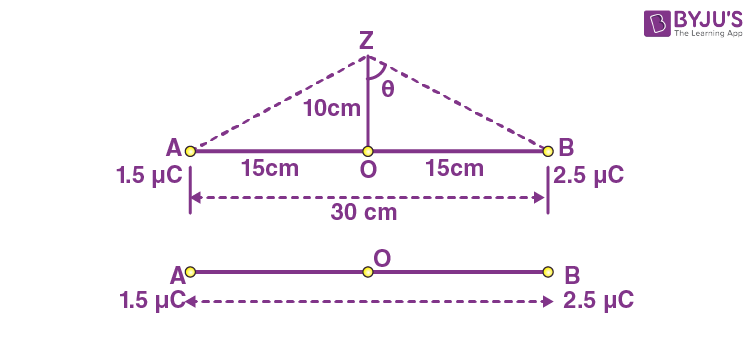
Two tiny spheres carrying charges are located at points A and B
The charge at point A, q1= 1.5 µC
The charge at point B, q2 = 2.5 µC
The distance between the two charges = 30 cm = 0.3 m
(a) Let O be the midpoint. Let V1 and E1 be the potential and electric fields, respectively, at the midpoint.
V1 = Potential due to charge at A + Potential due to charge at B
\(\begin{array}{l}V_{1}=\frac{q_{1}}{4\pi \epsilon _{0}(\frac{d}{2})}+ \frac{q_{2}}{4\pi \epsilon _{0}(\frac{d}{2})}\end{array} \)
\(\begin{array}{l}V_{1}=\frac{1}{4\pi \epsilon _{0}(\frac{d}{2})}(q_{1}+q_{2})\end{array} \)
Here,
ε0 = Permittivity of the free space
\(\begin{array}{l}\frac{1}{4\pi \epsilon _{0}} = 9 \times 10^{9}NC^{2}m^{-2}\end{array} \)
Therefore,
\(\begin{array}{l}V_{1}=\frac{9\times 10^{9}\times 10^{-6}}{(\frac{0.30}{2})}(2.5+ 1.5)= 2.4\times 10^{5}V\end{array} \)
Electric field at O, E1 = Electric field due to q2 – Electric field due to q1
\(\begin{array}{l}=\frac{q_{2}}{4\pi \epsilon _{0}(\frac{d}{2})^{2}}- \frac{q_{1}}{4\pi \epsilon _{0}(\frac{d}{2})^{2}}\end{array} \)
\(\begin{array}{l}=\frac{9\times 10^{9}}{(\frac{0.30}{2})^{2}}\times 10^{-6}\times (2.5-1.5)\end{array} \)
= 400 x 103 V/m
Therefore, the potential at the midpoint is 2.4 x 10⁵ V, and the electric field at the midpoint is 400 x 103 V/m.
(b) Consider a point Z such that the distance OZ = 10 cm = 0.1 m, as shown in the figure.
Let V2 and E2 be the potential and electric field, respectively, at point Z. The distance
\(\begin{array}{l}BZ = AZ = \sqrt{(0.1)^{2}+(0.15)^{2}}= 0.18 m\end{array} \)
The potential at V2 = Potential due to the charge at A + Potential due to the charge at B
\(\begin{array}{l}= \frac{q_{1}}{4\pi \epsilon _{0}(AZ)}+\frac{q_{2}}{4\pi \epsilon _{0}(BZ)}\end{array} \)
\(\begin{array}{l}=\frac{9\times 10^{9}\times 10^{-6}}{0.18}(1.5+2.5)\end{array} \)
= 2 x 10⁵ V
The electric field due to q1 at Z
\(\begin{array}{l}E_{A}=\frac{q_{1}}{4\pi \epsilon _{0}(AZ)^{2}}\end{array} \)
\(\begin{array}{l}= \frac{9\times 10^{9}\times 1.5\times 10^{-6}}{(0.18)^{2}}\end{array} \)
= 416 x 103 V/m
The electric field due to q2 at Z
\(\begin{array}{l}E_{B}=\frac{q_{2}}{4\pi \epsilon _{0}(BZ)^{2}}\end{array} \)
\(\begin{array}{l}= \frac{9\times 10^{9}\times 2.5\times 10^{-6}}{(0.18)^{2}}\end{array} \)
= 694 x 103 V/m
The resultant field intensity at Z
\(\begin{array}{l}E=\sqrt{E_{A}^{2}+E_{B}^{2}+2E_{A}E_{B}cos2\theta }\end{array} \)
From the figure we get cos θ = (0.10/0.18) = 5/9 = 0.5556
θ = cos -1 (0.5556) = 56.25
2θ = 2 x 56.25 = 112.50
cos 2θ = – 0.38
\(\begin{array}{l}E=\sqrt{(0.416\times 10^{6})^{2}+(0.69\times 10^{6})^{2}+2\times 0.416\times 0.69\times 10^{12}\times (-0.38)}\end{array} \)
= 6.6 x 10⁵ V/m
Therefore the potential at the point Z is 694 x 103 V/m, and the electric field is 6.6 x 10⁵ V/m.