My Cart
Your Cart 0

    Your cart is empty.

  • Total (Amount) ₹0.00
NCERT · Class 12 · Physics

Chapter 2: Electrostatic Potential and Capacitance

Practice each question, then open the answer or worked solution.

Questions

35 questions
Q2.22Written answer

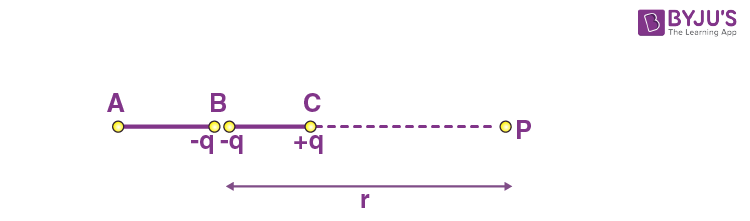
Figure below shows a charge array known as an electric quadrupole. For a point on the axis of the quadrupole, obtain the dependence of potential on r for r/a >> 1, and contrast your results with that due to an electric dipole and an electric monopole (i.e., a single charge).

NCERT Class 12 - Chapter 2 - Image - Question 2.12

Show solutionHide solution
Worked solution

image name

Four charges are placed at points A, B, B and C, respectively.

Let us consider point P, located at the axis of the quadrupole.

It can be considered that the electric quadrupole has three charges.

The charge +q is placed at A

The charge -2q is placed at B

The charge +q is placed at C

AB = BC = a

BP = r

PA = r + a

PZ = r – a

Therefore, the electrostatic potential due to the system of three charges is

\(\begin{array}{l}V =\frac{1}{4\pi \epsilon _{0}}\left [ \frac{q}{PA}-\frac{2q}{PB}+\frac{q}{PC} \right ]\end{array} \)
\(\begin{array}{l}\begin{array}{l} =\frac{1}{4 \pi \in_{0}}\left[\frac{q}{r+a}-\frac{2 q}{r}+\frac{q}{r-a}\right] \\ =\frac{q}{4 \pi \in_{0}}\left[\frac{r(r-a)-2(r+a)(r-a)+r(r+a)}{r(r+a)(r-a)}\right] \\ =\frac{q}{4 \pi \in_{0}}\left[\frac{r^{2}-r a-2 r^{2}+2 a^{2}+r^{2}+r a}{r\left(r^{2}-a^{2}\right)}\right]=\frac{q}{4 \pi \in_{0}}\left[\frac{2 a^{2}}{r\left(r^{2}-a^{2}\right)}\right] \\ =\frac{2 q a^{2}}{4 \pi \in_{0} r^{3}\left(1-\frac{a^{2}}{r^{2}}\right)} \end{array}\end{array} \)

Since r/a >>1,

a/r<< 1

Therefore, a2/r2 is negligible

So we get,

\(\begin{array}{l}V = \frac{2qa^{2}}{4\pi \epsilon _{0}r^{3}}\end{array} \)

Therefore we get,

V∝ 1/r3

However, for a dipole, V ∝ 1/r2

And for a monopole, V ∝ 1/r
Q2.23Written answer

An electrical technician requires a capacitance of 2 µF in a circuit across a potential difference of 1 kV. A large number of 1 µF capacitor are available to him, each of which can withstand a potential difference of not more than 400 V. Suggest a possible arrangement that requires the minimum number of capacitors.

Show solutionHide solution
Worked solution

Required Capacitance, C= 2μF

Potential difference, V = 1 kV = 1000 V

The capacitance of each capacitor, C1 = 1μF

Potential difference that the capacitors can withstand, V1 = 400 V

Suppose a number of capacitors are connected in series and then connected parallel to each other. Then the number of capacitors in each row is given by

1000/400 = 2.5

Therefore, the number of capacitors connected in series is three.

So the capacitance of each row is 

\(\begin{array}{l}\frac{1}{1+1+1}= \frac{1}{3}\mu F\end{array} \)

Let there be n parallel rows. Each of these rows will have 3 capacitors. Therefore, the equivalent capacitance of the circuit is given as

\(\begin{array}{l}\frac{1}{3}+\frac{1}{3}+\frac{1}{3}+——-n \, terms\end{array} \)

The required capacitance of the circuit is 2μF

Therefore, n/3 = 2

n = 6

Therefore, there are 6 rows of three capacitors in the circuit. A minimum of 6 x 3 = 18 capacitors are required.

Q2.24Written answer

What is the area of the plates of a 2 F parallel plate capacitor, given that the separation between the plates is 0.5 cm? [You will realise from your answer why ordinary capacitors are in the range of µF or less. However, electrolytic capacitors do have a much larger capacitance (0.1 F) because of the very minute separation between the conductors.]

Show solutionHide solution
Worked solution

The capacitance of the parallel plate capacitor, C = ε0A/d

The capacitance of the capacitor, C=2 F

Separation between the plates, d= 0.5 cm = 0.5 x 10⁻² m

ε0 = permittivity of the free space = 8.85 x 10⁻¹² C2N-1m-2

Area of the plates, A = Cd/ε0

A = [2 x 0.5 x 10-2]/8.85 x 10-12

= 1130 x 106 m2

Q2.25Written answer

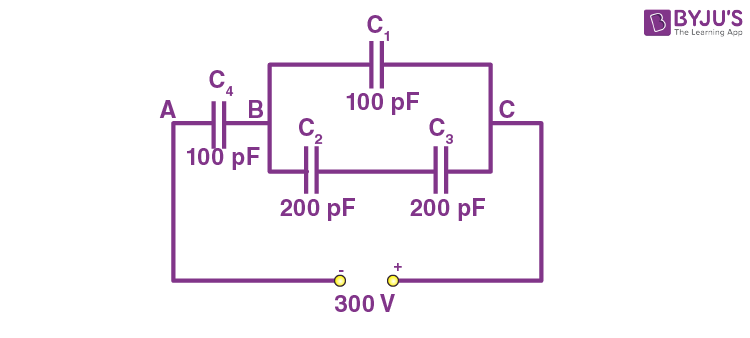
Obtain the equivalent capacitance of the network in Figure. For a 300 V supply, determine the charge and voltage across each capacitor.

NCERT Class 12 - Chapter 2 - Image - Question 2.25

Show solutionHide solution
Worked solution

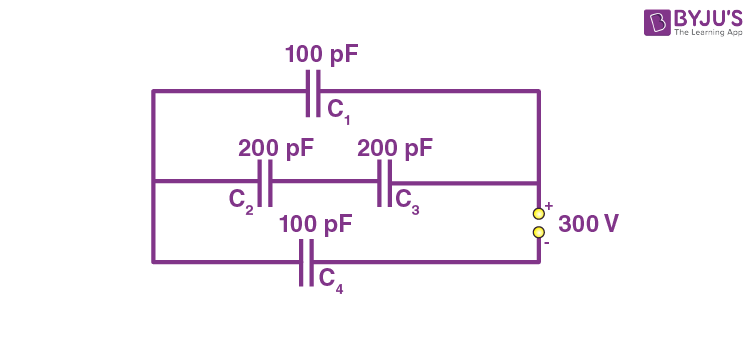
The above figure can be redrawn as given below

NCERT Class 12 - Chapter 2 - Image 2 - Question 2.25

The capacitors C2 and C3 are connected in series. The equivalent capacitance C’

\(\begin{array}{l}\frac{1}{C’}= \frac{1}{C_{2}}+\frac{1}{C_{3}} = \frac{1}{200}+\frac{1}{200}=\frac{2}{200}\end{array} \)

C’ = 100 pF

The capacitors C’ and C1 are parallel. The equivalent capacitance is C” = C’ + C1

C” = 100 + 100 = 200 pF

C” and C4 are connected in series. Let the equivalent capacitance be C

\(\begin{array}{l}\frac{1}{C} = \frac{1}{C^{”}}+\frac{1}{C_{4}} = \frac{1}{200}+\frac{1}{100}=\frac{3}{200}\end{array} \)

C = 200/3 pF

Hence, the equivalent capacitance of the circuit is 200/3 pF

Total charge, Q = CV = 

\(\begin{array}{l}\frac{200}{3}\times 10^{-12}\times 300 = 2 \times 10^{-8}C\end{array} \)

Q = Q4 = 2 x 10⁻⁸ C

Potential difference across C4, V4 = Q/C4

= (2 x 10 -8)/(100 x 10-12) = 200 V

Potential difference across C”,  V” = 300 V – 200 V = 100 V

Potential difference across C1,  V1 = V” = 100 V

Charge across C1, Q1 = C1V1 = (100 x 10-12) x 100 = 10-8 C

The charge across C2 and C3, Q2 = Q – Q1 = 2 x 10⁻⁸ – 10-8 

= 10-8 C

Potential across C2 , V2 = Q2/C2 = 10-8/ (200 x 10-12) = 50 V

Potential across C3, V3 = Q2/C3 = 10-8/(200 x 10-12) = 50 V

Therefore,

Q1 = 10-8 C , V1 = 100 V

Q2 =  10-8 C, V2 = 50 V

Q2 = Q3 = 10-8 C, V3 = 50 V

Q4 = 2 x 10⁻⁸ C , V4 = 200 V

Q2.26Written answer

The plates of a parallel plate capacitor have an area of 90 cm2 each and are separated by 2.5 mm. The capacitor is charged by connecting it to a 400 V supply.
(a) How much electrostatic energy is stored by the capacitor?
(b) View this energy as stored in the electrostatic field between the plates and obtain the energy per unit volume u. Hence, arrive at a relation between u and the magnitude of electric field E between the plates.

Show solutionHide solution
Worked solution

Area of the plates of a parallel plate capacitor, A = 90 cm2 = 90 x 10-4 m2

Separation between the plates, d = 2.5 mm = 2.5 x 10⁻³ m

The potential difference across the plates, V = 400 V

The capacitance of the capacitor, C = ε0A/d

Electrostatic energy stored in the capacitor, E = (1/2) CV2

\(\begin{array}{l}= \frac{1}{2}\frac{\epsilon _{0}A}{d}V^{2}\end{array} \)
\(\begin{array}{l}= \frac{1}{2}\frac{8.85 \times 10^{-12}\times 90\times 10^{-4}\times 400^{2}}{2\times 2.5\times 10^{-3}} = 2.55 \times 10^{-6}J\end{array} \)

Therefore, the electrostatic energy stored by the capacitor is 2.55 x 10⁻⁶ J

The volume of the capacitor, V = A x d

= 90 x 10-4  x 25 x 10-3

= 2.25 x 10⁻⁴ m3

Energy stored in the capacitor per unit volume is

u = E/V = 

\(\begin{array}{l}\frac{\frac{1}{2}CV^{2}}{Ad} = \frac{\frac{\epsilon _{0}A}{2d}V^{2}}{Ad}= \frac{1}{2}\epsilon _{0}(\frac{V}{d})^{2}\end{array} \)

Here, V/d = Electric intensity = E

Therefore,

\(\begin{array}{l}u = \frac{1}{2}\epsilon _{0}E^{2}\end{array} \)
Q2.27Written answer

A 4 µF capacitor is charged by a 200 V supply. It is then disconnected from the supply and connected to another uncharged 2 µF capacitor. How much electrostatic energy of the first capacitor is lost in the form of heat and electromagnetic radiation?

Show solutionHide solution
Worked solution

The capacitance of the capacitor, C1= 4 μF

Supply voltage, V1 = 200 V

The capacitance of the uncharged capacitor, C2= 2 μF

Electrostatic energy stored in C1 is given as

E1 = (1/2)C1V12

= (1/2) x 4 x 10-6 x (200)2

= 8 x 10⁻² J

When C1 is disconnected from the power supply and connected to C2, the voltage acquired by it is V2.

According to the law of conservation of energy, the initial charge on the capacitor C1 is equal to the final charge on the capacitors C1 and C2.

V2 (C1 + C2) = C1V1

V2 (4+ 2) x 10-6 =  4 x 10-6 x 200

V2 = (400/3) V

The electrostatic energy of the combination is

E2 =  (1/2)(C1+C2) V12

= (1/2) x (2+4) x 10-6 x (400/3)2

= 5.33 x 10⁻² J

Hence, the amount of electrostatic energy lost by capacitor C1 = E1 – E2

= 0.08 – 0.0533 = 0.0267

= 2.67 x 10⁻² J

Q2.28Written answer

Show that the force on each plate of a parallel plate capacitor has a magnitude equal to (½) QE, where Q is the charge on the capacitor, and E is the magnitude of the electric field between the plates. Explain the origin of the factor ½.

Show solutionHide solution
Worked solution

Let F be the force required to separate the plates of the parallel plate capacitors.

Let Δx be the distance between the two plates.

Therefore, the work done to separate the plates, W = F Δx. As a result, the potential energy of the capacitor increases by an amount equal to uAΔx.

here, u = energy density

A = area of each plate

d = distance between the plates

V = potential difference across the plates

The work done will be equal to the increase in potential energy

FΔx = uAΔx

F = uA

Substituting

\(\begin{array}{l}u = \frac{1}{2}\epsilon _{0}E^{2}\end{array} \)
\(\begin{array}{l}F= uA = \frac{1}{2}\epsilon _{0}E^{2}A\end{array} \)

The electric intensity, E = V/d

\(\begin{array}{l}F= uA = \frac{1}{2}\epsilon _{0}\frac{V}{d}EA\end{array} \)

However, capacitance, 

\(\begin{array}{l}C = \frac{\epsilon _{0}A}{d}\end{array} \)

Therefore, F = (1/2) (CV) E

Charge on the capacitor is given as Q = CV

Therefore, F = (1/2)QE

The electric field just outside the conductor is E and inside the conductor is zero. Hence, the average of the electric field E/2 is equal to the force.

Q2.29Written answer

A spherical capacitor consists of two concentric spherical conductors held in position by suitable insulating supports (as shown in the figure). Show that the capacitance of a spherical capacitor is given by

\(\begin{array}{l}C = \frac{4\pi \epsilon _{0}r_{1}r_{2}}{r_{1}-r_{2}}\end{array} \)

NCERT Class 12 - Chapter 2 - Image - Question 2.29

Where r1 and r2 are the radii of outer and inner spheres, respectively.

Show solutionHide solution
Worked solution

The radius of the outer shell = r1

The radius of the inner shell = r2

The charge on the inner surface of the outer shell = +Q

The charge on the outer surface of the inner shell = -Q

The potential difference between the two shells is given as

\(\begin{array}{l}V = \frac{Q}{4\pi \epsilon _{0}r_{2}}-\frac{Q}{4\pi \epsilon _{0}r_{1}}\end{array} \)

Here,

ε0 = Permittivity of free space

\(\begin{array}{l}V = \frac{Q}{4\pi \epsilon _{0}}\left [ \frac{1}{r_{2}}-\frac{1}{r_{1}} \right ]\end{array} \)


\(\begin{array}{l}V = \frac{Q(r_{1}-r_{_{2}})}{4\pi \epsilon _{0}r_{1}r_{2}}\end{array} \)

The capacitance of the given system is

C = Charge (Q)/ Potential difference (V)

Therefore,

\(\begin{array}{l}C = \frac{4\pi \epsilon _{0}r_{1}r_{2}}{(r_{1}-r_{_{2}})}\end{array} \)
Q2.30Written answer

A spherical capacitor has an inner sphere of radius 12 cm and an outer sphere of radius 13 cm. The outer sphere is earthed, and the inner sphere is given a charge of 2.5 µC. The space between the concentric spheres is filled with a liquid of dielectric constant 32.
(a) Determine the capacitance of the capacitor.
(b) What is the potential of the inner sphere?
(c) Compare the capacitance of this capacitor with that of an isolated sphere of radius 12 cm. Explain why the latter is much smaller.

Show solutionHide solution
Worked solution

Radius of the inner sphere, r1 = 12 cm = 0.12 m

Radius of the outer sphere, r2 = 13 cm = 0.13 m

Charge on the inner sphere, q = 2.5 μC = 2.5 x 10⁻⁶ C

The dielectric constant of the liquid, εr= 32

(a) Capacitance of the capacitor is given by the relation,

\(\begin{array}{l}C = \frac{4\pi \epsilon _{0}\epsilon _{r}r_{1}r_{2}}{(r_{1}-r_{_{2}})}\end{array} \)

Here,

ε0 = permittivity of the free space = 8.85 x 10⁻¹² C2 N-1 m-2

\(\begin{array}{l}\frac{1}{4\pi \epsilon _{0}}= 9\times 10^{9} Nm^{2}C^{-2}\end{array} \)

Therefore,

\(\begin{array}{l}C = \frac{32\times 0.12\times 0.13 }{(9\times10^{9}\times (0.13-0.12) }= 5.5\times 10^{-9}F\end{array} \)

Therefore, the capacitance of the capacitor is approximately 5.5 x 10⁻⁹ F.

(b) Potential of the inner sphere is

V = q/C

= (2.5 x 10⁻⁶)/(5.5 x 10-9) = 4.5 x 10² V

Hence the potential energy of the inner sphere is 4.5 x 10² V

(c) Radius of the isolated sphere, r = 12 x 10-2 m

The capacitance of the isolated sphere is given by the relation,

C’ = 4πε0r

= 4 x 3.14 x 8.85 x 10-12 x 12 x 10-2

= 1.333 x 10-11   F

The outer sphere of the concentric spheres is earthed. Therefore, the potential difference will be less for the concentric spheres, and the capacitance is more than for the isolated sphere.

Q2.31Written answer

Answer carefully:
(a) Two large conducting spheres carrying charges Q1 and Q2 are brought close to each other. Is the magnitude of the electrostatic force between them exactly given by Q1Q2/4πε0r2, where r is the distance between their centres?
(b) If Coulomb’s law involved 1/r3 dependence (instead of 1/r2), would Gauss’s law still be true?
(c) A small test charge is released at rest at a point in an electrostatic field configuration. Will it travel along the field line passing through that point?
(d) What is the work done by the field of a nucleus in a complete circular orbit of the electron? What if the orbit is elliptical?

(e) We know that the electric field is discontinuous across the surface of a charged conductor. Is electric potential also discontinuous there?
(f) What meaning would you give to the capacitance of a single conductor?
(g) Guess a possible reason why water has a much greater dielectric constant (= 80) than say, mica (= 6).

Show solutionHide solution
Worked solution

(a) No, because charge distributions on the spheres will not be uniform.
(b) No.
(c) Not necessarily. (True only if the field line is a straight line). The field line gives the direction of acceleration and not that of the velocity.
(d) Zero, no matter what the shape of the complete orbit is.
(e) No, the potential is continuous.
(f) A single conductor is a capacitor with one of the ‘plates’ at infinity.
(g) A water molecule has a permanent dipole moment. However, a detailed explanation of the value of the dielectric constant requires microscopic theory and is beyond the scope of the book.