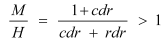
Instruments of monetary policy are as follows:
1. Qualitative
2. Quantitative
The qualitative measures include the following components:
a. Marginal Requirements: The grant of a loan by commercial banks is on the basis of the value of a security that is kept as a mortgage. Banks always maintain a margin of difference between the market value of a security that is mortgaged and the loan value. When the central bank restricts the money flow, it results in the rise of the marginal requirement of loans and vice versa in the case of credit policy.
b. Selective Credit Control (SCC): It is a monetary policy instrument that is essential for affecting the credit flow of a sector both negatively as well as positively. The positive aspect deals with the enhanced flow of credit to sectors that need priority, while the negative aspect deals with restricting credit flow to a particular sector.
c. Moral Suasion: It refers to a type of persuasion technique which is applied by central banks to keep pressure on commercial banks in order to abide by the monetary policies that are defined. It is carried out by conducting speeches, seminars and meetings.
The quantitative measures are as follows:
a. Bank Rate: The rate at which a central bank, for example, RBI, provides loans to a commercial bank is called as bank rate. If there is an increase in bank rates, it will make the loans dearer for commercial banks, which will increase the rate of lending, thereby reducing the capacity of the public to take credit. The opposite happens in case of a decrease in bank rates leading to easy access to credit.
b. Open Market Operations: In open market operations, securities are bought and sold in an open market, which will affect the money supply in the economy. Buying of securities by the central bank will boost the economy, while selling of securities by RBI will clear out the extra cash balance of the economy, which leads to a limited money supply.
c. Variable Reserve Ratios: There are two types of ratios that are used by RBI in order to regulate the supply of money. These are the Statutory Liquid Ratio (SLR) and Cash Reserve Ratio (CRR). SLR deals with the minimum percentage of asset that needs to be maintained with RBI in the form of fixed or liquid assets. When SLR increases, the flow of liquidity decreases and vice-versa. CRR deals with the minimum amount of funds that need to be maintained with the RBI. Change in the value of CRR has an impact on the economy. If CRR is increased, it will result in less money available for lending, while the opposite happens if CRR decreases.
At times, when foreign currency enters India in the form of bond purchases by foreigners by exchanging foreign currency for rupees, the currency thus collected will be deposited by a commercial bank to RBI, which experiences a rise in liabilities and assets. To counter such a situation, RBI sells securities in an open market in order to protect the enemy against shocks.