My Cart
Your Cart 0

    Your cart is empty.

  • Total (Amount) ₹0.00
NCERT · Class 12 · Economics

Chapter 3: Money and Banking

Practice each question, then open the answer or worked solution.

Questions

14 questions
Q1Written answer

What is a barter system? What are its drawbacks?

Show solutionHide solution
Worked solution

The barter system was used in ancient times for exchanging goods. It was a system where one commodity was exchanged for another. Like, we can say that a person has 1 kg of wheat and he wants to have 1 kg of rice in exchange for that, then he can exchange the same if there is someone who is willing to exchange rice for wheat. It was called commodity for commodity exchange. Later, it was replaced by the monetary system. The drawbacks of the barter system are listed below:

1. It suffered from the double coincidence of wants, which means two individuals should complement each other in their requirements in order for the exchange to happen. For example, wheat for rice.

2. There was a lack of common measurement, i.e. value of the good of one item was not always equal to the other item being exchanged for. For example, the exchange of rice for the cow.

3. It was difficult to store the items that were obtained from exchange for future exchanges, as many items perished.

4. It was difficult to make future payments and contractual payments.
Q2Written answer

What are the main functions of money? How does money overcome the shortcomings of a barter system?

Show solutionHide solution
Worked solution

Money had the following functions:

1. Primary

2. Secondary

The primary functions of money are as follows:

a. Money served as the medium of exchange and facilitated buying and selling of goods and services. The exchange was simple and could be scaled accordingly.

b. Money served as a common source of value for goods. In the barter system, it was not possible to determine the value of an item. But money made it possible to value goods. So it served as a measure of value.

The secondary functions of money are as follows:

a. Money could be easily stored as compared to the goods that were received in exchange in a barter system. So it acted as a store of value.

b. Deferred payments have become much easier with the introduction of money. Loans can be repaid in a much better way as compared to the barter system.

It overcame the following shortcomings of the barter system:

1. It eliminated the double coincidence of wants which was the most important shortcoming of the barter system.

2. It overcame the problem of the valuation of goods. In the barter system, goods exchanged were not proper in value with each other.

3. It facilitated contractual payments and future payments that were not possible in the barter system.

4. It was easy to store money than perishable goods as was provided in the barter system.

Q3Written answer

What is transaction demand for money? How is it related to the value of transactions over a specified period of time?

Show solutionHide solution
Worked solution

It is the amount of money that is essential for performing everyday transactions. It is also called the amount that everyone saves in order to finance the expenditures in future. There are two motives for holding transaction money. The income motive is for those who want to meet the expenditures of the household, and the business motive is for businessmen needing money to run the business.

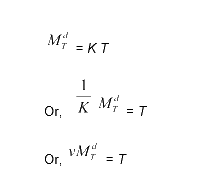
The relation between transaction demand and the value of transactions is as follows:

NCERT Macroeconomics Solutions Class 12 Chapter 3-1

Where

V = 1/K, which represents the velocity of circulation of money

T = Total transaction value over time in an economy

K = A positive fraction

MTD = Money stock that people were willing to hold at a time

Q4Written answer

Suppose a bond promises Rs. 500 at the end of two years with no intermediate return. If the rate of interest is 5 per cent per annum, what is the price of the bond?

Show solutionHide solution
Worked solution

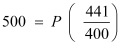
Let the price of the bond be Rs. P

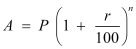
We know formulae of interest is

NCERT Macroeconomics Solutions Class 12 Chapter 3-2

According to the question,

A = Rs. 500

r = 5%

n = 2 years

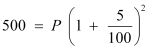
Putting the values in the formula

NCERT Macroeconomics Solutions Class 12 Chapter 3-3

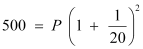
Or,
NCERT Macroeconomics Solutions Class 12 Chapter 3-4

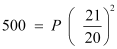
Or,
NCERT Macroeconomics Solutions Class 12 Chapter 3-5

Or,
NCERT Macroeconomics Solutions Class 12 Chapter 3-6

Or P=

P = Rs. 453.51

Therefore, it is calculated that the price of the bond is Rs.453.51.

Q5Written answer

Why is speculative demand for money inversely related to the rate of interest?

Show solutionHide solution
Worked solution

Speculative demand for money is the need to have money for transactions other than those necessary for living. It is the money that is essential for investment. The rate of interest is inversely related to speculative demand, as when the rate of interest is high, the speculative demand will be less and vice versa. If in a market, the rate of interest is high, everyone will start expecting it to become low in future so that they can gain from holding investments in the form of bonds and, as a result, will convert money into bonds which makes speculative demand for money low. In contrast, when the rate of interest is low, people will try the bond rates to rise in future, which will be capital loss and leads to converting bonds into money to avoid loss in future. It makes speculative demand for money high.

Q6Written answer

What is `liquidity trap’?

Show solutionHide solution
Worked solution

This is referred to as the situation when bond interest rates are low, and savings rates are high. It is believed that rates of interest will rise in future, which leads to a decrease in the value of bonds, so consumers do not like to keep an asset whose price is going to decline in future. Therefore, people convert bonds to money in order to avoid loss.

Q7Written answer

What are the alternative definitions of money supply in India?

Show solutionHide solution
Worked solution

There are four definitions of money supply in India which are: M1, M2, M3, and M4. These are arranged in descending order of liquidity. Therefore, M1 has the highest liquidity, and M4 has the least.

Now,

M1 = C + DD + OD

Where,

C is the currency held by the public of the nation

DD is the demand deposit present in banks

OD is the other type of deposit present in the RBI

Also

M2 = M1 + Savings done by people in post offices

M3 = M1 + Net time deposits of the banks

M4 = M3 + Total deposit held in post offices excluding NSC (National Savings Certificate).

Q8Written answer

What is a ‘legal tender’? What is ‘fiat money’?

Show solutionHide solution
Worked solution

A legal tender is a medium of payment which is accepted by a legal system for making payments in order to meet the financial obligation. It is a form of payment that is recognised by the government in order to pay for any kind of debt or the financial obligation. For example, the notes and coins that are in use in India are legal tender money.

Fiat money is a currency that lacks value in itself unless declared legal tender by the government. It acts as money which is backed by the government. It can be used to pay for the purchase of goods and services.

Q9Written answer

What is ‘high powered money’?

Show solutionHide solution
Worked solution

High powered money is referred to as the currency which has been issued by the Government or the Reserve Bank of India. A major portion of this currency is stored as reserves in Reserve Bank, while some part of it is kept with the public.

It can be represented by the equation

H = C+R

Where,

H stands for High Powered Money

C stands for Currency that is with the public (includes cash and coins)

R stands for Deposits in RBI with bank and government.

Q10Written answer

Explain the functions of a commercial bank.

Show solutionHide solution
Worked solution

Commercial banks have the following functions:

1. The primary function of banks is to accept deposits. There are different types of deposits, as detailed below:

a. Savings Account: It is a basic account in which an individual saves money and earns interest. At times of need, money can be withdrawn with cheques, withdrawal forms, ATMs etc.

b. Current Account: These are business accounts and no restrictions on withdrawal and deposit. No interest is earned, but an overdraft facility is available.

c. Fixed Deposit: These are deposits for a fixed time period, and money cannot be withdrawn in between. They have higher interest rates. The rate of interest is reduced if liquidated before maturity.

2. Banks provide loans and loan advances for various purposes. Loans can be of short or long-term and have a higher rate of interest.

3. Banks also perform the following agency functions:

a. Banks provide fund transfer facilities through the internet or other banking instruments.

b. Banks collect money for customers in the form of cheques or bills.

c. Banks provide the facility of periodic payments by using standing instructions.

d. Banks also collect periodic payments in the form of salary, pension, premium or dividend.

4. Provides financial assistance to businesses by discounting the bills of exchange. This is done by purchasing of bills produced by customers and deducting interest from the face value of the bill.

5. Banks create credit in the economy in the form of demand deposits. It helps in the growth of an economy.

6. Some other functions served by the bank include: providing locker facility, forex buying and selling, gold loans, share and debenture underwriting, gift cheques etc.