My Cart
Your Cart 0

    Your cart is empty.

  • Total (Amount) ₹0.00
NCERT · Class 12 · Biology

Chapter 7: Human Health and Diseases

Practice each question, then open the answer or worked solution.

Questions

17 questions
Q1Written answer

What are the various public health measures, which you would suggest as safeguard against infectious diseases?

Show solutionHide solution
Worked solution

Public health measures are the measures taken to prevent and check the spread of different infectious diseases. It is taken to lessen contact with infectious agents.

Some of these preventive measures are as follows:

  • Isolation – It prevents the spreading of airborne diseases (chicken pox, pneumonia, tuberculosis, etc.). We isolate an infected person to reduce the chances of the disease spreading.
  • Vaccination – It protects the body against communicable diseases by administering some agents that impersonate the microbe in the body. This helps in rendering passive immunization to the body. Vaccines are available for some diseases, such as mumps, polio, measles, etc.
  • Vector eradication – Diseases such as dengue, malaria, etc., that spread through vectors can be prevented by ensuring a clean environment and checking the breeding of mosquitoes which is facilitated by regulating water, and not letting it stagnate near residential areas. Some other measures are periodic cleaning of coolers and the use of mosquito nets and insecticides. It can also be controlled by introducing Laxvivorous fish such as Gambusia in ponds, as they control mosquito larvae breeding in stagnant water.
  • Maintaining public and personal hygiene is one of the most important practices to prevent the spread of infectious diseases. It includes maintaining a clean body, consuming healthy and nutritious food, clean water, etc. Proper disposal of wastes, excreta, and disinfection of water reservoirs are some of the measures that can be adapted as part of public hygiene.
Q2Written answer

In which way has the study of biology helped us to control infectious diseases?

Show solutionHide solution
Worked solution

Biology is a vast field of Science dealing with life forms and their processes. It has helped in controlling infectious diseases in the following ways:

  • Complete eradication of fatal diseases such as smallpox was possible with the use of immunization schemes and vaccines
  • Other infectious diseases, such as diptheria, polio, pneumonia, etc., have been successfully controlled with the use of vaccines
  • Treatment of several infectious diseases have successfully been carried out with the use of antibiotics and other drugs
Q3Written answer

How does the transmission of each of the following diseases take place?

(a) Amoebiasis (b) Malaria (c) Ascariasis (d) Pneumonia

Show solutionHide solution
Worked solution

The transmission of diseases is as given in the table:

Name of the disease Transmission
Amoebiasis Ingestion of quadrinucleated cysts of Entamoeba histolytica can cause the cysts to be passed from the patient’s faeces via water and food.
Malaria Plasmodium, or the malarial parasite, is communicated to a healthy person from a patient when bitten by a female Anopheles mosquito
Ascariasis It can be passed by ingesting contaminated water and food with the embryonated eggs of Ascaris
Pneumonia Transmitted by droplets and sputum given out when patient coughs. It is a bacterial disease
Q4Written answer

What measure would you take to prevent water-borne diseases?

Show solutionHide solution
Worked solution

Measures taken to prevent water-borne diseases are as follows:

  • Provision of clean water for drinking
  • Industries should be prohibited from discharging wastes into water bodies
  • Frequent cleaning and disinfecting of water tanks and reservoirs
Q5Written answer

Discuss with your teacher what does ‘a suitable gene’ mean, in the context of DNA vaccines.

Show solutionHide solution
Worked solution

The term ‘suitable gene’ is used to refer to a particular section of DNA that can be altered in the host in order to synthesize a particular protein which attacks and kills a specific disease-causing entity.

Q6Written answer

Name the primary and secondary lymphoid organs.

Show solutionHide solution
Worked solution

Primary lymphoid organs are – Thymus and bone marrow

Secondary lymphoid organs are – Mucosal-associated lymphoid tissues (MALT), Lymph nodes, Spleen, Peyer’s patches (small intestine)

Q7Written answer

The following are some well-known abbreviations, which have been used in this chapter. Expand each one to its full form:

(a) MALT (b) CMI (c) AIDS (d) NACO (e) HIV

Show solutionHide solution
Worked solution

The expansion is as follows:

(a) MALT – Mucosal-Associated lymphoid tissues

(b) CMI – Cell-mediated Immunity

(c) AIDS – Acquired Immuno-Deficiency Syndrome

d) NACO – National Aids Control Organization

(e) HIV – Human Immuno-deficiency Virus

Q8Written answer

Differentiate the following and give examples of each:

(a) Innate and acquired immunity (b) Active and passive immunity

Show solutionHide solution
Worked solution

The differences are as follows:

(a) Innate and acquired immunity

Innate immunity Acquired immunity
Non-specific in nature Specific in nature
Present from birth It is acquired in response to a particular pathogen
Has different barriers Has a memory of antibody
For instance, mucus traps bacteria and other particles For instance, post-vaccination antibodies respond

(b) Active and passive immunity

Active immunity Passive immunity
In response to pathogens, the body releases antigens To initiate immunity, an antigen is injected
Slower response Faster response
For instance, post-vaccination antibodies respond For instance, Colostrum is rich in antibodies
Q9Written answer

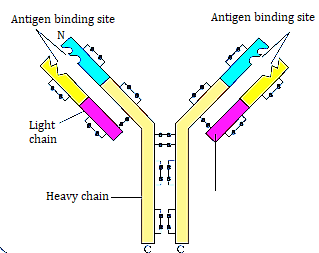
Draw a well-labelled diagram of an antibody molecule.

Show solutionHide solution
Worked solution

The diagram is as follows:

NCERT solutions class 12 Biology chapter 8 - 1

Q10Written answer

What are the various routes by which transmission of human immunodeficiency virus takes place?

Show solutionHide solution
Worked solution

The various routes by which transmission of the human immunodeficiency virus (HIV) takes place are as follows:

  • Sexual relation with the person infected
  • Organ transplantation from an infected person
  • Transfusion of contaminated blood products and blood
  • Transmitted from mother to the child through the placenta