My Cart
Your Cart 0

    Your cart is empty.

  • Total (Amount) ₹0.00
NCERT · Class 12 · Biology

Chapter 12: Ecosystem

Practice each question, then open the answer or worked solution.

Questions

13 questions
Q11Written answer

Give an account of energy flow in an ecosystem.

Show solutionHide solution
Worked solution

NCERT solutions class 12 Biology chapter 14 - 5

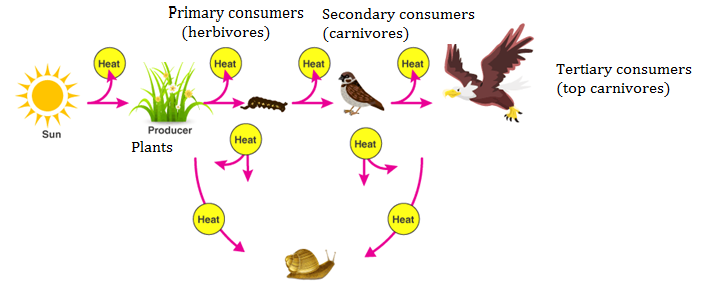
In an ecosystem, energy enters from the ultimate source of energy – the Sun. These solar rays pass through the atmosphere to be absorbed by the surface of the earth, which help plants in performing photosynthesis. Additionally, they also help in maintaining the temperature of the earth so that living entities survive. Some of these incident rays are reflected by the surface of the earth and only close to 2-10% of the solar energy is captured by the producers (green plants) during the photosynthesis process in order to convert it into food.

Gross primary productivity is the rate at which the biomass is generated by plants during the process of photosynthesis. Just 10% of the stored energy is transferred to herbivores from the producers when plants are consumed by herbivores. The rest of 90% of the energy is used for different processes by plants such as growth, respiration and reproduction. Likewise, a mere 10% of the energy of herbivores is conveyed to carnivores. This is referred to as the ten percent law of energy flow.
Q12Written answer

Write important features of a sedimentary cycle in an ecosystem.

Show solutionHide solution
Worked solution

Sedimentary cycles have reservoirs in the crust of earth or rocks. Nutrient elements such as phosphorus, sulphur, potassium and calcium are present in the sediments of the earth. These sedimentary cycles are unhurried, and slow. It takes a long time to complete their circulation and are deemed to be less perfect cycles. It is because when recycling, the nutrient elements may get sealed in the reservoir pool taking a long time to come out and continue circulation. Hence, they typically go out of circulation for a long period of time.

Q13Written answer

Outline salient features of carbon cycling in an ecosystem.

Show solutionHide solution
Worked solution

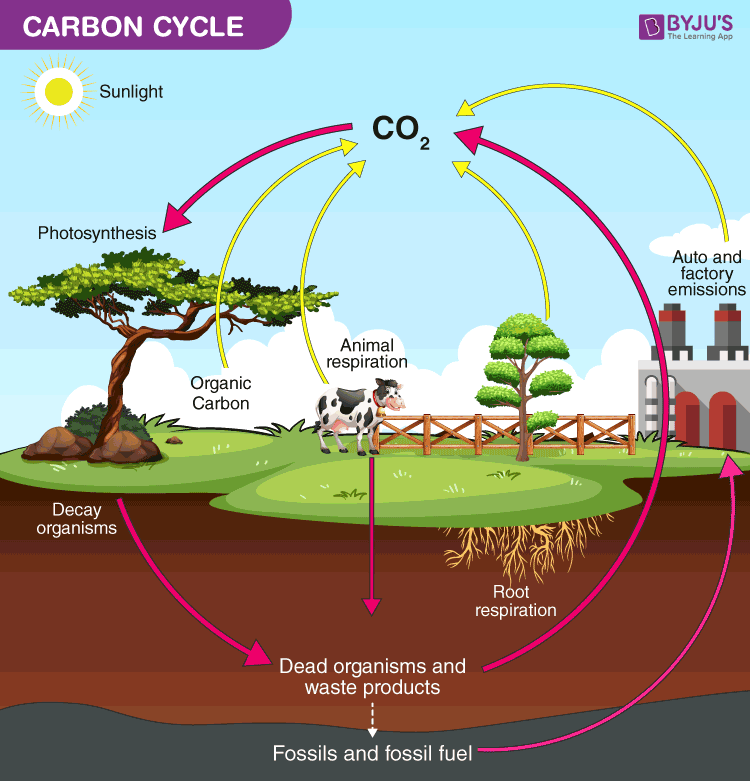
The carbon cycle is an essential gaseous cycle which has its reservoir pool in the atmosphere. All of the living entities consist of carbon as a major constituent of the body. This carbon is a basic element present in all the living forms. Biomolecules such as lipids, carbohydrates, proteins, etc that are crucial for life processes are made of carbon. Living forms are incorporated with carbon through the basic process of photosynthesis that is carried out by plants, the primary producers. The process of photosynthesis uses up atmospheric carbon dioxide and sunlight to produce a carbon compound known as ‘glucose’, this in turn is used by other living entities.

Hence, atmospheric carbon gets incorporated into life forms. It now becomes necessary to recycle this absorbed carbon dioxide back to the atmosphere to complete the cycle. For this recycling of carbon back to the atmosphere in the form of carbon dioxide gas, various processes can be carried out. The respiration process disintegrates glucose molecules to produce carbon dioxide gas. The decomposition process gives out carbon dioxide from dead bodies of animals and plants into the atmosphere. Some other sources of carbon dioxide are industrialization, combustion of fuels, deforestation, forest fires, volcanic eruptions and so on.

NCERT solutions class 12 Biology chapter 14 - 6