My Cart
Your Cart 0

    Your cart is empty.

  • Total (Amount) ₹0.00
NCERT · Class 12 · Biology

Chapter 1: Sexual Reproduction in Flowering Plants

Practice each question, then open the answer or worked solution.

Textbook exercises

18 questions
Q1Written answer

Name the parts of an angiosperm flower in which the development of male and female gametophytes takes place.

Show solutionHide solution
Worked solution

Ans: In pollen sacs of the anther, male gametophytes (microgametogenesis) develop up to the 2-celled stage. The nucellus of an ovule is where the gametophyte develops (megagametogenesis).
Q2Written answer

Differentiate between microsporogenesis and megasporogenesis. Which type of cell division occurs during these events? Name the structures formed at the end of these two events?

Show solutionHide solution
Worked solution

Ans: Microsporogenesis and megasporogenesis differ in the following ways:


Microsporogenesis

Megasporogenesis

The process by which microspore mother cells divide and produce pollen grains is known as microsporogenesis.


Megasporogenesis is the process by which megaspore mother cells are formed and differentiate into megaspores by meiosis.

Located within the pollen sac of the anthers.

It is present in the nucellus of the ovule.

A pollen grain produced by a microspore mother cell functions properly.

The megaspores have only one functional megaspore.

Results in the formation of pollen grains (male  gametophyte)


Resulting in the formation of embryo sacs (female gametophyte)

Microspore mother cells and megaspore mother cells are every diploid, as they have two sets of chromosomes.

The mother cells for megaspores and microspores enlarge and undergo meiosis in order to produce four haplotypic cells called megaspores and microspores, respectively.


Meiotic cell Division occurs during microsporogenesis and megasporogenesis. It leads to the production of haploid gametes, also known as reductional division.


Q3Written answer

Arrange the following terms in the correct developmental sequence: Pollen grain, sporogenous tissue, microspore tetrad, pollen mother cell, male gametes.

Show solutionHide solution
Worked solution

Ans: The sporogenous tissue is composed of a pollen mother cell, a microspore tetrad, pollen grains, and male gametes.


Q4Written answer

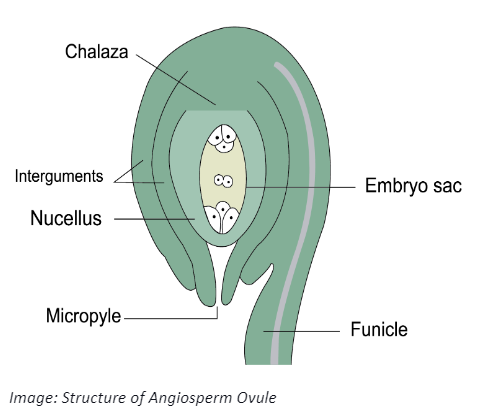
With a neat, labeled diagram, describe the parts of a typical angiosperm ovule.

Show solutionHide solution
Worked solution

Ans:


Structure of Angiosperm Ovule


An angiosperm ovary is capable of forming a small structure called an ovule. Nucellus, a multi-layered cellular tissue, develops as the ovule first appears on the placenta. Placentas are attached to ovules via a stalk known as a funicle. A funicle attaches to a placenta at the hilum. The hypodermal cells of the nucellus enlarge and transform into megaspore mother cells. One haploid cell undergoes meiosis to form an embryo sac (female gametophyte). The others do not develop. A pollen tube enters an ovule through a small opening called a micropyle, surrounded by one or two protective layers. Ovules consist of the nucellus and integuments of a fully developed embryo.


Q5Written answer

What is meant by monosporic development of female gametophytes?

Show solutionHide solution
Worked solution

Ans: The female gametophyte or embryo sac develops only from one of the four megaspores in many flowering plants. Degeneration occurs in the three remaining megaspores. The monosporic type of embryo sac formation is referred to as the monosporic type of embryo development.


Q6Written answer

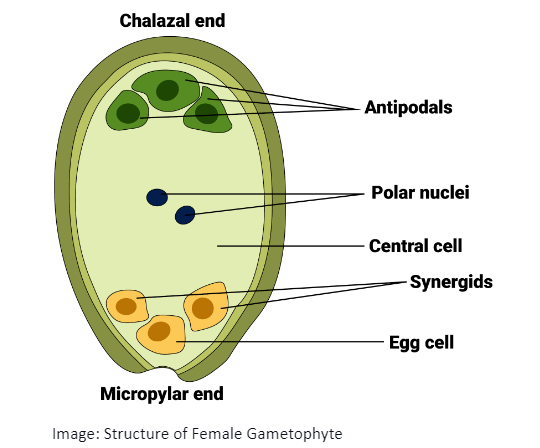
A neat diagram explains the 7-celled, 8-nucleate nature of the female gametophyte.


Structure of Female Gametophyte


Show solutionHide solution
Worked solution

Ans: 

  • Two nuclei form after the first mitotic division and move towards the micropylar and chalazal end, respectively.

  • Division and redivision occurs to form 8-nucleate stage and consequently there are four nuclei, each on either end.

  • A typical female gametophyte or embryo sac is formed after the 8-nucleate stage. The antipodal and micropylar end of each of the eight nuclei comprises the six nuclei grouped. Two synergids and an egg cell are at the centre of the egg apparatus. 

  • The polar nuclei are located within the large central cell of the embryo sac just below the egg apparatus. A typical female gametophyte comprises seven cells with eight nuclei, as both polar nuclei are present within the same cell.


Q7Written answer

What are chasmogamous flowers? Can cross-pollination occur in cleistogamous flowers? Give reasons for your answer.

Show solutionHide solution
Worked solution

Ans: The anther and stigma of chasmogamous flowers are exposed for pollination. Cleistogamous flowers are incapable of cross-pollination. Therefore, only self-pollination is caused by these closed flowers. During the dehiscence process of cleistogamous flowers, anthers dehisce into closed flowers. As a result, pollen grains are exposed to stigma. Therefore, it is impossible for cross-pollination to occur, such as Oxalis and Viola.


Q8Written answer

Mention two strategies evolved to prevent self-pollination in flowers

Show solutionHide solution
Worked solution

Ans: An individual race's vigor and vitality are diminished by continuous self-pollination. In order to prevent self-pollination and to promote cross-pollination, flowering plants have developed many devices. Cross-pollination is most frequently ensured by dichogamy and self-sterility.

Dichogamy: Different maturation times for the anthers and stigmas prevent self-pollination.

Self-sterility (or self-incompatibility): pollen grains from some flowers do not germinate on their stigma due to the presence of self-sterility genes. Examples include tobacco and potatoes.


Q9Written answer

What is self-incompatibility? Why does self-pollination not lead to seed formation in self-incompatible species?

Show solutionHide solution
Worked solution

Ans: On its stigma, a flower that does not produce pollen grains is incompatible or self-sterile. This condition is called self-incompatibility or self-sterility. It is called pollination when pollen grains are transferred from the stigma to the anthers. As a result of this transference, seeds are formed. The process of self-pollination occurs when pollen grains are shed from the anther in the same flower to the stigma in the same flower. Some flowers, however, do not produce seeds when self-pollination occurs because they contain the same sterile gene on the pistil and pollen grain. Since pollen grains cannot germinate, male gametes cannot fertilize egg cells. This prevents the ovule from developing into a seed.


Q10Written answer

What is a bagging technique? How is it useful in a plant breeding program?

Show solutionHide solution
Worked solution
  • Ans: When applied to emasculated flowers (which are in the bud stage), a bag of polythene butter paper prevents pollen contamination of its stigmas. Emasculated flowers can be removed from their buds and stuffed into a butter paper bag before anthesis. 

  • A pre-sterilized brush is used to dust the stigmas of mature emasculated flowers with pollen grains of desired male plants. Flowers are then re-bagged until the fruits are formed. 

  • Artificial hybridisation uses this technique primarily. Plant breeders use this technique to prevent unwanted pollen grains from contaminating the stigma of flowers.