My Cart
Your Cart 0

    Your cart is empty.

  • Total (Amount) ₹0.00
NCERT · Class 12 · Accountancy

Unit 2: Issue and Redemption of Debentures

Practice each question, then open the answer or worked solution.

Long Questions for NCERT Accountancy Solutions Part 2 Class 12 Chapter 2

10 questions
Q1Written answer

Explain the different types of debentures?

Show solutionHide solution
Worked solution

Debenture refers to a long-term instrument that companies use to borrow money from the market. It is the acknowledgement of a debt that is taken by a company. There are many types of debentures based on their nature, which are:

1. Based on the tenure

i. Redeemable Debenture: Debentures that have a specific date of redemption that is mentioned on the certificate, and the company is bound to pay the person/persons holding the debenture, the principal amount on that date.

ii. Perpetual/Irredeemable Debenture: Debentures that do not mention a specific date for redemption. The only way these can be redeemed is when the company is liquidated.

2. Based on Convertibility

i. Convertible Debenture: Those types of debentures that have the flexibility to convert into equity shares. The terms and conditions governing the conversion are clearly mentioned at the time of the issue of a debenture.

ii. Non-Convertible Debenture: These are debentures that do not have any special features and are not converted into equity shares.

3. Based on Security

i. Mortgage Debenture: A type of debenture that is backed by some asset or assets, and such asset can be used to recover funds in case

ii. Naked Debenture: Debenture that is issued based solely on the basis of credibility of the issuer.

4. Based on Priority

i. First Debenture: Also known as a preferred debenture. These debentures are the first to be paid in case of the winding up of a company.

ii. Second Debenture: These are ordinary debentures and are paid after the first debenture.

5. Based on registration:

i. Registered Debenture: Debentures that are registered with the age, name, address etc., are added to the debenture.

ii. Bearer Debenture: These debentures are transferred by delivery to the new holder.
Q2Written answer

Distinguish between a debenture and a share. Why is debenture known as loan capital? Explain.


Show solutionHide solution
Worked solution
Basis of Comparison Shares Debenture
Meaning Shares are funds that are owned by a company Debentures are funds that are borrowed from outside, i.e. it is debt for a company
Dividend Shareholders earn dividends from the profit of the company Debenture holders earn interest for the amount taken as debt
Deduction Being an appropriation of profit, not liable to be deducted Being an expense for business, deducted from profit
Conversion Shares cannot be converted into debentures Some debentures can be converted into shares after a period of time
Voting Right Shareholders have voting right No voting right
Risk Shareholders have the highest risk Debenture holders have the lowest risk
Compulsion to return It is not mandatory to declare a dividend It is mandatory to pay interest to creditors.
Status of Holders Shareholders are owners Debenture holders are creditors
Position in Financial Statement Shown under Shareholder Funds on the equity and liabilities side of the Balance Sheet Shown as non-current liabilities in the equity and liabilities side of the Balance Sheet.
Status at Liquidation Payment made after clearing all liabilities Payment made before shareholders.

Debentures are also called long-term debts. A company issues debentures to get funding for achieving growth in the long term. Interest needs to be paid on those loans. This interest is an expense for the business and is deducted as per applicable tax laws. Hence, debentures are known as loan capital.

Q3Written answer

Describe the meaning of ‘Debenture Issued as Collateral Securities’. What accounting treatment is given to the issue of debentures in the books of accounts?

Show solutionHide solution
Worked solution

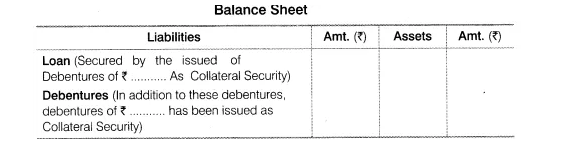
Collateral security refers to an additional layer of security over and above the primary security. It is seen in the case of a company taking a loan from a financial institution. In such cases, the company issues debentures which are additional security or collateral security. The money lender will not be receiving any interest on these debentures. In case the company defaults in making payment and the primary security is not sufficient to cover the debt, then debentures can be used to recover the amount.

Treatment of Debentures:

Debentures, when issued for the first time by a company, are not active, and to make them active an accounting entry is required to be passed

12-2

For creating an accounting record, Debenture Suspense A/C is debited, and the debenture account is credited. Debentures are represented on the liabilities side, and Debenture suspense A/c is shown on the credit side. When the debt is paid off by the business debenture account is debited, and the debenture suspense account gets credited.

Q4Written answer

How is ‘Discount on Issue of Debentures’ treated in the books of accounts? How will you deal with the ‘discount in issue of debentures’ when the debentures are to be redeemed in instalments?

Show solutionHide solution
Worked solution

Debentures which are issued at a value less than their face value (nominal value) are said to be issued at a discount. There is no restriction on companies for issuing debentures at a discount.

The following treatment is given when a discount is applied on the issue of debentures

12-3

There are two methods that are applicable when debentures are redeemed in instalments.

1. Fixed Instalment Method: Also known as the equal instalment method, this method is used when debentures are redeemed in a lump sum and after a specific time period. In this method, an equal amount of discount or loss is written off till the debenture is not paid off. The formula sed to calculate the discount amount is given below

12-4

2. Variable Instalment Method: This method is also known as Fluctuating or Reducing Instalment Method or Proportion Method. In this method, debentures are paid in annual drawings or instalments. The amount of discount that is written off every year should be in proportion to debentures that are outstanding at the beginning of each year. Therefore the amount of discount will vary each year, and it will be more in the initial years and will subsequently reduce at the end of redemption.

Q5Written answer

Explain the different terms for the issue of debentures with reference to their redemption.

Show solutionHide solution
Worked solution

Debentures can be issued in three ways: at par, premium and at a discount, while the debentures can be redeemed only at par and at a premium. The following combinations can be discussed:

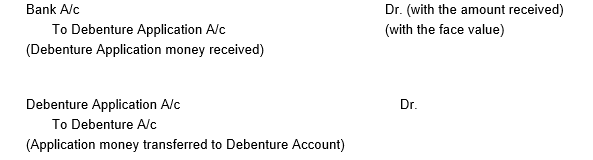
1. Issued at Par and Redeemable at Par: This is the condition when debentures are issued and redeemed at their par value or face value. The following entries can be seen

12-5

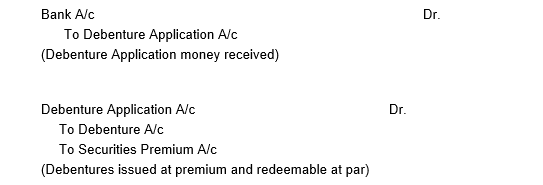
2. Issued at Premium and Redeemable at Par: A situation where debenture is issued at a premium and is redeemable at par. Issuing debentures at a premium is gain, so it is credited.

12-6

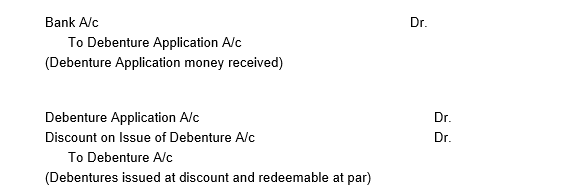
3. Issue at Discount and Redeemable at Par: The situation in which debenture is issued at a discount and is redeemable at par. Discount being a loss is recorded as a debit entry.

12-7

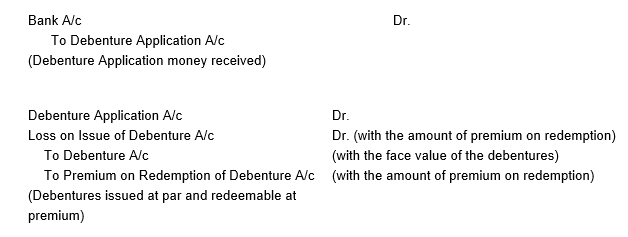
4. Issue at Par and Redeemable at Premium: Here, the share is issued at par and is redeemable at a premium. The following entries are recorded

12-8

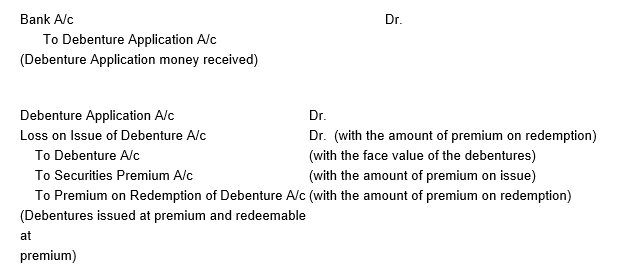
5. Issued at Premium and Redemption at Premium: In this situation, both the issue and redemption of the debenture are at a premium. It will give rise to the following entries

12-9

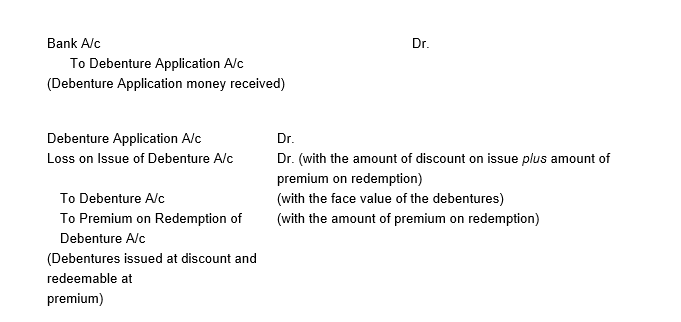
6. Issue of Discount and Redemption at Premium: When debentures are issued at a discount and redeemable at a premium. The following entries can be recorded

12-10

Q6Written answer

Differentiate between redemption of debentures out of capital and out of profits.

Redemption of Debentures Out of Capital

Show solutionHide solution
Worked solution

It refers to the condition when the debentures are redeemed from the capital without utilising the profits for redemption. Such a condition results in no profit being transferred to the Debenture Redemption Reserve, a reserve that needs to be created as debentures cannot be redeemed entirely from the capital. SEBI has issued guidelines for the redemption of debenture by creating a Debenture Redemption reserve. However, there are some industries that are exempted from creating a reserve, and they are:

1. Companies that issue debentures with a maturity of 18 months

2. Companies involved in the infrastructure sector, like maintenance, construction, and business development activities

Redemption of Debenture Out of Profits

Debentures, when redeemed out of profit, do not utilize the capital for redemption. It is mandatory to create a DRR before redeeming the debenture. This rule has been created by SEBI (Securities and Exchange Board of India), and as per that, a company should transfer an amount equal to 50% of debentures issued to DRR before redeeming the debentures. Profit gets transferred to DRR from the Profit and Loss Appropriation Account. This reduces the total profit, and therefore this process is called Redemption of Debenture out of profits. DRR is shown under the Reserve and Surplus section of the Liabilities part of the balance sheet. After all debentures are redeemed, a DRR account is closed by transferring it to the general reserve.

Q7Written answer

Explain the guidelines of SEBI for creating Debenture Redemption Reserve.

Show solutionHide solution
Worked solution

These points need to be followed while creating Debenture Redemption Reserve (DRR):

1. DRR needs to be created for companies which issue debentures with a maturity of more than 18 months.

2. For partly convertible debentures, DRR needs to be created for the non-convertible portion of the debenture in the same way as is done for fully non-convertible debenture issue.

3. Company should create DRR equivalent to 50% of the debenture issue before debenture redemption commences.

4. Withdrawal from DRR is permissible only after 10% of the debenture liability has been actually redeemed by the company.

As per SEBI’s guidelines the following type of companies will be exempted from creating DRR:

1. Company issuing debentures with a maturity of up to 18 months.

2. Companies involved in the infrastructure sector, like maintenance, construction, and business development activities

Q8Written answer

Describe the steps for creating Sinking Fund for redemption of debentures.

Show solutionHide solution
Worked solution

The following steps are involved:

1. Calculate the amount from the profit that needs to be set aside every year with information obtained from Sinking Fund Table.

2. This amount that is set aside every year in Step 1 is transferred to a Debenture Redemption Fund (Sinking Fund) by debiting P & L Appropriation Account.

3. The instalment hence determined is invested in obtaining the amount essential for redeeming the debenture by debiting the DRF (Debenture Redemption Fund).

4. The interest on the amount thus invested will be received on a bi-annual or annual basis.

5. The total investment, which includes investment and the interest, is re-invested in the following year.

6. Repeat the steps of transferring and investing till the last instalment, which will be debited from the P & L appropriation account.

7. The investment is sold off at the year of redemption

8. The profit/loss that is obtained from the sale of investment is transferred appropriately by debiting/crediting Debenture Redemption Fund (DRF) investment account to the DRF Account.

9. Payment is processed for the holders of the debenture

10. The balance remaining, if any, from the DRF Account is transferred to the General Reserve.

Q9Written answer

Can a company purchase its own debentures in the open market? Explain.

Show solutionHide solution
Worked solution

Redemption of debentures by purchase in the open market refers to the condition when a company is authorised by its Article of Association to be able to purchase its own debentures. The debentures are purchased to serve the following purpose:

1. As a source of investment which can be sold at a higher price on a later date to earn more profit

2. To cancel debenture liabilities if the debenture rate is higher than the rate of interest in the market.

Q10Written answer

What is meant by conversion of debentures? Describe the method of such a conversion.

Show solutionHide solution
Worked solution

The situation where a debenture holder is able to convert existing debentures into equity shares or new debentures after the expiry of the existing debenture’s time period is known as redemption of debentures by conversion. The issue price of shares must be equal to or less than the amount that is received from debentures, this should be kept in mind by the debenture holder when exercising the conversion option.

Debentures that can be converted to equity shares after a specified time are called Convertible Debentures. The time at which it can be converted to equity shares is mentioned when the debentures are issued. There are two types:

1. Partly convertible debentures: In this, only a part of the debentures is eligible to be converted into equity shares.

2. Fully convertible debentures: In this, all of the debentures can be converted to equity shares.

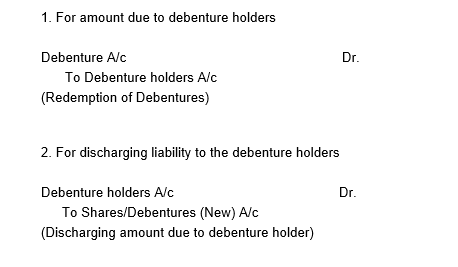
The following treatment is provided for the conversion:

12-11