My Cart
Your Cart 0

    Your cart is empty.

  • Total (Amount) ₹0.00
NCERT · Class 12 · Accountancy

Unit 1: Accounting for Share Capital

Practice each question, then open the answer or worked solution.

Long Questions for NCERT Accountancy Solutions Part 2 Class 12 Chapter 1

10 questions
Q1Written answer

What is meant by the word ‘Company’? Describe its characteristics.

Show solutionHide solution
Worked solution

Section 2(20) of the Companies Act 2013 defines the term “company” to mean “a company incorporated under the Companies Act, 2013 or any previous company law. In general parlance, a company is an artificial person created by law, having a separate legal entity, common seal, perpetual succession and limited liability. It is a voluntary association of persons who come together and contribute capital for doing business. The capital of a company is available in the form of shares, and the ownership of shares is subject to certain terms and conditions. Public and private are two forms of company.

Characteristics of a Company

1. A company is an association formed voluntarily by a group of persons having a common business goal. Minimum number of members required for a private company is two and that for a public company is seven.

2. Company is a juristic and artificial person created by law.

3. Company is a separate legal entity from shareholders and directors. It has the authority to open a bank account, sign contracts and own property in its name.

4. The liability of the members of a company is limited to the unpaid value of the shares they are holding.

5. The company has perpetual existence, which means the existence of the company is not affected by the death, insolvency or retirement of any of its members

6. The company, being an artificial person, has no individual signature; hence it carries a common seal for validating the official documents.

7. Shares of a public company are transferrable, while private companies do not allow the transfer of shares without members’ consent.
Q2Written answer

Explain in brief the main categories in which the share capital of a company is divided.

Show solutionHide solution
Worked solution

The following categories of share capital are there:

1. Authorised Capital: This is the maximum amount a company can raise by issuing shares. It is the amount mentioned during the formation of the Memorandum of Association.

2. Issued Capital: A portion of authorised share capital that is offered by the company to the general public for subscription.

3. Unissued Capital: A part of authorised capital that is not yet offered to the general public for subscription but can be offered in near future.

4. Subscribed Capital: A part of issued capital which is subscribed by the general public.

5. Unsubscribed Capital: Referred to as that part of issued capital that has not been subscribed by the people (public).

6. Called up Capital: It is a portion of the subscribed capital for which the shareholders are called to pay

7. Uncalled up capital: It is that part of a subscribed capital that is not yet called up, but can be called up as per requirement.

8. Paid Up Capital: It is part of called up share capital that is received by the shareholders

9. Reserve Capital: A company may call up certain part of uncalled share capital when a company is winding up. This cannot be used for any other purpose other than paying back creditors, hence it is called reserve capital.

Q3Written answer

What do you mean by the term ‘share’? Discuss the type of shares, which can be issued under the Companies Act, 2013 as amended to date.

Show solutionHide solution
Worked solution

In a company, the capital is split into small denominations, which are known as shares. Shares can be easily transferred from one person to another, and this transfer is bound by certain terms and conditions. A shareholder is a person who contributes capital in the form of shares. Ownership is limited to the value of shares possessed by the shareholder. There are two types of shares:

1) Preference Shares and 2) Equity Shares

1)Preference Share: Section 43 of the Companies Act, 2013 defines preference shares as those which entitle the holder to receive dividends and also the right to receive capital invested in order of preference before equity shareholders when the company winds up.

2) Equity Shares: Equity shareholders manage the affairs of the company and also have a voting right. These types of shares do not possess any preferential right for dividend payment or capital repayment. The dividend rate is not fixed and varies year on year, which is dependent on available profit left after distributing to preference shareholders.

Q4Written answer

Discuss the process for the allotment of shares of a company in case of over subscription.

Show solutionHide solution
Worked solution

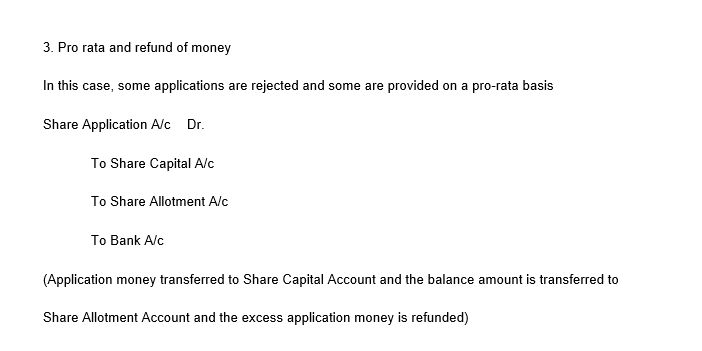
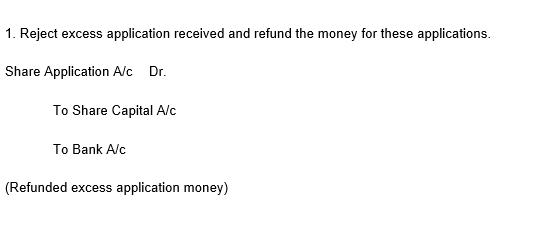
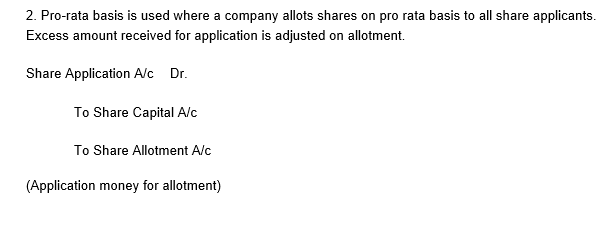
Over-subscription: It is referred to as the situation where the total number of applications received for share allotment exceeds the available number of shares that are issued by the company for public.

In case of over-subscription, there are 3 ways to deal with it:

1

2

3

Q5Written answer

What is a ‘Preference Share’? Describe the different types of preference shares.

Show solutionHide solution
Worked solution

Preference Share: Section 43 of the Companies Act, 2013 defines preference shares as shares which entitle the holder to receive dividends and also the right to receive capital invested in order of preference before equity shareholders when the company winds up.

The different types are:

1. Cumulative Preference Share: When arrears of a dividend are cumulative, and such arrears are paid before paying any dividend to equity shareholders, such shares are known as cumulative shares.

2. Non-Cumulative Preference Share: Shares where the dividend is paid from the net profits earned each year, are known as non-cumulative preference shares. If the company does not earn profits in any of the years, the arrears of dividends cannot be claimed.

3. Participating preference share: In these types of shares, the preference shareholder has the luxury of participating in the surplus profit (i.e. apart from the fixed rate of dividend), which is remaining after paying equity shareholders.

4. Non-participating Preference Share: The condition in which the shareholder is entitled only to a fixed dividend pay-out and no share in surplus profits is known as a non-participating preference share.

5. Convertible Preference Share: A type of share which can be converted to equity shares within a period of time.

6. Non-Convertible Preference Share: Type of shares which do not have the right to convert into equity shares.

7. Redeemable Preference Shares: Those shares that can be repaid to the shareholders after a certain period as per provisions mentioned in the Companies Act, 1956

8. Guaranteed Preference Shares: These shares have the provision of getting fixed dividend, even if the company is making no profits

Q6Written answer

Describe the provision of law relating to ‘Calls-in-Arrears’ and ‘Calls-in-Advance’.

Show solutionHide solution
Worked solution

When an investor (shareholder) fails to pay all the instalments for the allotted shares in due time, the company expects the investor to pay the amount on subsequent calls or stages. The amount of money that is paid at later stages is called as Call-in-Arrears. The company is authorized by its Article of Association to charge interest at a specified rate on the call in arrears amount from the due date till the date of payment. If the Article of Association does not mention or is silent about such a case, then a 5% charge is levied.

The amount is deducted from called-up share capital on the liabilities side of the Balance Sheet. If the due amount is not paid, the shares can be forfeited with proper notice to shareholders.

When the shareholder pays the whole amount before the share payment date becomes due, i.e., before the share issuing company makes a call for it, it is known as Calls-in-advance. In case of advance payment, the company has a provision in their article of association to pay interest to shareholders from the date of payment till the date of call. If the article of association is silent in this regard, then a default 6% interest is provided.

It is shown on the liabilities side of the Balance Sheet under the heading of current liabilities.

Q7Written answer

Explain the terms ‘Over-subscription’ and ‘Under-subscription’. How are they dealt with in accounting records?

Show solutionHide solution
Worked solution

Over-subscription: It is referred to as the situation where the total number of applications received for share allotment exceeds the available number of shares that are issued by the company for the public.

Under-subscription: This is the situation when the number of applications for share allotment is less than the number of shares issued by the company. A 90% subscription of the shares is called a Mini Subscription. If a 90% subscription does not take place, the company should refund the money back to applicants.

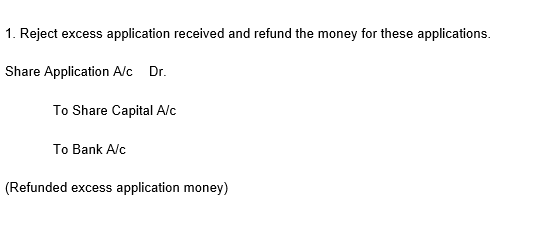
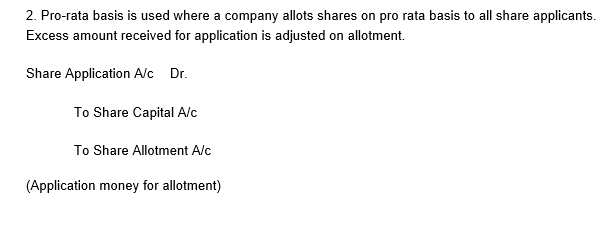
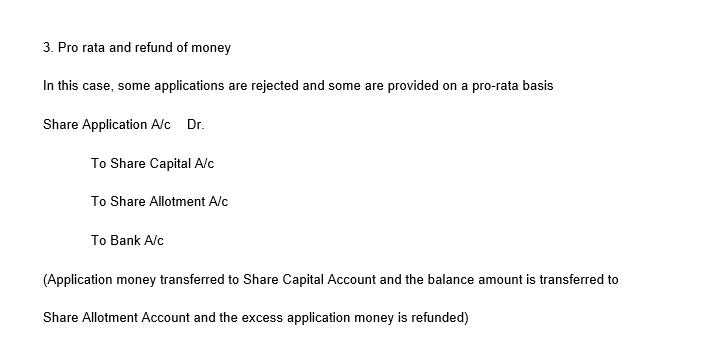
In case of over-subscription, there are 3 ways to deal with it:

4

5

6

Q8Written answer

Describe the purposes for which a company can use ‘Securities Premium Account’.

Show solutionHide solution
Worked solution

A securities premium account can be used for these activities:

1. Issuing fully paid-up bonus shares to existing shareholders.

2. Writing off the expense of the issue of shares and debentures, such as the discount given on the issue of shares.

3. Writing off preliminary expenses

4. Buying back shares

5. For paying premium payable on redemption of debentures

Q9Written answer

State clearly the conditions under which a company can issue shares at a discount.

Show solutionHide solution
Worked solution

Under the following conditions, a company can issue shares at a discount:

1. The shares issued must belong to a class of shares that are already issued.

2. Shares can be issued at a discount after a minimum time frame of 1 year from the date business has started

3. The issue of shares at a discount is authorised by a resolution that is passed by the company in a general meeting and approved by the Company law board.

4. Shares can be issued at a discount within two months of obtaining sanction company law board.

5. Maximum rate of discount must not cross 10% of the face value or as decided by the company law board.

Q10Written answer

Explain the term ‘Forfeiture of Shares’ and give the accounting treatment on forfeiture.

Show solutionHide solution
Worked solution

A shareholder has to pay allotment money for holding the shares and has to pay the calls, which are part of the share allotment. When a shareholder fails to do so, a 14 days’ notice is served to the shareholder. If the shareholder does not pay in these 14 days, the shares will be forfeited.

Table A of the Companies Act, 2013 deals with the Memorandum of Association for a company limited by shares. It has the following procedure for forfeiting shares:

1. Notice sent to the shareholder for making payment related to call arrears and interest on outstanding call money within a period of 14 days of receipt of the notice.

2. On non-payment of dues, the company can forfeit the share by passing a resolution

3. Forfeit notice resolution sent to the shareholder and a statement published in a daily newspaper

4. Name of shareholder removed from registered shareholders list. 

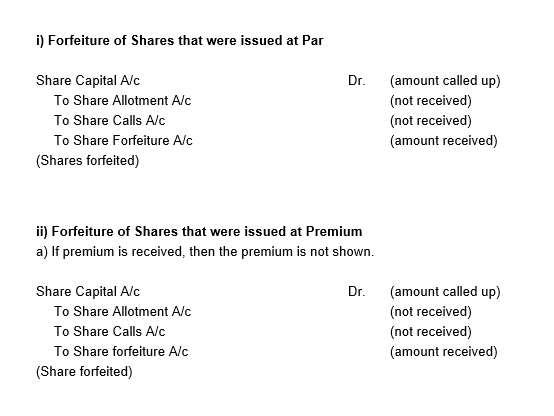
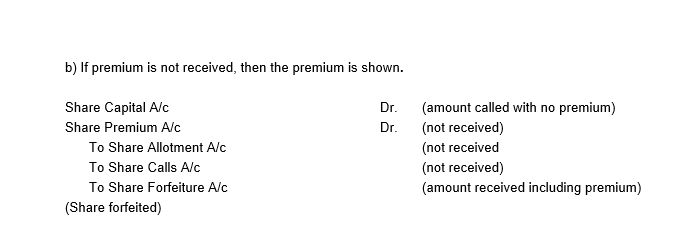
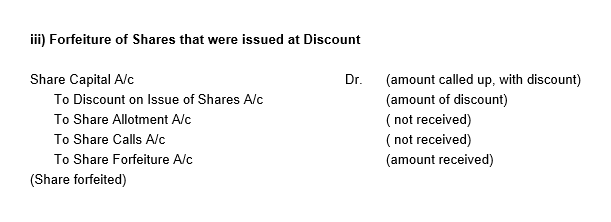
Accounting Treatment for Forfeiture of Shares:

7

8

9