My Cart
Your Cart 0

    Your cart is empty.

  • Total (Amount) ₹0.00
NCERT · Class 12 · Accountancy

Unit 2: Reconstitution of a Partnership Firm – Admission of a Partner

Practice each question, then open the answer or worked solution.

Long Questions for NCERT Accountancy Solutions Class 12 Part 1 Chapter 3

8 questions
Q1Written answer

Do you advise that Liabilities and Assets must be revalued at the time of admission of a partner? If so, why? Also, describe how this is treated in the book of account.

Show solutionHide solution
Worked solution

It is logical to revalue Liabilities and Assets when a new partner gets admitted to the firm, as it is helpful in determining their true value of them on that day. Revaluation is helpful as the value of Liabilities and Assets may increase or decrease, and as such, their values in the existing balance sheet may not be justified; also, some assets or liabilities may not be recorded at all. Hence, for recording the changes in market value for the Liabilities and Assets, a revaluation account is needed to be prepared, and the associated profits or losses need to be distributed between the existing partners of the firm.

Following journal entries are added to the account on the date a new partner is admitted to a firm.

i. When asset value increases:

Assets A/c Dr.

To Revaluation A/c

(For increase in asset value)

ii) When asset value decreases.

Revaluation A/c Dr.
To Asset A/c
(For Decrease in asset value)

iii) When Liabilities increase.

Revaluation A/c Dr.
To Liabilities A/c
(For increase in liabilities value)

iv) When liabilities decrease.

Liability A/c Dr.
To Revaluation A/c
(For decrease in liabilities value)

v) To record assets that are unrecorded.

Unrecorded Assets A/c Dr.
To Revaluation A/c
(Recording unrecorded assets)

vi) To record liabilities that are unrecorded.

Revaluation A/c Dr.
To Unrecorded Liabilities A/c
(To record unrecorded liabilities)

vii) Transferring credit balance of Revaluation account.

Revaluation Dr.
To Old Partner’s Capital A/c
(Transfer of profit earned from Revaluation to Old Partners as per existing profit sharing ratio)

vii) Transferring debit balance of Revaluation account.

Old Partner’s Capital A/c Dr.
To Revaluation A/c
(Transfer of loss on revaluation to Old Partners as per existing profit sharing ratio)
Q2Written answer

What is goodwill? What are the factors that affect goodwill?

Show solutionHide solution
Worked solution

Goodwill refers to the intangible asset that represents the firm’s value and reputation and the brand name that it carries in the market. Goodwill is earned by a firm from the work it does, which helps earn people’s trust by meeting all customer demands both in quality and quantity. Having positive goodwill is very much helpful for a firm to earn extraordinary profits in comparison to its competitors. It also ensures profits that keep coming in the future and helps in retaining old customers.

Factors affecting firms’ goodwill are

1. Product Quality: A firm which is constantly delivering the best product for its customers will have greater goodwill.

2. Location: A central location makes it easy to reach and attracts more footfall, which leads to higher sales and more goodwill.

3. Management: Cost efficiency and higher productivity can be achieved by having efficient management in place; also, it ensures quality products at less price, which increases goodwill.

4. Market Structure: A firm will enjoy more benefits of goodwill if the market is monopolistic in nature and there are no substitutes; it will add more goodwill to the firm.

5. Other Advantages: A firm that is getting benefits such as the continuous supply of fuel, power and raw materials and uses them to produce quality goods enjoys higher goodwill.

Q3Written answer

Explain various methods of valuation of goodwill.

Show solutionHide solution
Worked solution

There are four different methods of goodwill valuation:

1. Average Profit Method: In this method, the calculation of goodwill is done based on the average profits of the past years. It can be calculated as

Goodwill = Average Profit × No. of Years Purchase

NCERT Act Class 12 Chp 3-1

Here, the number of years of purchase signifies the years till which the firm expects profits to generate in the same way as the current period

The following steps are involved in this method:

1. Determine the total profit of past years.

2. Add all losses which are abnormal in nature, such as theft, fire, etc.

3. Add all normal income, if not done previously.

4. Deduct all incomes that are not obtained from business and all such abnormal incomes, for e.g., winning a lottery.

5. Deduct all normal expenses, if not deducted previously.

6. Calculate the average profit by dividing the total profit determined in the previous step.

7. Multiply the average profit hence obtained by the number of year’s purchases in order to determine goodwill.

Example:

Last 5 years profits are 3,00,000,  9,00,000,   (6,00,000),  15,00,000,  24,00,000.

Goodwill calculated as

NCERT Act Class 12 Chp 3-2

Goodwill = 9, 00,000 × 4 = 36, 00,000

2. Weight Average Method: In this method, weights are allocated to each year’s profit, with the highest weight given to the recent year’s profit and lower weights marked for the past years’ profits. The product of the profits and weights are added and divided by the total weight to determine weighted average profits. It is a modified version of the Average Profit Method. The following formulae are used.

NCERT Act Class 12 Chp 3-3

The following steps are involved:

1. Assign the highest weightage to the recent year’s profit and the lowest weightage to the past years’ profits.

2. Multiply weights with the profits corresponding to each year.

3. Determine the product’s total.

4. Divide the product total by the total weightage to find the Weighted Average Profit.

5. Multiply the weighted average profit by the number of years purchased.

For example,

Last 5 years profits are ₹ 3,00,000,   ₹ 9,00,000,   ₹ (6,00,000),   ₹ 15,00,000,   ₹ 24,00,000.

Goodwill calculated as,

Profit/Loss

₹

Weights Product

₹

3,00,000 1 3,00,000 × 1 = 3,00,000
9,00,000 2 9,00,000 × 2 = 18,00,000
(6,00,000) 3 (6,00,000) × 3 = (18,00,000)
15,00,000 4 15,00,000 × 4  = 60,00,000
24,00,000 5 24,00,000× 5  = 1,20,00,000
Total 15 ₹ 1,83,00,000

NCERT Act Class 12 Chp 3-4

3. Super Profit Method:  In this method, goodwill is determined by the excess profit earned by a firm as compared to profit earned by rivals in the same industry. The excess profit earned over normal profit is called a Super Normal Profit

The following steps are involved:

1. Calculate the average profit

2. Calculating average capital engaged

NCERT Act Class 12 Chp 3-5

3. Calculating normal profit

NCERT Act Class 12 Chp 3-6

4. Calculation of Super Normal Profit using the formulae: Super Normal Profit = Average Profit – Normal Profit

5. Multiply super normal profit with the number of years the purchase to determine goodwill.

4. Capitalisation Method: Goodwill is determined in two ways as follows:

a) By Average Profit capitalisation. b) By Super Profit capitalisation.

a) By Average Profit capitalisation

The following steps are involved:

1. Average profit is calculated.

2. Calculating average profits capitalised value using the formulae.

NCERT Act Class 12 Chp 3-7

3. Determine Actual Capital Employed

4. Deduct Actual Capital Employed from Capitalised Average Profit to calculate goodwill.

Goodwill = Capitalised Average Profit – Actual Capital Employed

b) By Super Profit capitalisation.

The following steps are involved:

1. Capital Employed for calculation

2. Calculation of Normal profit

NCERT Act Class 12 Chp 3-8

3. Calculation of average profit

4. Calculating Super Normal Profit

Super Normal Profit = Average Profit – Normal Profit

Step 5: Goodwill calculation by the following formula:

NCERT Act Class 12 Chp 3-9
https://img-nm.mnimgs.com/img/study_content/editlive_ncert/75/2012_03_28_10_27_29/aifygvth2084271488060742129.gif

Q4Written answer

If it is agreed that the capital of all the partners is proportionate to the new profit-sharing ratio, how will you work out the new capital of each partner? Give examples and state how necessary adjustments will be made.

Show solutionHide solution
Worked solution

When a new partner is admitted to the firm, the capital of all partners must be determined using the new profit-sharing ratio. In such cases new capital of each partner is determined and is dependent on the following instances:

1. New partner’s capital is given

2. Firm’s total capital is given

1) New partner’s capital is given

It involves the following steps:

1. Calculation of the total capital of the firm based on the new partners’ capital.

2. Divide the total capital of the firm by individual shares of the partner’s profits to determine each partner’s new capital.

3. After posting adjustments, determine each partner’s capital balance.

4. The capital determined previously is written in the Partners Capital account on the credit side.

5. Calculation of surplus or deficit. If new capital is more than the old share, then it needs to be contributed by old partners and is termed deficit, and if new capital is less than old capital, it is called surplus and the difference is paid to old partners.

Let us understand the above steps with the help of an example.

A & B are partners in business who share profits and losses equally. They agree to admit C for
https://img-nm.mnimgs.com/img/study_content/curr/1/15/17/2430/15050/Gr12_Acc_Book1_Chap3_NCERTsol_TQ_Ami_Ami_Ad_html_m6dbf2043.gifshare in profit. C brings ₹ 1, 00,000 as capital. A and B have old capital of ₹ 80,000 and ₹ 60,000, respectively, at the time of admission of C.
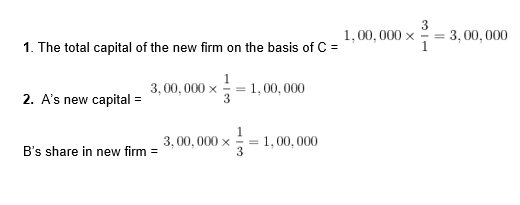


NCERT Act Class 12 Chp 3-10

Step 3:

A B
New Capital 100,000 100,000
Less: Existing Capital (80,000) (60,000)
Withdrawal (deposit) (20,000) (40,000)

So both A and B need to pay 20,000 and 40,000 more as shares for their new capital.

2) When new firms’ total capital is known:

When the new partner’s capital is not mentioned, then new capital is determined based on the total capital of the firm on a proportionate basis. The amount that is determined has to be brought in by the new partner as capital. The following steps are taken to determine the new partners’ capital:

1. Finding the total old capital of the existing partners after performing all adjustments.

2. Finding the total capital of the new firm by multiplying the old capital of existing partners with the reciprocal of the old partner’s total share.

NCERT Act Class 12 Chp 3-10

3. The new capital of each partner is determined on the basis of the total capital calculated, which is multiplying the new profit ratio with the total capital, individually, for all partners. Here is an example to help you understand the concept.

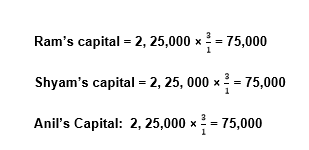
Ram and Shyam are partners in a firm, sharing profit and loss equally. They agreed to admit Anil for 1/3rd share in profit and decided to share future profit and loss equally. X’s capital is ₹ 1, 00,000 and Y’s capital is ₹ 50,000. Z brings sufficient capital for his share in profit.

1. Old Capital= ₹ 1, 00,000 + 50,000 = 1, 50,000

2. Calculation of total capital

NCERT Act Class 12 Chp 3-11

NCERT Act Class 12 Chp 3-12

3. New Partners Capital

NCERT Act Class 12 Chp 3-13

Q5Written answer

Explain how will you deal with goodwill when a new partner is not in a position to bring his share of goodwill in cash?

Show solutionHide solution
Worked solution

In a situation in which a new partner is unable to bring his share of goodwill in cash, the goodwill account gets adjusted through the Old Partners account. The new partners’ capital account is debited with the share of goodwill, and the same gets credited to Old Partner’s account.

New Partner’s Capital A/c Dr.
To Old Partners’ Capital A/c
(New Partner account debited)

Note: According to Para 16 of Accounting Standard 10, Goodwill is recorded only when it is any transaction equivalent to money or money’s worth. It is a mandatory practice that is followed.

Q6Written answer

Explain various methods for the treatment of goodwill on the admission of a new partner?

Show solutionHide solution
Worked solution

Goodwill is treated in the following ways on the introduction of a new partner:

1. Premium Method

2. Revaluation Method

When a new partner pays the share of goodwill in the form of cash, it is called a premium method. There can be two scenarios:

1. New partners pay directly to old partners

2. Partner brings goodwill in the form of cash, and it is retained in the business.

The corresponding entries are:

(i) When goodwill brought in cash by the new partner

Cash/Bank A/c Dr.

To Premium for Goodwill A/c

(Amount of goodwill brought in by new partner)

(ii)When goodwill is retained by the business:

Premium for Goodwill A/c Dr

To Sacrificing Partners’ Capital A/c

(Goodwill brought by the new partner is distributed among old partners as per the sharing ratio.)

Revaluation Method: Situations when a new partner is unable to bring goodwill in the form of cash.

New Partner’s Capital A/c Dr. (Goodwill amount not brought by new partner)

To Old Partners’ Capital A/c

(Goodwill of new partner distributed to old partners as per their sharing ratio.)

Note: According to Para 16 of Accounting Standard 10, Goodwill is recorded only when it is any transaction equivalent to money or money’s worth. It is a mandatory practice that is followed.

Q7Written answer

How will you deal with the accumulated profit and losses and reserves on the admission of a new partner?

Show solutionHide solution
Worked solution

A new partner is not entitled to bear the losses or enjoy the profits of a previous business. Hence, when a new partner is added to the firm, the accumulated profits or losses or reserves need to be distributed to current partners (partners of the old firm) in their profit-sharing ratio.

Treatment of accumulated losses, profits and reserve.

Profit and Loss A/C Dr.

General Reserve A/C Dr.

Contingency Reserve A/C Dr.

When losses accumulate over a period.

For Profits and losses

Deferred Advertising expense Dr.

(Losses accumulated shared to old partners as per sharing ratio)

Q8Written answer

At what figures does the value of Liabilities and Assets appear in the books of the firm after revaluation has been done? Show with the help of an imaginary balance sheet.

Show solutionHide solution
Worked solution

After revaluation has been done, the Liabilities and Assets appear at their current market values on the Balance Sheet of the reconstituted firm. This can be better explained with the help of the below-explained example.

Anil and Bijay shares profit and loss equally.

Balance Sheet of A and B as on April 01, 2019


Liabilities Amount

₹

Assets Amount

₹

Sundry Creditors 1,00,000 Cash in Hand 8,000
Capital Accounts Cash at Bank 1,78,000
Anil 1,50,000 Debtors 40,000
Bijay 1,50,000 3,00,000 Stock 36,000
Furniture 38,000
Plant and Machinery 1,00,000
4,00,000 4,00,000

1) On that date, Chetan is admitted as he is the new partner for 1/3rd share and offers 2, 00,000 as capital.

2) Value of stocks increased by ₹ 7,000.

3) A ₹ 2,000 provision has been created against Debtors.

4) ₹ 35,000 value obtained after revaluating furniture.

5) A machinery costing ₹ 100,000 purchased is not recorded in books.

6) Outstanding rent ₹ 2,000.

Prepare Revaluation Account, Partners’ Capital Account, Cash Account and Balance Sheet.


Revaluation Account
Dr. Cr.
Particular Amount

₹

Particular Amount

₹

Rent Outstanding A/c 2,000 Stock 7,000
Provision for Debtors 2,000 Machinery 100,000
Furniture 35,000
Profit transferred:
Anil’s Capital A/c 50,000
Bijay’s Capital A/c 50,000 100,000
107,000 107,000


Anil’s Capital Account
Dr. Cr.
Date Particular J.F. Amount

₹

Date Particular J.F. Amount

₹

Balance c/d 2,00,000 Balance b/d 150,000
Revaluation A/c 50,000
2,00,000 2,00,000
Bijay’s Capital Account
Dr. Cr.
Date Particular J.F. Amount

₹

Date Particular J.F. Amount

₹

Balance c/d 2,00,000 Balance b/d 150,000
Revaluation A/c 50,000
2,00,000 2,00,000
Chetan’s Capital Account
Dr. Cr.
Date Particular J.F. Amount

₹

Date Particular J.F. Amount

₹

  Balance c/d 2,00,000 Cash A/c 2,00,000
2,00,000 2,00,000
Cash Account
Dr. Cr.
Date Particular J.F. Amount

₹

Date Particular J.F. Amount

₹

  Balance b/d 8,000 Balance c/d 2,08,000
Chetan’s Capital A/c 2,00,000
2,08,000 2,08,000
Balance Sheet of Anil, Bijay & Chetan as of April


Liabilities Amount

₹

Assets Amount

₹

Sundry Creditors 1,00,000 Cash in hand 2,08,000
Rent Outstanding 2,000 Cash at Bank 178,000
Debtors 40,000
Less: Provision 2,000 38,000
Capital Account
Anil 2,00,000 Stock 43,000
Bijay 2,00,000 Furniture 35,000
Chetan 2,00,000 6,00,000 Plant and Machinery 2,00,000
7,02,000 7,02,000