
Show solutionHide solution
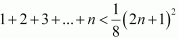
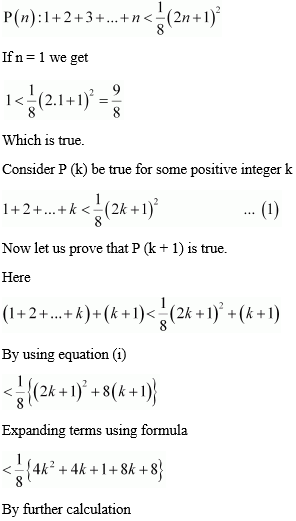
We can write the given statement as


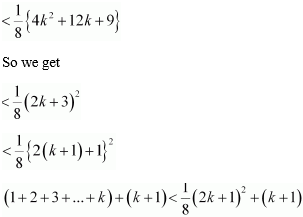
P (k + 1) is true whenever P (k) is true.
Therefore, by the principle of mathematical induction, statement P (n) is true for all natural numbers, i.e., n.
Your cart is empty.
Practice each question, then open the answer or worked solution.

We can write the given statement as


P (k + 1) is true whenever P (k) is true.
Therefore, by the principle of mathematical induction, statement P (n) is true for all natural numbers, i.e., n.
n (n + 1) (n + 5) is a multiple of 3.
We can write the given statement as
P (n): n (n + 1) (n + 5), which is a multiple of 3.
If n = 1, we get
1 (1 + 1) (1 + 5) = 12, which is a multiple of 3.
Which is true.
Consider P (k) to be true for some positive integer k.
k (k + 1) (k + 5) is a multiple of 3
k (k + 1) (k + 5) = 3m, where m ∈ N …… (1)
Now, let us prove that P (k + 1) is true.
Here,
(k + 1) {(k + 1) + 1} {(k + 1) + 5}
We can write it as
= (k + 1) (k + 2) {(k + 5) + 1}
By multiplying the terms,
= (k + 1) (k + 2) (k + 5) + (k + 1) (k + 2)
So, we get
= {k (k + 1) (k + 5) + 2 (k + 1) (k + 5)} + (k + 1) (k + 2)
Substituting equation (1),
= 3m + (k + 1) {2 (k + 5) + (k + 2)}
By multiplication,
= 3m + (k + 1) {2k + 10 + k + 2}
On further calculation,
= 3m + (k + 1) (3k + 12)
Taking 3 as common,
= 3m + 3 (k + 1) (k + 4)
We get
= 3 {m + (k + 1) (k + 4)}
= 3 × q where q = {m + (k + 1) (k + 4)} is some natural number
(k + 1) {(k + 1) + 1} {(k + 1) + 5} is a multiple of 3
P (k + 1) is true whenever P (k) is true.
Therefore, by the principle of mathematical induction, statement P (n) is true for all natural numbers, i.e., n.
102n – 1 + 1 is divisible by 11.
We can write the given statement as
P (n): 102n – 1 + 1 is divisible by 11.
If n = 1, we get
P (1) = 102.1 – 1 + 1 = 11, which is divisible by 11.
Which is true.
Consider P (k) to be true for some positive integer k.
102k – 1 + 1 is divisible by 11
102k – 1 + 1 = 11m, where m ∈ N …… (1)
Now, let us prove that P (k + 1) is true.
Here,
10 2 (k + 1) – 1 + 1
We can write it as
= 10 2k + 2 – 1 + 1
= 10 2k + 1 + 1
By addition and subtraction of 1,
= 10 2 (102k-1 + 1 – 1) + 1
We get
= 10 2 (102k-1 + 1) – 102 + 1
Using equation 1, we get
= 102. 11m – 100 + 1
= 100 × 11m – 99
Taking out the common terms,
= 11 (100m – 9)
= 11 r, where r = (100m – 9) is some natural number
10 2(k + 1) – 1 + 1 is divisible by 11
P (k + 1) is true whenever P (k) is true.
Therefore, by the principle of mathematical induction, statement P (n) is true for all natural numbers, i.e., n.
x2n – y2n is divisible by x + y.
We can write the given statement as
P (n): x2n – y2n is divisible by x + y
If n = 1, we get
P (1) = x2 × 1 – y2 × 1 = x2 – y2 = (x + y) (x – y), which is divisible by (x + y)
Which is true.
Consider P (k) to be true for some positive integer k.
x2k – y2k is divisible by x + y
x2k – y2k = m (x + y), where m ∈ N …… (1)
Now, let us prove that P (k + 1) is true.
Here,
x 2(k + 1) – y 2(k + 1)
We can write it as
= x 2k . x2 – y2k . y2
By adding and subtracting y2k, we get
= x2 (x2k – y2k + y2k) – y2k. y2
From equation (1), we get
= x2 {m (x + y) + y2k} – y2k. y2
By multiplying the terms,
= m (x + y) x2 + y2k. x2 – y2k. y2
Taking out the common terms,
= m (x + y) x2 + y2k (x2 – y2)
Expanding using formula,
= m (x + y) x2 + y2k (x + y) (x – y)
So, we get
= (x + y) {mx2 + y2k (x – y)}, which is a factor of (x + y)
P (k + 1) is true whenever P (k) is true.
Therefore, by the principle of mathematical induction, statement P (n) is true for all natural numbers, i.e., n.
32n + 2 – 8n – 9 is divisible by 8.
We can write the given statement as
P (n): 32n + 2 – 8n – 9 is divisible by 8.
If n = 1, we get
P (1) = 32 × 1 + 2 – 8 × 1 – 9 = 64, which is divisible by 8.
Which is true.
Consider P (k) to be true for some positive integer k.
32k + 2 – 8k – 9 is divisible by 8
32k + 2 – 8k – 9 = 8m, where m ∈ N …… (1)
Now, let us prove that P (k + 1) is true.
Here,
3 2(k + 1) + 2 – 8 (k + 1) – 9
We can write it as
= 3 2k + 2 . 32 – 8k – 8 – 9
By adding and subtracting 8k and 9, we get
= 32 (32k + 2 – 8k – 9 + 8k + 9) – 8k – 17
On further simplification,
= 32 (32k + 2 – 8k – 9) + 32 (8k + 9) – 8k – 17
From equation (1), we get
= 9. 8m + 9 (8k + 9) – 8k – 17
By multiplying the terms,
= 9. 8m + 72k + 81 – 8k – 17
So, we get
= 9. 8m + 64k + 64
By taking out the common terms,
= 8 (9m + 8k + 8)
= 8r, where r = (9m + 8k + 8) is a natural number
So, 3 2(k + 1) + 2 – 8 (k + 1) – 9 is divisible by 8.
P (k + 1) is true whenever P (k) is true.
Therefore, by the principle of mathematical induction, statement P (n) is true for all natural numbers, i.e., n.
41n – 14n is a multiple of 27.
We can write the given statement as
P (n):41n – 14nis a multiple of 27.
If n = 1, we get
P (1) = 411 – 141 = 27, which is a multiple by 27.
Which is true.
Consider P (k) to be true for some positive integer k.
41k – 14kis a multiple of 27
41k – 14k = 27m, where m ∈ N …… (1)
Now, let us prove that P (k + 1) is true.
Here,
41k + 1 – 14 k + 1
We can write it as
= 41k. 41 – 14k. 14
By adding and subtracting 14k, we get
= 41 (41k – 14k + 14k) – 14k. 14
On further simplification,
= 41 (41k – 14k) + 41. 14k – 14k. 14
From equation (1), we get
= 41. 27m + 14k ( 41 – 14)
By multiplying the terms,
= 41. 27m + 27. 14k
By taking out the common terms,
= 27 (41m – 14k)
= 27r, where r = (41m – 14k) is a natural number
So, 41k + 1 – 14k + 1 is a multiple of 27.
P (k + 1) is true whenever P (k) is true.
Therefore, by the principle of mathematical induction, statement P (n) is true for all natural numbers, i.e., n.
(2n +7) < (n + 3)2
We can write the given statement as
P(n): (2n +7) < (n + 3)2
If n = 1, we get
2.1 + 7 = 9 < (1 + 3)2 = 16
Which is true.
Consider P (k) to be true for some positive integer k.
(2k + 7) < (k + 3)2 … (1)
Now, let us prove that P (k + 1) is true.
Here,
{2 (k + 1) + 7} = (2k + 7) + 2
We can write it as
= {2 (k + 1) + 7}
From equation (1), we get
(2k + 7) + 2 < (k + 3)2 + 2
By expanding the terms,
2 (k + 1) + 7 < k2 + 6k + 9 + 2
On further calculation,
2 (k + 1) + 7 < k2 + 6k + 11
Here, k2 + 6k + 11 < k2 + 8k + 16
We can write it as
2 (k + 1) + 7 < (k + 4)2
2 (k + 1) + 7 < {(k + 1) + 3}2
P (k + 1) is true whenever P (k) is true.
Therefore, by the principle of mathematical induction, statement P (n) is true for all natural numbers, i.e., n.