My Cart
Your Cart 0

    Your cart is empty.

  • Total (Amount) ₹0.00
NCERT · Class 11 · Maths

Chapter 16: Probability Exercise 16.3

Practice each question, then open the answer or worked solution.

Questions

21 questions
Q11Written answer

In a lottery, a person chooses six different natural numbers at random from 1 to 20, and if these six numbers match with the six numbers already fixed by the lottery committee, he wins the prize. What is the probability of winning the prize in the game? [Hint: The order of the numbers is not important.]

Show solutionHide solution
Worked solution

Solution:-

From the question, it is given that

Total numbers of numbers in the draw = 20

Numbers to be selected = 6
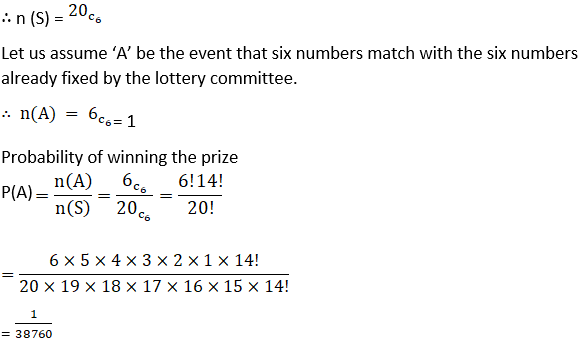
NCERT Soluitons for Class 11 Maths Chapter 16 Probability Image 11

Q12Written answer

Check whether the following probabilities P(A) and P(B) are consistently defined

(i) P(A) = 0.5, P(B) = 0.7, P(A ∩ B) = 0.6

(ii) P(A) = 0.5, P(B) = 0.4, P(A ∪ B) = 0.8

Show solutionHide solution
Worked solution

Solution:-

(i) P(A) = 0.5, P(B) = 0.7, P(A ∩ B) = 0.6

P(A ∩ B) > P(A)

Therefore, the given probabilities are not consistently defined.

(ii) P(A) = 0.5, P(B) = 0.4, P(A ∪ B) = 0.8

Then,

P(A ∪ B) = P(A) + P(B) – P(A ∩ B)

0.8 = 0.5 + 0.4 – P(A ∩ B)

Transposing – P(A ∩ B) to LHS, and it becomes P(A ∩ B) and 0.8 to RHS, and it becomes – 0.8.

P(A ∩ B) = 0.9 – 0.8

= 0.1

Therefore, P(A ∩ B) < P(A) and P(A ∩ B) < P(B)

So, the given probabilities are consistently defined.

Q13Written answer

Fill in the blanks in the following table.

P(A) P(B) P(A ∩ B) P(A ∪ B)
(i) 1/3 1/5 1/15 ….
(ii) 0.35 ….. 0.25 0.6
(iii) 0.5 0.35 …. 0.7
Show solutionHide solution
Worked solution

Solution:-

From the given table,

(i) P(A) = 1/3, P(B) = 1/5, P(A ∩ B) = 1/15, P(A ∪ B) = ?

We know that,

P(A ∪ B) = P(A) + P(B) – P(A ∩ B)

= (1/3) + (1/5) – (1/15)

= ((5 + 3)/15) – (1/15)

= (8/15) – (1/15)

= (8 – 1)/15

= 7/15

(ii) P(A) = 0.35, P(B) = ?, P(A ∩ B) = 0.25, P(A ∪ B) = 0.6

Then,

P(A ∪ B) = P(A) + P(B) – P(A ∩ B)

0.6 = 0.35 + P(B) – 0.25

Transposing – 0.25, 0.35 to LHS, and it becomes 0.25 and – 0.35.

P(B) = 0.6 + 0.25 – 0.35

= 0.5

(iii) P(A) = 0.5, P(B) = 0.35, P(A ∪ B) = 0.7, P(A ∩ B) = ?

Then,

P(A ∪ B) = P(A) + P(B) – P(A ∩ B)

0.7 = 0.5 + 0.35 – P(A ∩ B)

Transposing – P(A ∩ B) to LHS, and it becomes P(A ∩ B) and 0.7 to RHS, and it becomes – 0.7.

P(A ∩ B) = 0.85 – 0.7

= 0.15

Q14Written answer

Given P(A) = 5/3 and P(B) = 1/5 . Find P(A or B), if A and B are mutually exclusive events.

Show solutionHide solution
Worked solution

Solution:-

From the question, it is given that

P(A) = 5/3 and P(B) = 1/5

Then, P(A or B), if A and B are mutually exclusive.

P(A∪B) or P(A or B) = P(A) + P(B)

= (3/5) + (1/5)

= 4/5

Q15Written answer

If E and F are events such that P(E) = ¼ , P(F) = ½ and P(E and F) = 1/8, find

(i) P(E or F), (ii) P(not E and not F)

Show solutionHide solution
Worked solution

Solution:-

From the question, we have P(E) = ¼ , P(F) = ½ and P(E ∩ F) = 1/8

(i) P(E or F), i.e., P(E∪F) = P(E) + P(F) – P(E ∩ F)

= ¼ + ½ – (1/8)

= 5/8

NCERT Soluitons for Class 11 Maths Chapter 16 Probability Image 12

= 1 – (5/8)

= (8 – 5)/8

= 3/8

Q16Written answer

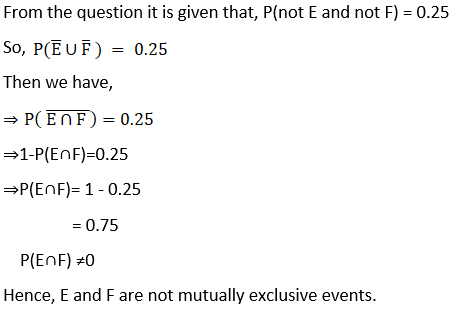
Events E and F are such that P(not E or not F) = 0.25. State whether E and F are mutually exclusive.

Show solutionHide solution
Worked solution

Solution:-

NCERT Soluitons for Class 11 Maths Chapter 16 Probability Image 13

Q17Written answer

A and B are events such that P(A) = 0.42, P(B) = 0.48 and P(A and B) = 0.16. Determine (i) P(not A), (ii) P(not B) and (iii) P(A or B)

Show solutionHide solution
Worked solution

Solution:-

From the question, it is given that P(A) = 0.42, P(B) = 0.48 and P(A and B) = 0.16.

(i) P(not A) = 1 – P(A)

= 1 – 0.42

= 0.58

(ii) P(not B) = 1 – P(B)

= 1 – 0.48

= 0.52

(iii) P(A not B) = P(A ∪ B) = P(A) + P(B) – P(A ∩ B)

= 0.42 + 0.48 – 0.16

= 0.74

Q18Written answer

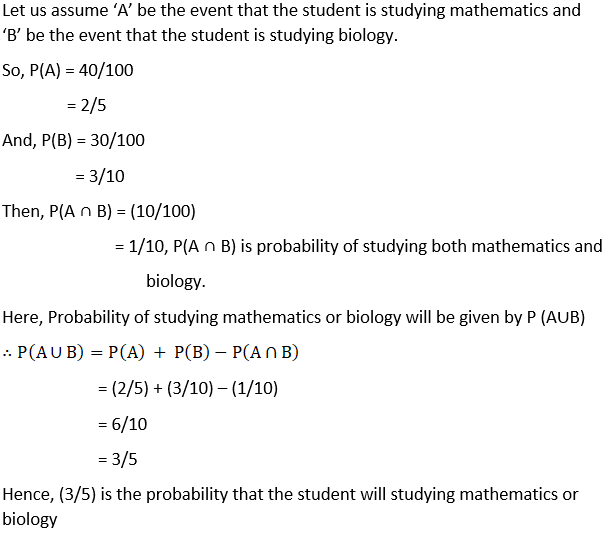
In Class XI of a school, 40% of the students study Mathematics and 30% study Biology. 10% of the class study both Mathematics and Biology. If a student is selected at random from the class, find the probability that he will be studying Mathematics or Biology.

Show solutionHide solution
Worked solution

Solution:-

NCERT Soluitons for Class 11 Maths Chapter 16 Probability Image 14

Q19Written answer

In an entrance test that is graded on the basis of two examinations, the probability of a randomly chosen student passing the first examination is 0.8, and the probability of passing the second examination is 0.7. The probability of passing at least one of them is 0.95. What is the probability of passing both?

Show solutionHide solution
Worked solution

Solution:-

Let us assume the probability of a randomly chosen student passing the first examination is 0.8 be P(A).

And also, assume the probability of passing the second examination is 0.7 be P(B).

Then,

P(A∪B) is the probability of passing at least one of the examinations.

Now,

P(A∪B) = 0.95 , P(A)=0.8, P(B)=0.7

∴ P(A∪B) = P(A) + P(B) – P(A∩B)

0.95 = 0.8 + 0.7 – P(A∩B)

Transposing – P(A ∩ B) to LHS, and it becomes P(A ∩ B) and 0.95 to RHS, and it becomes

– 0.95

P(A∩B) = 1.5 – 0.95

= 0.55

Hence, 0.55 is the probability that the student will pass both examinations.

Q20Written answer

The probability that a student will pass the final examination in both English and Hindi is 0.5, and the probability of passing neither is 0.1. If the probability of passing the English examination is 0.75, what is the probability of passing the Hindi examination?

Show solutionHide solution
Worked solution

Solution:-

Let us assume the probability of passing the English examination is 0.75 be P(A).

And also, assume the probability of passing the Hindi examination is P(B).

Here, given P(A) = 0.75, P(A∩B) – 0.5, P(AI∩BI) = 0.1

We know that, P(AI∩BI) = 1 – P(A∪B)

Then, P(A∪B) = 1 – P(AI∩BI)

= 1 – 0.1

= 0.9

∴ P(A∪B) = P(A) + P(B) – P(A∩B)

0.9 = 0.75 + P(B) – 0.5

Transposing 0.75, – 0.5 to LHS, and it becomes – 0.75, 0.5.

P(B) = 0.9 + 0.5 – 0.75

= 0.65