My Cart
Your Cart 0

    Your cart is empty.

  • Total (Amount) ₹0.00
NCERT · Class 11 · Maths

Chapter 16: Probability Exercise 16.2

Practice each question, then open the answer or worked solution.

Questions

7 questions
Q1Written answer

A die is rolled. Let E be the event “die shows 4” and F be the event “die shows even number”. Are E and F mutually exclusive?

Show solutionHide solution
Worked solution

Solution:-

Let us assume that 1, 2, 3, 4, 5 and 6 are the possible outcomes when the die is thrown.

So, S = (1, 2, 3, 4, 5, 6)

As per the conditions given in the question,

E be the event “die shows 4”.

E = (4)

F be the event “die shows even number”.

F = (2, 4, 6)

E∩F = (4) ∩ (2, 4, 6)

= 4

4 ≠ φ … [because there is a common element in E and F]

Therefore, E and F are not mutually exclusive events.

Q2Written answer

A die is thrown. Describe the following events.

(i) A: a number less than 7 (ii) B: a number greater than 7

(iii) C: a multiple of 3 (iv) D: a number less than 4

(v) E: an even number greater than 4 (vi) F: a number not less than 3

Also, find A ∪ B, A ∩ B, B ∪ C, E ∩ F, D ∩ E, A – C, D – E, E ∩ FI, FI

Show solutionHide solution
Worked solution

Solution:-

Let us assume that 1, 2, 3, 4, 5 and 6 are the possible outcomes when the die is thrown.

So, S = (1, 2, 3, 4, 5, 6)

As per the conditions given in the question,

(i) A: a number less than 7

All the numbers in the die are less than 7.

A = (1, 2, 3, 4, 5, 6)

(ii) B: a number greater than 7

There is no number greater than 7 on the die.

Then,

B= (φ)

(iii) C: a multiple of 3

There are only two numbers which are multiple of 3.

Then,

C= (3, 6)

(iv) D: a number less than 4

D= (1, 2, 3)

(v) E: an even number greater than 4

E = (6)

(vi) F: a number not less than 3

F= (3, 4, 5, 6)

Also, we have to find, A U B, A ∩ B, B U C, E ∩ F, D ∩ E, D – E, A – C, E ∩ F’, F’

So,

A ∩ B = (1, 2, 3, 4, 5, 6) ∩ (φ)

= (φ)

B U C = (φ) U (3, 6)

= (3, 6)

E ∩ F = (6) ∩ (3, 4, 5, 6)

= (6)

D ∩ E = (1, 2, 3) ∩ (6)

= (φ)

D – E = (1, 2, 3) – (6)

= (1, 2, 3)

A – C = (1, 2, 3, 4, 5, 6) –  (3, 6)

= (1, 2, 4, 5)

F’ = S – F

= (1, 2, 3, 4, 5, 6) – (3, 4, 5, 6)

= (1, 2)

E ∩ F’ = (6) ∩ (1, 2)

= (φ)

Q3Written answer

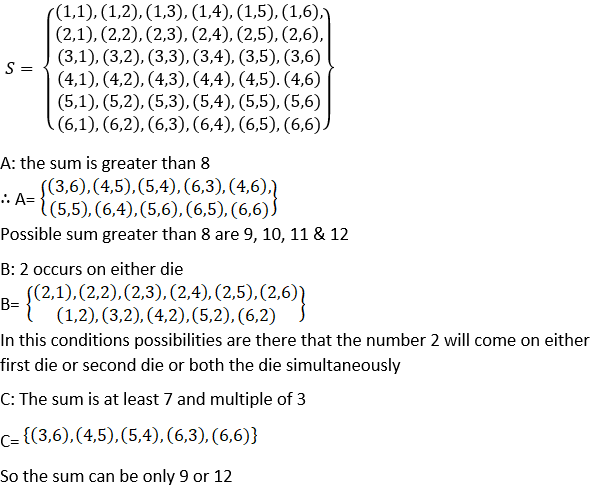
An experiment involves rolling a pair of dice and recording the numbers that come up. Describe the following events: A: the sum is greater than 8, B: 2 occurs on either die, C: the sum is at least 7 and a multiple of 3. Which pairs of these events are mutually exclusive?

Show solutionHide solution
Worked solution

Solution:-

Let us assume that 1, 2, 3, 4, 5 and 6 are the possible outcomes when the die is thrown.

In the question, it is given that pair of die is thrown, so sample space will be

NCERT Soluitons for Class 11 Maths Chapter 16 Probability Image 1

Now, we shall find whether pairs of these events are mutually exclusive or not.

(i) A∩ B = φ

There is no common element in A and B.

Therefore, A & B are mutually exclusive.

(ii) B ∩ C = φ

There is no common element between them.

Therefore, B and C are mutually exclusive.

(iii) A ∩ C {(3,6), (4,5), (5,4), (6,3), (6,6)}

⇒ {(3,6), (4,5), (5,4), (6,3), (6,6)} ≠ φ

A and C have common elements.

Therefore, A and C are mutually exclusive.

Q4Written answer

Three coins are tossed once. Let A denotes the event ‘three heads show”, B denotes the event “two heads and one tail show”, C denotes the event” three tails show and D denote the event ‘a head shows on the first coin”. Which events are

(i) Mutually exclusive? (ii) Simple? (iii) Compound?

Show solutionHide solution
Worked solution

Solution:-

Either coin can turn up Head (H) or Tail (T), are the possible outcomes.

But, now three coins are tossed once, so the possible sample space contains

S = {HHH, HHT, HTH, THH, HTT, THT, TTH, TTH}

Now,

A: ‘three heads’

A= (HHH)

B: “two heads and one tail”

B= (HHT, THH, HTH)

C: ‘three tails’

C= (TTT)

D: a head shows on the first coin

D= (HHH, HHT, HTH, HTT)

(i) Mutually exclusive

A ∩ B = (HHH) ∩ (HHT, THH, HTH)

= φ

Therefore, A and C are mutually exclusive.

A ∩ C = (HHH) ∩ (TTT)

= φ

There, A and C are mutually exclusive.

A ∩ D = (HHH) ∩ (HHH, HHT, HTH, HTT)

= (HHH)

A ∩ D ≠ φ

So they are not mutually exclusive.

B ∩ C = (HHT, HTH, THH) ∩ (TTT)

= φ

There is no common element in B & C, so they are mutually exclusive.

B ∩ D = (HHT, THH, HTH) ∩ (HHH, HHT, HTH, HTT)

= (HHT, HTH)

B ∩ D ≠ φ

There are common elements in B & D.

So, they are not mutually exclusive.

C ∩ D = (TTT) ∩ (HHH, HHT, HTH, HTT)

= φ

There is no common element in C & D.

So they are not mutually exclusive.

(ii) Simple event

If an event has only one sample point of a sample space, it is called a simple (or elementary) event.

A = (HHH)

C = (TTT)

Both A & C have only one element.

So they are simple events.

(iii) Compound events

If an event has more than one sample point, it is called a Compound event.

B= (HHT, HTH, THH)

D= (HHH, HHT, HTH, HTT)

Both B & D have more than one element.

So, they are compound events.

Q5Multiple choice

Three coins are tossed. Describe

(v) Three events which are mutually exclusive but not exhaustive.

Show solutionHide solution
Worked solution

Solution:-

Either coin can turn up Head (H) or Tail (T), are the possible outcomes.

But, now three coins are tossed once, so the possible sample space contains

S= (HHH, HHT, HTH, HTT, THH, THT, TTH, TTT)

(i) Two events which are mutually exclusive.

Let us assume A be the event of getting only head.

A = (HHH)

Also, let us assume B be the event of getting only Tail.

B = (TTT)

So, A ∩ B = φ

There is no common element in A& B, so these two are mutually exclusive.

(ii) Three events which are mutually exclusive and exhaustive

Now,

Let us assume P be the event of getting exactly two tails.

P = (HTT, TTH, THT)

Let us assume Q be the event of getting at least two heads.

Q = (HHT, HTH, THH, HHH)

Let us assume R be the event of getting only one tail.

C= (TTT)

P ∩ Q = (HTT, TTH, THT) ∩ (HHT, HTH, THH, HHH)

= φ

There is no common element in P and Q.

Therefore, they are mutually exclusive.

Q ∩ R = (HHT, HTH, THH, HHH) ∩ (TTT)

= φ

There is no common element in Q and R.

Hence, they are mutually exclusive.

P ∩ R = (HTT, TTH, THT) ∩ (TTT)

= φ

There is no common element in P and R.

So they are mutually exclusive.

Now, P and Q, Q and R, and P and R are mutually exclusive.

∴ P, Q, and R are mutually exclusive.

Also,

P ∪ Q ∪ R = (HTT, TTH, THT, HHT, HTH, THH, HHH, TTT) = S

Hence P, Q and R are exhaustive events.

(iii) Two events which are not mutually exclusive

Let us assume ‘A’ be the event of getting at least two heads.

A = (HHH, HHT, THH, HTH)

Let us assume ‘B’ be the event of getting only head.

B= (HHH)

Now A ∩ B = (HHH, HHT, THH, HTH) ∩ (HHH)

= (HHH)

A ∩ B ≠ φ

There is a common element in A and B.

So they are not mutually exclusive.

(iv) Two events which are mutually exclusive but not exhaustive

Let us assume ‘P’ be the event of getting only Head.

P = (HHH)

Let us assume ‘Q’ be the event of getting only tail.

Q = (TTT)

P ∩ Q = (HHH) ∩ (TTT)

= φ

There is no common element in P and Q.

So these are mutually exclusive events.

But,

P ∪ Q = (HHH) ∪ (TTT)

= {HHH, TTT}

P ∪ Q ≠ S

Since P ∪ Q ≠ S, these are not exhaustive events.

(v) Three events which are mutually exclusive but not exhaustive

Let us assume ‘X’ be the event of getting only head.

X = (HHH)

Let us assume ‘Y’ be the event of getting only tail.

Y = (TTT)

Let us assume ‘Z’ be the event of getting exactly two heads.

Z= (HHT, THH, HTH)

Now,

X ∩ Y = (HHH) ∩ (TTT)

= φ

X ∩ Z = (HHH) ∩ (HHT, THH, HTH)

= φ

Y ∩ Z = (TTT) ∩ (HHT, THH, HTH)

= φ

Therefore, they are mutually exclusive.

Also

X ∪ Y ∪ Z = (HHH TTT, HHT, THH, HTH)

X ∪ Y ∪ Z ≠ S

So, X, Y and Z are not exhaustive.

Hence, it is proved that X, Y and X are mutually exclusive but not exhaustive.
Q6Written answer

Two dice are thrown. The events A, B and C are as follows:

A: getting an even number on the first die.

B: getting an odd number on the first die.

C: getting the sum of the numbers on the dice ≤ 5.

Describe the events

(i) AI (ii) not B (iii) A or B

(iv) A and B (v) A but not C (vi) B or C

(vii) B and C (viii) A ∩ BI ∩ CI

Show solutionHide solution
Worked solution

Solution:-

Let us assume that 1, 2, 3, 4, 5 and 6 are the possible outcomes when the die is thrown.

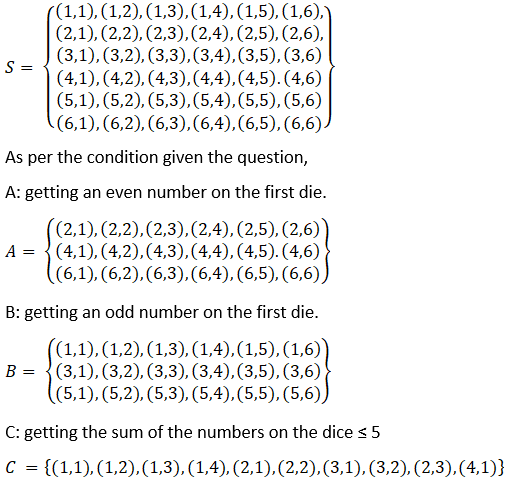
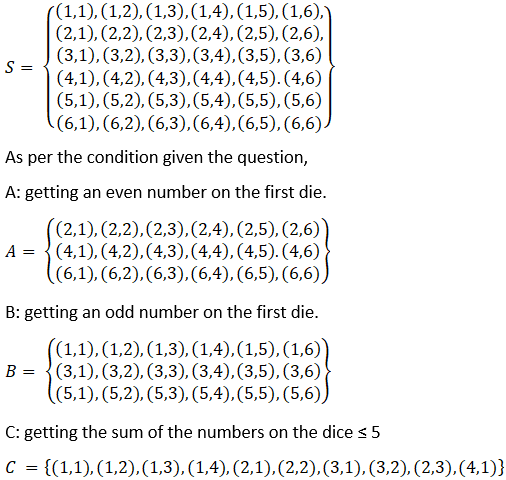
In the question, it is given that pair of die is thrown, so sample space will be

NCERT Soluitons for Class 11 Maths Chapter 16 Probability Image 2

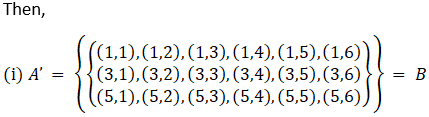
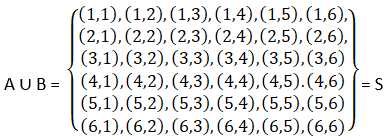
NCERT Soluitons for Class 11 Maths Chapter 16 Probability Image 3

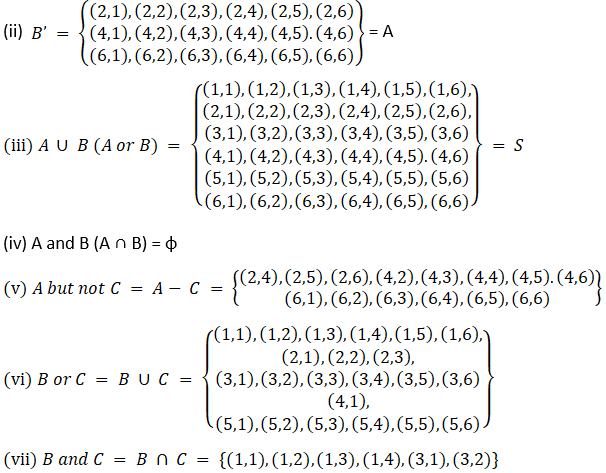
NCERT Soluitons for Class 11 Maths Chapter 16 Probability Image 4

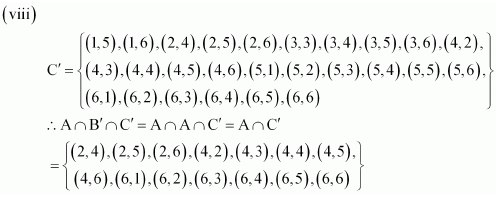
NCERT Soluitons for Class 11 Maths Chapter 16 Probability Image 5

Q7Written answer

Refer to question 6 above and state true or false. (Give reasons for your answer.)

(i) A and B are mutually exclusive.

(ii) A and B are mutually exclusive and exhaustive.

(iii) A = BI

(iv) A and C are mutually exclusive.

(v) A and BI are mutually exclusive.

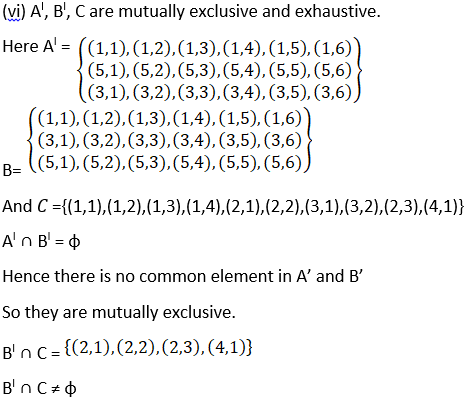
(vi) AI, BI, C are mutually exclusive and exhaustive.

Show solutionHide solution
Worked solution

Solution:-

Let us assume that 1, 2, 3, 4, 5 and 6 are the possible outcomes when the die is thrown.

In the question is given that pair of die is thrown, so sample space will be

By referring the question 6 above,

NCERT Soluitons for Class 11 Maths Chapter 16 Probability Image 6

(i) A and B are mutually exclusive.

So, (A ∩ B) = φ

So, A & B are mutually exclusive.

Hence, the given statement is true.

(ii) A and B are mutually exclusive and exhaustive.

NCERT Soluitons for Class 11 Maths Chapter 16 Probability Image 7

⇒ A ∪ B = S

From statement (i), we have A and B are mutually exclusive.

∴ A and B are mutually exclusive and exhaustive.

Hence, the statement is true.

(iii) A = B

NCERT Soluitons for Class 11 Maths Chapter 16 Probability Image 8

Therefore, the statement is true.

(iv) A and C are mutually exclusive.

We have,

A ∩ C = {(2, 1), (2, 2), (2, 3), (4, 1)}

A ∩ C ≠ φ

A and C are not mutually exclusive.

Hence, the given statement is false.

(v) A and BI are mutually exclusive.

We have,

A ∩ BI = A ∩ A = A

∴ A ∩ BI ≠ φ

So, A and BI are not mutually exclusive.

Therefore, the given statement is false.

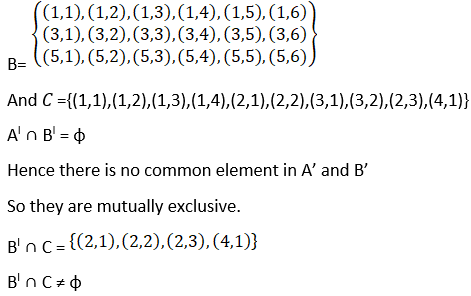
NCERT Soluitons for Class 11 Maths Chapter 16 Probability Image 9

NCERT Soluitons for Class 11 Maths Chapter 16 Probability Image 10

They are not mutually exclusive.

BI and C are not mutually exclusive.

Therefore A’, B’ and C are not mutually exclusive and exhaustive.

So, the given statement is false.