My Cart
Your Cart 0

    Your cart is empty.

  • Total (Amount) ₹0.00
NCERT · Class 11 · Chemistry

Chapter 7: Redox Reactions

Practice each question, then open the answer or worked solution.

Questions

30 questions
Q11Written answer

Whenever a reaction between an oxidising agent and a reducing agent is carried out, a compound of lower oxidation state is formed if the reducing agent is in excess and a compound of higher oxidation state is formed if the oxidising agent is in excess. Justify this statement giving three illustrations.

Justify the above statement with three examples.

Show solutionHide solution
Worked solution

When there is a reaction between a reducing agent and an oxidizing agent, a compound is formed, which has a lower oxidation number if the reducing agent is in excess. A compound is formed which has a higher oxidation number if the oxidizing agent is in excess.

(i)

\(\begin{array}{l}P_{ 4 }\end{array} \)
and
\(\begin{array}{l}F_{ 2 }\end{array} \)
are reducing and oxidizing agent respectively.

In an excess amount of

\(\begin{array}{l}P_{ 4 }\end{array} \)
is reacted with
\(\begin{array}{l}F_{ 2 }\end{array} \)
, then
\(\begin{array}{l}PF_{ 3 }\end{array} \)
would be produced, where the oxidation no. of P is +3.

\(\begin{array}{l}P_{ 4 } \; _{(excess)}\; + \; F_{ 2 } \; \rightarrow \; PF_{ 3 }\end{array} \)

If

\(\begin{array}{l}P_{ 4 }\end{array} \)
is reacted with excess of
\(\begin{array}{l}F_{ 2 }\end{array} \)
, then
\(\begin{array}{l}PF_{ 5 }\end{array} \)
would be produced, where the oxidation no. of P is +5.

\(\begin{array}{l}P_{ 4 } \; + \; F_{ 2 } \; _{(excess)} \; \rightarrow \; PF_{ 5 }\end{array} \)

(ii) K and

\(\begin{array}{l}O_{ 2 }\end{array} \)
acts as a reducing agent and oxidizing agent respectively.

If an excess of K reacts with

\(\begin{array}{l}O_{ 2 }\end{array} \)
, it produces
\(\begin{array}{l}K_{ 2 }O\end{array} \)
. Here, the oxidation number of O is -2.

\(\begin{array}{l}4 \; K \; _{(excess)} \; + \; O_{ 2 } \; \rightarrow \; 2 \; K_{ 2 }O^{ -2 }\end{array} \)

If K reacts with an excess of

\(\begin{array}{l}O_{ 2 }\end{array} \)
, it produces
\(\begin{array}{l}K_{ 2 }O_{ 2 }\end{array} \)
, where the oxidation number of O is –1.

\(\begin{array}{l}2 \; K \; + \; O_{ 2 } \; _{(excess)} \; \rightarrow \; K_{ 2 }O_{ 2 }^{ -1 }\end{array} \)

(iii) C and

\(\begin{array}{l}O_{ 2 }\end{array} \)
acts as a reducing agent and oxidizing agent respectively.

If an excess amount of C is reacted with an insufficient amount of

\(\begin{array}{l}O_{ 2 }\end{array} \)
, then it produces CO, where the oxidation number of C is +2.

\(\begin{array}{l}C \; _{(excess)} \; + \; O_{ 2 } \; \rightarrow \; CO\end{array} \)

If C is burnt in excess amount of

\(\begin{array}{l}O_{ 2 }\end{array} \)
, then
\(\begin{array}{l}CO_{ 2 }\end{array} \)
is produced, where the oxidation number of C is +4.

\(\begin{array}{l}C \; + \; O_{ 2 } \; _{(excess)} \; \rightarrow \; CO_{ 2 }\end{array} \)


Q12Written answer

How do you count for the following observations?

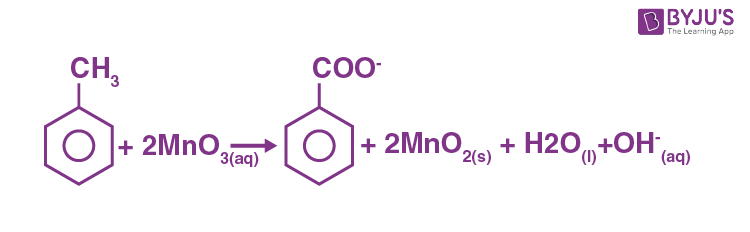
(a) Though alkaline potassium permanganate and acidic potassium permanganate both are used as oxidants, yet in the manufacture of benzoic acid from toluene we use alcoholic potassium permanganate as an oxidant. Why? Write a balanced redox equation for the reaction.

(b) When concentrated sulphuric acid is added to an inorganic mixture containing chloride, we get colourless pungent smelling gas HCl, but if the mixture contains bromide then we get red vapour of bromine. Why?

Show solutionHide solution
Worked solution

(a) While manufacturing benzoic acid from toluene, alcoholic potassium permanganate is used as an oxidant due to the given reasons.

(i) In a neutral medium,

\(\begin{array}{l}OH^{ – }\end{array} \)
ions are produced in the reaction. Due to that, the cost of adding an acid or a base can be reduced.

(ii)

\(\begin{array}{l}KMnO_{ 4 }\end{array} \)
and alcohol are homogeneous to each other as they are polar. Alcohol and toluene are homogeneous to each other because both are organic compounds. Reactions can proceed at a faster rate in a homogeneous medium compared to a heterogeneous medium. Therefore, in alcohol,
\(\begin{array}{l}KMnO_{ 4 }\end{array} \)
and toluene can react at a faster rate.

The redox reaction is as given below:

NCERT Solutions for Class 11 Chemistry- Chapter 8 Redox Reactions Q.12(a)


(b) When concentrated

\(\begin{array}{l}H_{ 2 }SO_{ 4 }\end{array} \)
is added to an inorganic mixture containing bromide, firstly HBr is produced. HBr, a strong reducing agent, reduces
\(\begin{array}{l}H_{ 2 }SO_{ 4 }\end{array} \)
to
\(\begin{array}{l}SO_{ 2 }\end{array} \)
with the evolution of bromine’s red vapour.

\(\begin{array}{l}2 \; NaBr \; + \; 2 \; H_{ 2 }SO_{ 4 } \; \rightarrow \; 2 \; NaHSO_{ 4 } \; + \; 2 \; HBr\end{array} \)

\(\begin{array}{l}2 \; HBr \; + \; H_{ 2 }SO_{ 4 } \; \rightarrow \; Br_{ 2 } \; + \; SO_{ 2 } \; + \; 2 \; H_{ 2 }O\end{array} \)

When concentrated

\(\begin{array}{l}H_{ 2 }SO_{ 4 }\end{array} \)
I added to an inorganic mixture containing chloride, a pungent smelling gas (HCl) is evolved. HCl, a weak reducing agent, cannot reduce
\(\begin{array}{l}H_{ 2 }SO_{ 4 }\end{array} \)
to
\(\begin{array}{l}SO_{ 2 }\end{array} \)
.

\(\begin{array}{l}2 \; NaCl \; + \; 2 \; H_{ 2 }SO_{ 4 } \; \rightarrow \; 2 \; NaHSO_{ 4 } \; + \; 2 \; HCl\end{array} \)


Q13Written answer

Identify the substance oxidised, reduced, oxidising agent and reducing agent for each of the following reactions:

(a)

\(\begin{array}{l}2 \; AgBr_{ (s) } \; + \; C_{ 6 }H_{ 6 }O_{ 2 \; (aq) } \; \rightarrow \; 2 \; Ag_{ (s) } \; + \; 2 \; HBr_{ (aq)} \; + \; C_{ 6 }H_{ 4 }O_{ 2 \; (aq) }\end{array} \)

(b)

\(\begin{array}{l}HCHO_{ (l) } \; + \; 2 \; [Ag(NH_{ 3 })_{ 2 }]^{ + }_{ (aq) } \; + \; 3 \; OH^{ – }_{ (aq) } \; \rightarrow \; 2 \; Ag_{ (s) } \; + \; HCOO^{ – }_{ (aq) } \; + \; 4 \; NH_{ 3 \; (aq) } \; + \; 2 \; H_{ 2 }O_{ (l) }\end{array} \)

(c)

\(\begin{array}{l}HCHO_{ (l) } \; + \; 2 \; Cu^{ 2+ }_{ (aq) } \; + \; 5 \; OH^{ – }_{ (aq) } \; \rightarrow \; Cu_{ 2 }O_{ (s) } \; + \; HCOO^{ – }_{ (aq) } \; + \; 3 \; H_{ 2 }O_{ (l) }\end{array} \)

(d)

\(\begin{array}{l}N_{ 2 }H_{ 4 \; (l) } \; + \; 2 \; H_{ 2 }O_{ 2 \; (l) } \; \rightarrow \; N_{ 2 \; (g) } \; + \; 4 \; H_{ 2 }O_{ (l) }\end{array} \)

(e)

\(\begin{array}{l}Pb_{ (s) } \; + \; PbO_{ 2 \; (s) } \; + \; 2 \; H_{ 2 }SO_{ 4 \; (aq) } \; \rightarrow \; 2 \; PbSO_{ 4 \; (aq) } \; + \; 2 \; H_{ 2 }O_{ (l) }\end{array} \)

Show solutionHide solution
Worked solution

(a)

\(\begin{array}{l}2 \; AgBr_{ (s) } \; + \; C_{ 6 }H_{ 6 }O_{ 2 \; (aq) } \; \rightarrow \; 2 \; Ag_{ (s) } \; + \; 2 \; HBr_{ (aq)} \; + \; C_{ 6 }H_{ 4 }O_{ 2 \; (aq) }\end{array} \)

\(\begin{array}{l}C_{ 6 }H_{ 6 }O_{ 2 }\end{array} \)
=> Oxidized substance

AgBr => Reduced substance

AgBr =>Oxidizing agent

\(\begin{array}{l}C_{ 6 }H_{ 6 }O_{ 2 }\end{array} \)
=> Reducing agent

(b)

\(\begin{array}{l}HCHO_{ (l) } \; + \; 2 \; [Ag(NH_{ 3 })_{ 2 }]^{ + }_{ (aq) } \; + \; 3 \; OH^{ – }_{ (aq) } \; \rightarrow \; 2 \; Ag_{ (s) } \; + \; HCOO^{ – }_{ (aq) } \; + \; 4 \; NH_{ 3 \; (aq) } \; + \; 2 \; H_{ 2 }O_{ (l) }\end{array} \)

HCHO => Oxidized substance

\(\begin{array}{l}[Ag(NH_{ 3 })_{ 2 }]^{ + }\end{array} \)
=> Reduced substance

\(\begin{array}{l}[Ag(NH_{ 3 })_{ 2 }]^{ + }\end{array} \)
=> Oxidizing agent

HCHO=> Reducing agent

(c)

\(\begin{array}{l}HCHO_{ (l) } \; + \; 2 \; Cu^{ 2+ }_{ (aq) } \; + \; 5 \; OH^{ – }_{ (aq) } \; \rightarrow \; Cu_{ 2 }O_{ (s) } \; + \; HCOO^{ – }_{ (aq) } \; + \; 3 \; H_{ 2 }O_{ (l) }\end{array} \)

HCHO => Oxidized substance

\(\begin{array}{l}Cu^{ 2+ }\end{array} \)
=> Reduced substance

\(\begin{array}{l}Cu^{ 2+ }\end{array} \)
=> Oxidizing agent

HCHO => Reducing agent

(d)

\(\begin{array}{l}N_{ 2 }H_{ 4 \; (l) } \; + \; 2 \; H_{ 2 }O_{ 2 \; (l) } \; \rightarrow \; N_{ 2 \; (g) } \; + \; 4 \; H_{ 2 }O_{ (l) }\end{array} \)

\(\begin{array}{l}N_{ 2 }H_{ 4 }\end{array} \)
=> Oxidized substance

\(\begin{array}{l}H_{ 2 }O_{ 2 }\end{array} \)
=> Reduced substance

\(\begin{array}{l}H_{ 2 }O_{ 2 }\end{array} \)
=> Oxidizing agent

\(\begin{array}{l}N_{ 2 }H_{ 4 }\end{array} \)
=> Reducing agent

(e)

\(\begin{array}{l}Pb_{ (s) } \; + \; PbO_{ 2 \; (s) } \; + \; 2 \; H_{ 2 }SO_{ 4 \; (aq) } \; \rightarrow \; 2 \; PbSO_{ 4 \; (aq) } \; + \; 2 \; H_{ 2 }O_{ (l) }\end{array} \)

Pb=> Oxidized substance

\(\begin{array}{l}PbO_{ 2 }\end{array} \)
=> Reduced substance

\(\begin{array}{l}PbO_{ 2 }\end{array} \)
=> Oxidizing agent

Pb => Reducing agent


Q14Written answer

Consider the reactions :

\(\begin{array}{l}2 \; S_{ 2 }O^{ 2- }_{ 3 \; (aq) } \; + \; I_{ 2 \; (s) } \; \rightarrow \; S_{ 4 }O^{ 2- }_{ 6 \; (aq) } \; + \; 2 \; I^{ – }_{ (aq) }\end{array} \)

\(\begin{array}{l}S_{ 2 }O^{ 2- }_{ 3 \; (aq) } \; + \; 2 \; Br_{ 2 \; (l) } \; + \; 5 \; H_{ 2 }O_{ (l) } \; \rightarrow \; 2 \; SO^{ 2- }_{ 4 \; (aq) } \; + \; 4 \; Br^{ – }_{ (aq) } \; + \; 10 \; H^{ + }_{ (aq) }\end{array} \)

Why does the same reductant, thiosulphate react differently with iodine and bromine ?

Show solutionHide solution
Worked solution


The average oxidation no. of S in

\(\begin{array}{l}S_{ 2 }O_{ 3 }^{ 2- }\end{array} \)
is +2.

The average oxidation no. of S in

\(\begin{array}{l}S_{ 4 }O_{ 6 }^{ 2- }\end{array} \)
is +2.5.

The oxidation no. of S in

\(\begin{array}{l}S_{ 2 }O_{ 3 }^{ 2- }\end{array} \)
is +2.

The oxidation no. of S in

\(\begin{array}{l}SO_{ 4 }^{ 2- }\end{array} \)
is +6.

As

\(\begin{array}{l}Br_{ 2 }\end{array} \)
is a stronger oxidizing agent than
\(\begin{array}{l}I_{ 2 }\end{array} \)
, it oxidizes S of  
\(\begin{array}{l}S_{ 2 }O_{ 3 }^{ 2- }\end{array} \)
to a higher oxidation no. of +6 in
\(\begin{array}{l}SO_{ 4 }^{ 2- }\end{array} \)
.

As

\(\begin{array}{l}I_{ 2 }\end{array} \)
is a weaker oxidizing agent, it oxidizes S of
\(\begin{array}{l}S_{ 2 }O_{ 3 }^{ 2- }\end{array} \)
ion to a lower oxidation no. that is 2.5 in
\(\begin{array}{l}S_{ 4 }O_{ 6 }^{ 2- }\end{array} \)
ions.

Thus, thiosulphate reacts differently with

\(\begin{array}{l}I_{ 2 }\end{array} \)
and
\(\begin{array}{l}Br_{ 2 }\end{array} \)
.


Q15Written answer

Justify giving reactions that among halogens, fluorine is the best oxidant and among hydrohalic compounds, hydroiodic acid is the best reductant.

Show solutionHide solution
Worked solution

\(\begin{array}{l}F_{ 2 }\end{array} \)
can oxidize
\(\begin{array}{l}Cl^{ – }\end{array} \)
to
\(\begin{array}{l}Cl_{ 2 }\end{array} \)
,
\(\begin{array}{l}Br^{ – }\end{array} \)
to
\(\begin{array}{l}Br_{ 2 }\end{array} \)
, and
\(\begin{array}{l}I^{ – }\end{array} \)
to
\(\begin{array}{l}I_{ 2 }\end{array} \)
as:

\(\begin{array}{l}F_{ 2 \; (aq) } \; + \; 2 \; Cl^{ – }_{ (s) } \; \rightarrow \; 2 \; F^{ – }_{ (aq) } \; + \; Cl_{ 2 \; (g) }\end{array} \)

\(\begin{array}{l}F_{ 2 \; (aq) } \; + \; 2 \; Br^{ – }_{ (aq) } \; \rightarrow \; 2 \; F^{ – }_{ (aq) } \; + \; Br_{ 2 \; (l) }\end{array} \)

\(\begin{array}{l}F_{ 2 \; (aq) } \; + \; 2 \; I^{ – }_{ (aq) } \; \rightarrow \; 2 \; F^{ – }_{ (aq) } \; + \; I_{ 2 \; (s) }\end{array} \)

But,

\(\begin{array}{l}Cl_{ 2 }\end{array} \)
,
\(\begin{array}{l}Br_{ 2 }\end{array} \)
, and
\(\begin{array}{l}I_{ 2 }\end{array} \)
cannot oxidize
\(\begin{array}{l}F^{ – }\end{array} \)
to
\(\begin{array}{l}F_{ 2 }\end{array} \)
. The oxidizing power of halogens increases in the order as given below:

\(\begin{array}{l}I_{ 2 }\end{array} \)
<
\(\begin{array}{l}Br_{ 2 }\end{array} \)
<
\(\begin{array}{l}Cl_{ 2 }\end{array} \)
<
\(\begin{array}{l}F_{ 2 }\end{array} \)

Therefore, fluorine is the best oxidant among halogens.

\(\begin{array}{l}HI\end{array} \)
and
\(\begin{array}{l}HBr\end{array} \)
can reduce
\(\begin{array}{l}H_{ 2 }SO_{ 4 }\end{array} \)
to
\(\begin{array}{l}SO_{ 2 }\end{array} \)
, but
\(\begin{array}{l}HCl\end{array} \)
and
\(\begin{array}{l}HF\end{array} \)
cannot. Hence,
\(\begin{array}{l}HI\end{array} \)
and
\(\begin{array}{l}HBr\end{array} \)
are stronger reductants compared to
\(\begin{array}{l}HCl\end{array} \)
and
\(\begin{array}{l}HF\end{array} \)
.

\(\begin{array}{l}2 \; HI \; + \; H_{ 2 }SO_{ 4 } \; \rightarrow \; I_{ 2 } \; + \; SO_{ 2 } \; + \; 2 \; H_{ 2 }O\end{array} \)

\(\begin{array}{l}2 \; HBr \; + \; H_{ 2 }SO_{ 4 } \; \rightarrow \; Br_{ 2 } \; + \; SO_{ 2 } \; + \; 2 \; H_{ 2 }O\end{array} \)

\(\begin{array}{l}I^{ – }\end{array} \)
can reduce
\(\begin{array}{l}Cu^{ 2+ }\end{array} \)
to
\(\begin{array}{l}Cu^{ + }\end{array} \)
, but
\(\begin{array}{l}Br^{ – }\end{array} \)
cannot.

\(\begin{array}{l}4 \; I^{ – }_{ (aq) } \; + \; 2 \; Cu^{ 2+ }_{ (aq) } \; \rightarrow \; Cu_{ 2 }I_{ 2 \; (s) } \; + \; I_{ 2 \; (aq) }\end{array} \)

Therefore, hydrochloric acid is the best reductant among hydrohalic compounds.

Hence, the reducing power of hydrohalic acids increases as given below:

\(\begin{array}{l}HF\end{array} \)
<
\(\begin{array}{l}HCl\end{array} \)
<
\(\begin{array}{l}HBr\end{array} \)
<
\(\begin{array}{l}HI\end{array} \)


Q16Written answer

Why does the following reaction occur?

\(\begin{array}{l}XeO^{ 4- }_{ 6 \; (aq) } \; + \; 2 \; F^{ – }_{ (aq) } \; + \; 6 \; H^{ + }_{ (aq) } \; \rightarrow \; XeO_{ 3 \; (g) } \; + \; F_{ 2 \; (g) } \; + \; 3 \; H_{ 2 }O_{ (l) }\end{array} \)

What conclusion about the compound

\(\begin{array}{l}Na_{ 4 }XeO_{ 6 }\end{array} \)
( of which
\(\begin{array}{l}XeO_{ 6 }^{ 4- }\end{array} \)
is a part) can be drawn from the reaction?

Show solutionHide solution
Worked solution

\(\begin{array}{l}XeO^{ 4- }_{ 6 \; (aq) } \; + \; 2 \; F^{ – }_{ (aq) } \; + \; 6 \; H^{ + }_{ (aq) } \; \rightarrow \; XeO_{ 3 \; (g) } \; + \; F_{ 2 \; (g) } \; + \; 3 \; H_{ 2 }O_{ (l) }\end{array} \)

The oxidation no. of Xe reduces from +8 in

\(\begin{array}{l}XeO_{ 6 }^{ 4- }\end{array} \)
to +6 in
\(\begin{array}{l}XeO_{ 3 }\end{array} \)
.

The oxidation no. of F increases from -1 in

\(\begin{array}{l}F^{ – }\end{array} \)
to 0 in
\(\begin{array}{l}F_{ 2 }\end{array} \)
.

Hence,

\(\begin{array}{l}XeO_{ 6 }^{ 4- }\end{array} \)
is reduced on the other hand
\(\begin{array}{l}F^{ – }\end{array} \)
is oxidized. As
\(\begin{array}{l}Na_{ 2 }XeO_{ 6 }^{ 4- }\end{array} \)
(or
\(\begin{array}{l}XeO_{ 6 }^{ 4- }\end{array} \)
) is a stronger oxidizing agent compared to
\(\begin{array}{l}F_{ 2 }\end{array} \)
, this reaction occurs.


Q17Written answer

Consider the reactions:

(a)

\(\begin{array}{l}H_{ 3 }PO_{ 2 \; (aq) } \; + \; 4 \; AgNO_{ 3 \; (aq) } \; + \; 2 \; H_{ 2 }O_{ (l) } \; \rightarrow \; H_{ 3 }PO_{ 4 \; (aq) } \; + \; 4 \; Ag_{ (s) } \; + \; 4 \; HNO_{ 3 \; (aq) }\end{array} \)

(b)

\(\begin{array}{l}H_{ 3 }PO_{ 2 \; (aq) } \; + \; 2 \; CuSO_{ 4 \; (aq) } \; + \; 2 \; H_{ 2 }O_{ (l) } \; \rightarrow \; H_{ 3 }PO_{ 4 \; (aq) } \; + \; 2 \; Cu_{ (s) } \; + \; H_{ 2 }SO_{ 4 \; (aq) }\end{array} \)

(c)

\(\begin{array}{l}C_{ 6 }H_{ 5 }CHO_{ (l) } \; + \; 2 \; [Ag(NH_{ 3 })_{ 2 }]^{ + }_{ (aq) } \; + \; 3 \; OH^{ – }_{ (aq) } \; \rightarrow \; C_{ 6 }H_{ 5 }COO^{ – }_{(aq)} \; + \; 2\; Ag_{ (s) } \; + \; 4 \; NH_{ 3 \; (aq)} \; + \; 2 \; H_{ 2 }O_{ (l) }\end{array} \)

(d)

\(\begin{array}{l}C_{ 6 }H_{ 5 }CHO_{ (l) } \; + \; 2 \; Cu^{ 2+ }_{ (aq) } \; + \; 5 \; OH^{ – }_{ (aq) } \; \rightarrow\end{array} \)
No change is observed

What inference do you draw about the behavior of

\(\begin{array}{l}Ag^{ + }\end{array} \)
and
\(\begin{array}{l}Cu^{ 2+ }\end{array} \)
from these reactions?

Show solutionHide solution
Worked solution

\(\begin{array}{l}Ag^{ + }\end{array} \)
and
\(\begin{array}{l}Cu^{ 2+ }\end{array} \)
behave as oxidizing agents in reactions (i) and (ii), respectively.

In reaction (iii),

\(\begin{array}{l}Ag^{ + }\end{array} \)
oxidizes
\(\begin{array}{l}C_{ 6 }H_{ 5 }CHO\end{array} \)
to
\(\begin{array}{l}C_{ 6 }H_{ 5 }COO^{ – }\end{array} \)

In reaction (iv),

\(\begin{array}{l}Cu^{ 2+ }\end{array} \)
cannot oxidize
\(\begin{array}{l}C_{ 6 }H_{ 5 }CHO\end{array} \)
.

Therefore,

\(\begin{array}{l}Ag^{ + }\end{array} \)
is a stronger oxidizing agent compared to
\(\begin{array}{l}Cu^{ 2+ }\end{array} \)
.


Q18Written answer

Balance the following redox reactions by ion – electron method :

(a)

\(\begin{array}{l}MnO^{ – }_{ 4 \; (aq) } \; + \; I_{ (aq) }^{ – } \; \rightarrow \; MnO_{ 2 \; (s) } \; + \; I_{ 2 \; (s) }\end{array} \)
(Basic medium)

(b)

\(\begin{array}{l}MnO^{ – }_{ 4 \; (aq) } \; + \; SO_{ 2 \; (g) } \; \rightarrow \; Mn^{ 2+ }_{ (aq) } \; + \; H_{ 2 }SO_{ 4 }^{ – }\end{array} \)
(Acidic medium)

(c)

\(\begin{array}{l}H_{ 2 }O_{ 2 \; (aq) } \; + \; Fe^{ 2+ }_{ (aq) } \; \rightarrow \; Fe_{ (aq) }^{ 3+ } \; + \; H_{ 2 }O_{ (l) }\end{array} \)
(Acidic medium)

(d)

\(\begin{array}{l}Cr_{ 2 }^{ 2- }O_{ 7 \; (aq) } \; + \; SO_{ 2 \; (g) } \; \rightarrow \; Cr^{ 3+ }_{ (aq) } \; + \; SO^{ 2- }_{ (aq) }\end{array} \)
(Acidic medium)

Show solutionHide solution
Worked solution

(a)

\(\begin{array}{l}MnO^{ – }_{ 4 \; (aq) } \; + \; I_{ (aq) }^{ – } \; \rightarrow \; MnO_{ 2 \; (s) } \; + \; I_{ 2 \; (s) }\end{array} \)

Step 1

The two half-reactions are given below:

Oxidation half-reaction:

\(\begin{array}{l}I_{ (aq) } \; \rightarrow \; I_{ 2 \; (s) }\end{array} \)

Reduction half-reaction:

\(\begin{array}{l}MnO_{ 4 }^{ – } \; \rightarrow \; MnO_{ 2 }\end{array} \)

Step 2

Balance I in oxidation half-reaction:

\(\begin{array}{l}2 \; I^{ – }_{(aq)} \; \rightarrow \; I_{ 2 \; (s) }\end{array} \)

Add 2

\(\begin{array}{l}e^{ – }\end{array} \)
to the right-hand side of the reaction to balance the charge:

\(\begin{array}{l}2I^{ – }_{ (aq) } \; \rightarrow \; I_{ 2 \; (s) } \; + \; 2 \; e^{ – }\end{array} \)

Step 3

The oxidation no. of Mn has decreased from +7 to +4 in the reduction half-reaction. Therefore, 3 electrons are added to the left-hand side of the reaction.

\(\begin{array}{l}MnO^{ – }_{ 4 \; (aq) } \; + \; 3 \; e^{ – } \; \rightarrow \; MnO_{ 2 \; (aq)}\end{array} \)

Add 4

\(\begin{array}{l}OH^{ – }\end{array} \)
ions to the right-hand side of the reaction to balance the charge.

\(\begin{array}{l}MnO^{ – }_{ 4 \; (aq) } \; + \; 3 \; e^{ – } \; \rightarrow \; MnO_{ 2 \;(aq)} \; + \; 4 \; OH^{ – }\end{array} \)

Step 4

There are 6 oxygen atoms on the right-hand side and 4 oxygen atoms on the left-hand side. Hence, 2 water molecules are added to the left-hand side.

\(\begin{array}{l}MnO^{ – }_{ 4 \; (aq) } \; + \; 2 \; H_{ 2 }O \; + \; 3\; e^{ – }\; \rightarrow \; MnO_{ 2 \; (aq) } \; + \; 4 OH^{ – }\end{array} \)

Step 5

Equal the no. of electrons on both sides by multiplying the oxidation half-reaction by 3 and the reduction half-reaction by 2:

\(\begin{array}{l}6 \; I_{ (aq) }^{ – } \; \rightarrow \; 3 \; I_{ 2 \; (s)} \; + \; 6 \; e^{ – }\end{array} \)

\(\begin{array}{l}2 \; MnO^{ – }_{ 4 \; (aq) } \; + \; 4 \; H_{ 2 }O \; + \; 6\; e^{ – } \; \rightarrow 2 \; MnO_{ 2 \; (s)} \; + \; 8\; OH^{ – }_{ (aq) }\end{array} \)

Step 6

After adding both the half-reactions, we get the balanced reaction as given below:

\(\begin{array}{l}6 \; I_{ (aq) }^{ – } \; + \; 2 \; MnO^{ – }_{ 4 \; (aq) } \;+ \; 4 \; H_{ 2 }O_{ (l) } \; \rightarrow \; 3 \; I_{ 2 \; (s)} \; + \; 2 \; MnO_{ 2 \; (s)} \; + \; 8\; OH^{ – }_{ (aq) }\end{array} \)

(b)

\(\begin{array}{l}MnO^{ – }_{ 4 \; (aq) } \; + \; SO_{ 2 \; (g) } \; \rightarrow \; Mn^{ 2+ }_{ (aq) } \; + \; H_{ 2 }SO_{ 4 }^{ – }\end{array} \)

Step 1

Similar to (i), the oxidation half-reaction is:

\(\begin{array}{l}SO_{ 2 \; (g) } \; + \; 2\; H_{ 2 }O_{ (l) } \; \rightarrow \; HSO^{ – }_{ 4 \; (aq) } \; + \; 3 \; H^{ + }_{ (aq) } \; + \; 2 \; e^{ – }_{ (aq) }\end{array} \)

Step 2

Reduction half-reaction is:

\(\begin{array}{l}MnO^{ – }_{ 4 \; (aq) } \; + \; 8\; H^{ + }_{ (aq) } \; + \; 5 \; e^{ – } \; \rightarrow \; Mn^{ 2+ }_{ (aq) } \; + \; 4 \; H_{ 2 }O_{ (l) }\end{array} \)

Step 3

Multiply the oxidation half-reaction with 5 and the reduction half-reaction with 2, then add them. We get the balanced reaction as given below:

\(\begin{array}{l}2 \; MnO^{ – }_{ 4 \; (aq) } \; + \; 5 \; SO_{ 2 \; (g) } \; + \; 2\; H_{ 2 }O_{ (l) } \; +\; H^{ + }_{ (aq) } \; \rightarrow \; 2 \; Mn^{ 2+ }_{ (aq) } \; + \; 5 \; HSO^{ – }_{ 4 \; (aq) }\end{array} \)

(c)

\(\begin{array}{l}H_{ 2 }O_{ 2 \; (aq) } \; + \; Fe^{ 2+ }_{ (aq) } \; \rightarrow \; Fe_{ (aq) }^{ 3+ } \; + \; H_{ 2 }O_{ (l) }\end{array} \)

Step 1

Similar to (i), oxidation half-reaction is:

\(\begin{array}{l}Fe^{ 2+ }_{ (aq) } \; \rightarrow \; Fe_{ (aq) }^{ 3+ } \; + \; e^{ – }\end{array} \)

Step 2

Reduction half-reaction is:

\(\begin{array}{l}H_{ 2 }O_{ 2 \; (aq) } \; + \; 2\; H_{ (aq) }^{ + } \; + \; 2\; e^{ – } \; \rightarrow \; 2\; H_{ 2 }O_{ (l) }\end{array} \)

Step 3

Multiply the oxidation half-reaction with 2 then add it to the reduction half-reaction. We get the balanced reaction as given below:

\(\begin{array}{l}H_{ 2 }O_{ 2 \; (aq) } \; + \; 2 \;Fe^{ 2+ }_{ (aq) } \; 2\; H_{ (aq) }^{ + } \; \rightarrow \; 2 \;Fe_{ (aq) }^{ 3+ }2\; H_{ 2 }O_{ (l) }\end{array} \)

(d)

\(\begin{array}{l}Cr_{ 2 }^{ 2- }O_{ 7 \; (aq) } \; + \; SO_{ 2 \; (g) } \; \rightarrow \; Cr^{ 3+ }_{ (aq) } \; + \; SO^{ 2- }_{ (aq) }\end{array} \)

Step 1

Similar to (i), oxidation half-reaction is:

\(\begin{array}{l}SO_{ 2 \; (g) } \; + \; 2 \; H_{ 2 }O_{ (l) } \; \rightarrow \; SO^{ 2- }_{ 4 \; (aq) } \; + \; 4 \; H_{ (aq) }^{ + } \; + \; 2 \; e^{ – }\end{array} \)

Step 2

Reduction half-reaction is:

\(\begin{array}{l}Cr_{ 2 }O^{ 2- }_{ 7 \; (aq) } \; + \; 14 \; H^{ + }_{ (aq) } \; + \; 6 \; e^{ – } \; \rightarrow \; 2 \; Cr_{ (aq) }^{ 3+ } \; + \; 7 \; H_{ 2 }O_{(l)}\end{array} \)

Step 3

Multiply the oxidation half-reaction with 2, then add it to the reduction half-reaction. We get the balanced reaction as given below:

\(\begin{array}{l}Cr_{ 2 }^{ 2- }O_{ 7 \; (aq) } \; + \;3 \; SO_{ 2 \; (g) } \; + \; 2 \; H^{ + }_{ (aq) } \; \rightarrow \; 2 \; Cr_{ (aq) }^{ 3+ } \; + \;3 \; SO^{ 2- }_{ 4 \; (aq) } \;+ \; H_{ 2 }O_{(l)}\end{array} \)


Q19Written answer

Balance the following equations in basic medium by ion-electron method and oxidation number methods and identify the oxidising agent and the reducing agent.

(a)

\(\begin{array}{l}P_{ 4 \; (s) } \; + \; OH^{ – }_{ (aq) } \; \rightarrow \; PH_{ 3 \; (g) } \; + \; HPO^{ – }_{ 2 \; (aq) }\end{array} \)

(b)

\(\begin{array}{l}N_{ 2 }H_{ 4 \; (l) } \; + \; ClO^{ – }_{ 3 \; (aq) } \; \rightarrow \; NO_{ (g) } \; + \; Cl_{ (g) }^{ – }\end{array} \)

(c)

\(\begin{array}{l}Cl_{ 2 }O_{ 7 \; (g) } \; + \; H_{ 2 }O_{ 2 \; (aq) } \; \rightarrow \; ClO^{ – }_{ 2 \; (aq) } \; + \;O_{ 2 \; (g) } \; + \; H^{ + }_{ (aq) }\end{array} \)

Show solutionHide solution
Worked solution

(a) The Oxidation no. of P reduces from 0 in

\(\begin{array}{l}P_{ 4 }\end{array} \)
to – 3 in
\(\begin{array}{l}PH_{ 3 }\end{array} \)

The oxidation no. of P increases from 0 in

\(\begin{array}{l}P_{ 4 }\end{array} \)
to + 2 in
\(\begin{array}{l}HPO_{ 2 }^{ – }\end{array} \)
. Therefore,
\(\begin{array}{l}P_{ 4 }\end{array} \)
behaves both as a reducing agent as well as an oxidizing agent in the reaction.

Ion–electron method:

 – The oxidation half-reaction:

\(\begin{array}{l}P_{ 4 \; (s) } \; \rightarrow \; HPO^{ – }_{ 2 \; (aq) }\end{array} \)

 – Balance atom P:

\(\begin{array}{l}P_{ 4 \; (s) } \; \rightarrow \;4 \; HPO^{ – }_{ 2 \; (aq) }\end{array} \)

 – Add 8 electrons to balance oxidation no.

\(\begin{array}{l}P_{4\;(s)}\;\rightarrow \;4 \; HPO^{ – }_{ 2 \; (aq) } \; + \; 8 \; e^{ – }\end{array} \)

 – Add

\(\begin{array}{l}12 \; OH^{ – }\end{array} \)
to balance the charge:

\(\begin{array}{l}P_{4\;(s)}\;+\;12\;OH^{-}_{(aq)}\;\rightarrow\;4\;HPO^{-}_{2\;(aq)}\;+\;8\;e^{-}\end{array} \)

 – Add 4

\(\begin{array}{l}H_{ 2 }O\end{array} \)
to balance H and O atoms:

\(\begin{array}{l}P_{ 4 \; (s) } \; + \; 12 \; OH^{-}_{ (aq) } \; \rightarrow \;4 \; HPO^{ – }_{ 2 \; (aq) } \; + \; 4 \; H_{ 2 }O_{ (l) } \; + \; 8 \; e^{ – }\end{array} \)
———-(1)

 – The reduction half-reaction:

\(\begin{array}{l}P_{ 4 \; (s) } \; \rightarrow \; PH_{ 3 \; (g) }\end{array} \)

 – Balance atom P:

\(\begin{array}{l}P^{0}_{ 4 \; (s) } \; \rightarrow \;4 \; P^{-3} H_{ 3 \; (g) }\end{array} \)

 – Add 12 electrons to balance oxidation no.

\(\begin{array}{l}P_{4\;(s)}\;+\;12\;e^{-}\;\rightarrow\;4\;PH_{3\;(g)}\end{array} \)

 – Add

\(\begin{array}{l}12 \; OH^{ – }\end{array} \)
to balance the charge:

\(\begin{array}{l}P_{4\;(s)}\;+\;12\;e^{-}\;\rightarrow\;4\;PH_{3\;(g)}\;+\;12\;OH^{-}_{(aq)}\end{array} \)

 – Add 12

\(\begin{array}{l}H_{ 2 }O\end{array} \)
to balance H and O atoms:

\(\begin{array}{l}P_{4\;(s)}\;+\;12\;H_{2}O_{(l)}\;+\;12\;e^{-}\;\rightarrow\;4\;PH_{3\;(g)} \;+\;12\;OH^{-}_{(aq)}\end{array} \)
———- (2)

 – Now, multiply the equation (1) by 3 and equation (2) by 2. Then, after adding them, we get the balanced redox reaction as given below:

\(\begin{array}{l}5\;P_{4\;(s)}\;+\; 12 \; H_{ 2 }O_{ (l) } \; + \; 12 \; HO^{ – }_{ (aq) } \; \rightarrow \;8 \; PH_{ 3 \; (g) } \; + \; 12 \; HPO^{ – }_{ 2 \; (aq ) }\end{array} \)

(b)
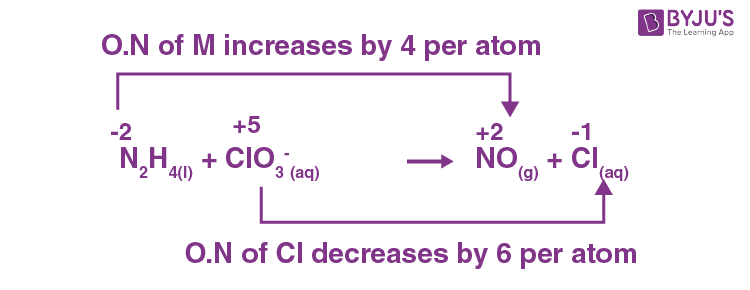
NCERT Solutions for Class 11 Chemistry- Chapter 8 Redox Reactions Q.19(b)

The Oxidation no. of N increases from -2 in

\(\begin{array}{l}N_{ 2 }H_{ 4 }\end{array} \)
to –+2 in NO.

The oxidation no. of Cl reduces from +5 in

\(\begin{array}{l}ClO_{ 3 }^{ – }\end{array} \)
to +-1 in
\(\begin{array}{l}Cl^{ – }\end{array} \)
.

Therefore,

\(\begin{array}{l}N_{ 2 }H_{ 4 }\end{array} \)
behaves as a reducing agent while
\(\begin{array}{l}ClO_{ 3 }^{ – }\end{array} \)
 behaves as an oxidizing agent in the reaction.

Ion–electron method:

 – The oxidation half-reaction:

\(\begin{array}{l}N_{2}H_{4\; (l) } \; \rightarrow \; NO_{ (g) }\end{array} \)

 – Balance atom N:

\(\begin{array}{l}N_{2}H_{4\;(l)}\; \rightarrow\;2\;NO_{(g)}\end{array} \)

 – Add 8 electrons to balance oxidation no:

\(\begin{array}{l}N_{2}H_{4 \; (l) } \; \rightarrow \; 2 \; NO_{ (g) } \; + \; 8 \; e^{-}\end{array} \)

 – Add

\(\begin{array}{l}8 \; OH^{ – }\end{array} \)
to balance the charge:

\(\begin{array}{l}N_{2}H_{ 4 \; (l) } \; + \; 8 \; OH^{ – }_{ (aq) } \; \rightarrow \; 2\;NO_{(g)} \; + \; 8 \; e^{-}\end{array} \)

 – Add 6

\(\begin{array}{l}H_{ 2 }O\end{array} \)
to balance O atoms:

\(\begin{array}{l}N_{2}H_{4\;(l)} \; + \; 8\; OH^{-}_{(aq)} \; \rightarrow \; 2\;NO_{(g)} \; + \; 6 \; H_{2}O_{(l)} \; + \; 8 \; e^{-}\end{array} \)
——— (1)

 – The reduction half-reaction:

\(\begin{array}{l}ClO_{ 3 \; (aq) }^{ – } \; \rightarrow \; Cl_{ (aq) }^{ – }\end{array} \)

 – Add 6 electrons to balance oxidation no.

\(\begin{array}{l}ClO_{3\;(aq)}^{-} \; + \; 6 \; e^{-} \; \rightarrow \; Cl_{(aq)}^{-}\end{array} \)

 – Add

\(\begin{array}{l}6 \; OH^{ – }\end{array} \)
ions to balance the charge:

\(\begin{array}{l}ClO_{3\;(aq)}^{-} \; + \; 6 \; e^{-} \; \rightarrow \; Cl_{(aq)}^{-} \; + \; 6 \; OH^{-}_{(aq)}\end{array} \)

 – Add 3

\(\begin{array}{l}H_{ 2 }O\end{array} \)
to balance O atoms:

\(\begin{array}{l}ClO_{3\;(aq)}^{-} \; + \; 3\; H_{2}O_{(l)} \; + \; 6 \; e^{-} \; \rightarrow \; Cl_{(aq)}^{-} \; + \; 6 \; OH^{-}_{(aq)}\end{array} \)
——— (2)

Now, multiply equation (1) by 3 and equation (2) by 4. Then, after adding them, we get the balanced redox reaction as given below:

\(\begin{array}{l}3 \; N_{ 2 }H_{ 4 \; (l) } \; + \; 4 \; ClO_{ 3 \; (aq) }^{ – } \; \rightarrow \;6 \; NO_{ (g) }\; + \; 4 \; Cl_{ (aq) }^{ – } \; + \; 6 \; H_{ 2 }O_{ (l) }\end{array} \)

Oxidation number method:

 – Reduction in the oxidation no. of N = 2 × 4 = 8

 – Increment in the oxidation no. of Cl = 1 × 6 = 6

Multiply

\(\begin{array}{l}N_{ 2 }H_{ 4 }\end{array} \)
by 3 and
\(\begin{array}{l}ClO_{ 3 }^{ – }\end{array} \)
by 4 to balance the reduction and increment of the oxidation no. :

\(\begin{array}{l}3 \; N_{ 2 }H_{ 4 \; (l) } \; + \; 4 \; ClO^{ – }_{ 3 \; (aq) } \; \rightarrow \; NO_{ (g) } \; + \; Cl^{ – }_{ (aq) }\end{array} \)

 – Balance Cl and n atoms:

\(\begin{array}{l}3 \; N_{ 2 }H_{ 4 \; (l) } \; + \; 4 \; ClO^{ – }_{ 3 \; (aq) } \; \rightarrow \; 6 \; NO_{ (g) } \; + \; 4 \; Cl^{ – }_{ (aq) }\end{array} \)

 – Add 6

\(\begin{array}{l}H_{ 2 }O\end{array} \)
to balance O atoms:

\(\begin{array}{l}3 \; N_{ 2 }H_{ 4 \; (l) } \; + \; 4 \; ClO^{ – }_{ 3 \; (aq) } \; \rightarrow \; 6 \; NO_{ (g) } \; + \; 4 \; Cl^{ – }_{ (aq) } \; + \; 6 \; H_{ 2 }O_{ (l) }\end{array} \)

This is the required reaction equation.

(c)
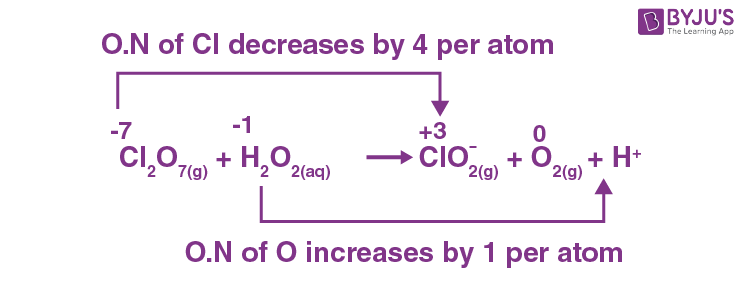
NCERT Solutions for Class 11 Chemistry- Chapter 8 Redox Reactions Q.19(c)

The Oxidation no. of Cldecreases from +7 in

\(\begin{array}{l}Cl_{ 2 }O_{ 7 }\end{array} \)
to +3 in
\(\begin{array}{l}ClO_{ 2 }^{ – }\end{array} \)
.

The oxidation no. of increases from -1 in

\(\begin{array}{l}H_{ 2 }O_{ 2 }\end{array} \)
to 0 in
\(\begin{array}{l}O_{ 2 }\end{array} \)
.

Therefore,

\(\begin{array}{l}H_{ 2 }O_{ 2 }\end{array} \)
behaves as a reducing agent while
\(\begin{array}{l}Cl_{ 2 }O_{ 7 }\end{array} \)
behaves as an oxidizing agent in the reaction.

Ion–electron method:

 – The oxidation half-reaction:

\(\begin{array}{l}H_{ 2 }O_{ 2 \; (aq) } \; \rightarrow \; O_{ 2 \; (g) }\end{array} \)

 – Add 2 electrons to balance oxidation no:

\(\begin{array}{l}H_{ 2 }O_{ 2 \; (aq) } \; \rightarrow \; O_{ 2 \; (g) } \; + \; 2 \; e^{ – }\end{array} \)

 – Add

\(\begin{array}{l}2 \; OH^{ – }\end{array} \)
to balance the charge:

\(\begin{array}{l}H_{ 2 }O_{ 2 \; (aq) } \; + \; 2 \; OH^{ – }_{ (aq) } \rightarrow \; O_{ 2 \; (g) } \; + \; 2 \; e^{ – }\end{array} \)

 – Add 2

\(\begin{array}{l}H_{ 2 }O\end{array} \)
to balance O atoms:

\(\begin{array}{l}H_{ 2 }O_{ 2 \; (aq) } \; + \; 2 \; OH^{ – }_{ (aq) } \rightarrow \; O_{ 2 \; (g) } \; + \; 2 \; H_{ 2 }O_{ (l) } \; + \; 2 \; e^{ – }\end{array} \)
——– (1)

 – The reduction half-reaction:

\(\begin{array}{l}Cl_{ 2 }O_{ 7 \; (g) } \; \rightarrow \; ClO^{ – }_{ 2 \; (aq) }\end{array} \)

 – Balance Cl atoms:

\(\begin{array}{l}Cl_{ 2 }O_{ 7 \; (g) } \; \rightarrow \; 2 \; ClO^{ – }_{ 2 \; (aq) }\end{array} \)

 – Add 8 electrons to balance oxidation no.

\(\begin{array}{l}Cl_{ 2 }O_{ 7 \; (g) } \; + \; 8\; e^{ – } \; \rightarrow \; 2 \; ClO^{ – }_{ 2 \; (aq) }\end{array} \)

 – Add

\(\begin{array}{l}6 \; OH^{ – }\end{array} \)
ions to balance the charge:

\(\begin{array}{l}Cl_{ 2 }O_{ 7 \; (g) } \; + \; 8\; e^{ – } \; \rightarrow \; 2 \; ClO^{ – }_{ 2 \; (aq) } \; + \;6 \; OH^{ – }_{ (aq) }\end{array} \)

 – Add 3

\(\begin{array}{l}H_{ 2 }O\end{array} \)
to balance O atoms:

\(\begin{array}{l}Cl_{ 2 }O_{ 7 \; (g) } \; + \; 3 \; H_{ 2 }O_{ (l) } \; + 8\; e^{ – } \; \rightarrow \; 2 \; ClO^{ – }_{ 2 \; (aq) } \; + \;6 \; OH^{ – }_{ (aq) }\end{array} \)

Now, multiply the equation (1) by 4. Then, adding equation (1) and (2), we get the balanced redox reaction as given below:

\(\begin{array}{l}Cl_{ 2 }O_{ 7 \; (g) } \; + \; 4 \; H_{ 2 }O_{ 2 \; (aq) } \; + 2\; OH^{ – }_{ (aq) } \; \rightarrow \; 2 \; ClO^{ – }_{ 2  (aq) } \; + \; 4 \; O_{ 2 \; (g) } \; + \; 5 \; H_{ 2 }O_{ (l) }\end{array} \)

Oxidation number method:

 – Reduction in the oxidation no. of

\(\begin{array}{l}Cl_{ 2 }O_{ 7 }\end{array} \)
= 4× 2 = 8

 – Increment in the oxidation no. of

\(\begin{array}{l}H_{ 2 }O_{ 2 }\end{array} \)
= 2× 1 = 2

Multiply

\(\begin{array}{l}H_{ 2 }O_{ 2 }\end{array} \)
by 4 and
\(\begin{array}{l}O_{ 2 }\end{array} \)
by 4 to balance the reduction and increment of the oxidation no. :

\(\begin{array}{l}3 \; N_{ 2 }H_{ 4 \; (l) } \; + \; 4 \; ClO^{ – }_{ 3 \; (aq) } \; \rightarrow \; NO_{ (g) } \; + \; Cl^{ – }_{ (aq) }\end{array} \)

 – Balance Cl and n atoms:

\(\begin{array}{l}Cl_{ 2 }O_{ 7 \; (g) } \; + \; 4 \; H_{ 2 }O_{ 2 \; (aq) } \; \rightarrow \; 2\; ClO^{ – }_{ 2 \;(aq) } \; + \; 4 \; O_{ 2 \; (g) }\end{array} \)

 – Add 3

\(\begin{array}{l}H_{ 2 }O\end{array} \)
to balance O atoms:

\(\begin{array}{l}Cl_{ 2 }O_{ 7 \; (g) } \; + \; 4 \; H_{ 2 }O_{ 2 \; (aq) } \; \rightarrow \; 2 \; ClO^{ – }_{ 2  (aq) } \; + \; 4 \; O_{ 2  (g) } \; + \; 3 \; H_{ 2 }O_{ (l) }\end{array} \)

 – Add

\(\begin{array}{l}2 \; OH^{ – }\end{array} \)
and
\(\begin{array}{l}2 \; H_{ 2 }O\end{array} \)
to balance H atoms:

\(\begin{array}{l}Cl_{ 2 }O_{ 7 \; (g) } \; + \; 4 \; H_{ 2 }O_{ 2 \; (aq) } \; 2 \; OH^{ – }_{ (aq) } \; \rightarrow \; 2 \; ClO^{ – }_{ 2 \; (aq) } \; + \; 4 \; O_{ 2 \; (g) } \; + \; 5 \; H_{ 2 }O_{ (l) }\end{array} \)

This is the required reaction equation.


Q20Written answer

What sorts of informations can you draw from the following reaction ?

\(\begin{array}{l}(CN)_{ 2 \; (g) } \; + \; 2 \; OH^{ – }_{ (aq) } \; \rightarrow \; CN_{ (aq) }^{ – } \; + \; CNO_{ (aq) }^{ – } \; + \; H_{ 2 }O_{ (l) }\end{array} \)

Show solutionHide solution
Worked solution

The oxidation no. of C in

\(\begin{array}{l}(CN)_{ 2 }\end{array} \)
,
\(\begin{array}{l}CN^{ – }\end{array} \)
and
\(\begin{array}{l}CNO^{ – }\end{array} \)
are +3, +2 and +4 respectively.

Let the oxidation no. of C be y.

\(\begin{array}{l}(CN)_{ 2 }\end{array} \)

2(y – 3) = 0

Therefore, y = 3

\(\begin{array}{l}CN^{ – }\end{array} \)

y – 3 = -1

Therefore, y = 2

\(\begin{array}{l}CNO^{ – }\end{array} \)

y – 3 -2 = -1

Therefore, y = 4

The oxidation no. of C in the reaction is:

Oxidation no. of C in

\(\begin{array}{l}(CN)_{ 2 }\end{array} \)
is +3

Oxidation no. of C in

\(\begin{array}{l}CN^{ – }\end{array} \)
is +2

Oxidation no. of C in

\(\begin{array}{l}CNO^{ – }\end{array} \)
is +4

We can see that the same compound is oxidized and reduced simultaneously in the reaction.

The reactions in which the same compound is oxidized and reduced is known as disproportionation reaction. Then, we can say that the alkaline decomposition of cyanogens is a disproportionation reaction.