My Cart
Your Cart 0

    Your cart is empty.

  • Total (Amount) ₹0.00
NCERT · Class 11 · Chemistry

Chapter 7: Redox Reactions

Practice each question, then open the answer or worked solution.

Questions

30 questions
Q1Written answer

Assign oxidation number to the underlined elements in each of the following species:

(a)

\(\begin{array}{l}NaH_2\underline{P}O_4\end{array} \)

(b)

\(\begin{array}{l}NaH\underline{S}O_{4}\end{array} \)

(c)

\(\begin{array}{l}H_{4}\underline{P}_{2}O_{7}\end{array} \)

(d)

\(\begin{array}{l}K_{2}\underline{Mn}O_{4}\end{array} \)

(e)

\(\begin{array}{l}Ca\underline{O}_{2}\end{array} \)

(f)

\(\begin{array}{l}Na\underline{B}H_{4}\end{array} \)

(g)

\(\begin{array}{l}H_{2}\underline{S}_{2}O_{7}\end{array} \)

(h)

\(\begin{array}{l}KAl(\underline{S}O_{4})_{2}.12H_{2}O\end{array} \)


Show solutionHide solution
Worked solution

(a) 

\(\begin{array}{l}NaH_2\underline{P}O_4\end{array} \)

Let x be the oxidation no. of P.

Oxidation no. of Na = +1

Oxidation no. of H = +1

Oxidation no. of O = -2

NCERT Solutions for Class 11 Chemistry- Chapter 8 Redox Reactions Q.1(a)

Then,

1(+1) + 2(+1) + 1(x) + 4(-2) = 0

1 + 2 + x -8 = 0

x = +5

Therefore, oxidation no. of P is +5.

(b) 

\(\begin{array}{l}NaH\underline{S}O_{4}\end{array} \)

NCERT Solutions for Class 11 Chemistry- Chapter 8 Redox Reactions Q.1(b)

Let x be the oxidation no. of S.

Oxidation no. of Na = +1

Oxidation no. of H = +1

Oxidation no. of O = -2

Then,

1(+1) + 1(+1) + 1(x) + 4(-2) = 0

1 + 1 + x -8 = 0

x = +6

Therefore, oxidation no. of S is +6.

(c)

\(\begin{array}{l}H_{4}\underline{P}_{2}O_{7}\end{array} \)

NCERT Solutions for Class 11 Chemistry- Chapter 8 Redox Reactions Q.1(c)
Let x be the oxidation no. of P.

Oxidation no. of H = +1

Oxidation no. of O = -2

Then,

4(+1) + 2(x) + 7(-2) = 0

4 + 2x – 14 = 0

2x = +10

x = +5

Therefore, oxidation no. of P is +5.

(d)

\(\begin{array}{l}K_{2}\underline{Mn}O_{4}\end{array} \)

NCERT Solutions for Class 11 Chemistry- Chapter 8 Redox Reactions Q.1(d)

Let x be the oxidation no. of Mn.

Oxidation no. of K = +1

Oxidation no. of O = -2

Then,

2(+1) + x + 4(-2) = 0

2 + x – 8 = 0

x = +6

Therefore, oxidation no. of Mn is +6.

(e)

\(\begin{array}{l}Ca\underline{O}_{2}\end{array} \)

NCERT Solutions for Class 11 Chemistry- Chapter 8 Redox Reactions Q.1(e)

Let x be the oxidation no. of O.

Oxidation no. of Ca = +2

Then,

(+2) + 2(x) = 0

2 + 2x = 0

2x = -2

x = -1

Therefore, oxidation no. of O is -1.

(f)

\(\begin{array}{l}Na\underline{B}H_{4}\end{array} \)

NCERT Solutions for Class 11 Chemistry- Chapter 8 Redox Reactions Q.1(f)

Let x be the oxidation no. of B.

Oxidation no. of Na = +1

Oxidation no. of H = -1

Then,

1(+1) + 1(x) + 4(-1) = 0

1 + x -4 = 0

x = +3

Therefore, oxidation no. of B is +3.

(g)

\(\begin{array}{l}H_{2}\underline{S}_{2}O_{7}\end{array} \)

NCERT Solutions for Class 11 Chemistry- Chapter 8 Redox Reactions Q.1(g)

Let x be the oxidation no. of S.

Oxidation no. of H = +1

Oxidation no. of O = -2

Then,

2(+1) + 2(x) + 7(-2) = 0

2 + 2x – 14 = 0

2x = +12

x = +6

Therefore, oxidation no. of S is +6.

(h)
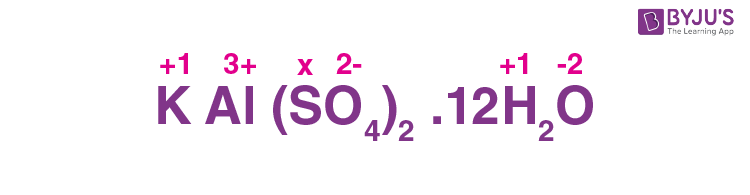
\(\begin{array}{l}KAl(\underline{S}O_{4})_{2}.12H_{2}O\end{array} \)

NCERT Solutions for Class 11 Chemistry- Chapter 8 Redox Reactions Q.1(h)

Let x be the oxidation no. of S.

Oxidation no. of K = +1

Oxidation no. of Al = +3

Oxidation no. of O= -2

Oxidation no. of H = +1

Then,

1(+1) + 1(+3) + 2(x) + 8(-2) + 24(+1) + 12(-2) = 0

1 + 3 + 2x – 16 + 24 – 24 = 0

2x = +12

x = +6

Therefore, oxidation no. of S is +6.

OR

Ignore the water molecules because it is neutral. Then, the summation of the oxidation no. of all atoms of water molecules can be taken as 0. Hence, ignore the water molecule.

1(+1) + 1(+3) + 2(x) + 8(-2) = 0

1 + 3 + 2x -16 = 0

2x = 12

x = +6

Therefore, oxidation no. of S is +6.

 

Q2Written answer

What are the oxidation numbers of the underlined elements in each of the following and how do you rationalise your results?

(a)

\(\begin{array}{l}K\underline{I}_{3}\end{array} \)

(b)

\(\begin{array}{l}H_{2}\underline{S}_{4}O_{6}\end{array} \)

(c)

\(\begin{array}{l}\underline{Fe}_{3}O_{4}\end{array} \)

(d)

\(\begin{array}{l}\underline{C}H_{3}\underline{C}H_{2}OH\end{array} \)

(e)

\(\begin{array}{l}\underline{C}H_{3}\underline{C}OOH\end{array} \)


Show solutionHide solution
Worked solution

(a)

\(\begin{array}{l}K\underline{I}_{3}\end{array} \)

Let x be the oxidation no. of I.

Oxidation no. of K = +1

Then,

1(+1) + 3(x) = 0

1 + 3x = 0

x =

\(\begin{array}{l}-\frac{1}{3}\end{array} \)

Oxidation no. cannot be fractional. Hence, consider the structure of

\(\begin{array}{l}KI_{3}\end{array} \)

In

\(\begin{array}{l}KI_{3}\end{array} \)

NCERT Solutions for Class 11 Chemistry- Chapter 8 Redox Reactions Q.2(a)

Therefore, in

\(\begin{array}{l}KI_{3}\end{array} \)
\(\begin{array}{l}I_{2}\end{array} \)

(b)

\(\begin{array}{l}H_{2}\underline{S}_{4}O_{6}\end{array} \)

NCERT Solutions for Class 11 Chemistry- Chapter 8 Redox Reactions Q.2(b)

Let x be the oxidation no. of S.

Oxidation no. of H = +1

Oxidation no. of O = -2

Then,

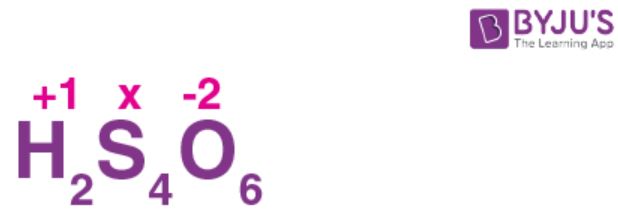
2(+1) + 4(x) + 6(-2) = 0

2 + 4x -12 = 0

4x = 10

x =

\(\begin{array}{l}+2\frac{1}{2}\end{array} \)

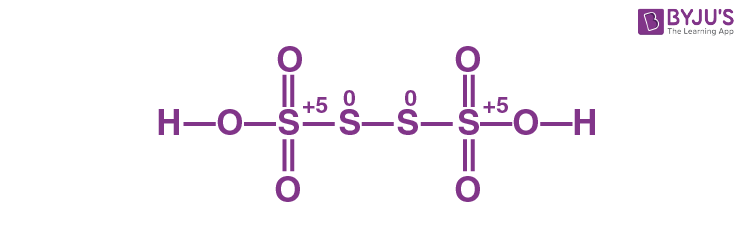
Oxidation no. cannot be fractional. Therefore, S would be present with different oxidation states in the molecule.

NCERT Solutions for Class 11 Chemistry- Chapter 8 Redox Reactions Q.2(b)-1

The oxidation no. of two out of the four S atoms is +5 while that of the other two atoms is 0.

(c)

\(\begin{array}{l}\underline{Fe}_{3}O_{4}\end{array} \)

Let x be the oxidation no. of Fe.

Oxidation no. of O = -2

Then,

3(x) + 4(-2) = 0

3x -8 = 0

x =

\(\begin{array}{l}\frac{8}{3}\end{array} \)

Oxidation no. cannot be fractional.

One of the three atoms of Fe has oxidation no. +2 and the other two atoms of Fe have oxidation no. +3.

NCERT Solutions for Class 11 Chemistry- Chapter 8 Redox Reactions Q.2(c)

(d)

\(\begin{array}{l}\underline{C}H_{3}\underline{C}H_{2}OH\end{array} \)

NCERT Solutions for Class 11 Chemistry- Chapter 8 Redox Reactions Q.2(d)

Let x be the oxidation no. of C.

Oxidation no. of O= -2

Oxidation no. of H = +1

Then,

2(x) + 4(+1) + 1(-2) = 0

2x + 4 -2 = 0

x = -2

Therefore, oxidation no. of C is -2.

(e)

\(\begin{array}{l}\underline{C}H_{3}\underline{C}OOH\end{array} \)

NCERT Solutions for Class 11 Chemistry- Chapter 8 Redox Reactions Q.2(e)

Let x be the oxidation no. of C.

Oxidation no. of O= -2

Oxidation no. of H = +1

Then,

2(x) + 4(+1) + 2(-2) = 0

2x + 4 -4 = 0

x = 0

Therefore, the average oxidation no. of C is 0. Both the carbon atoms are present in different environments, so they cannot have the same oxidation no. Therefore, carbon has oxidation no. of +2 and _2 in

\(\begin{array}{l}CH_{3}COOH\end{array} \)

NCERT Solutions for Class 11 Chemistry- Chapter 8 Redox Reactions Q.2(e)-1


Q3Written answer

Justify that the following reactions are redox reactions:

(a)

\(\begin{array}{l}CuO_{(s)} \; + \; H_{2 \; (g)} \; \rightarrow \; Cu_{(s)} \; + \; H_{2}O_{(g)}\end{array} \)

(b)

\(\begin{array}{l}Fe_{2}O_{3 \; (s)} \; + \; 3 \; CO_{(g)} \; \rightarrow \; 2 \; Fe_{(s)} \; + \; 3 \; CO_{2 \; (g)}\end{array} \)

(c)

\(\begin{array}{l}4 \; BCl_{3 \; (g)} \; + \; 3 \; LiAlH_{4 \; (s)} \; \rightarrow \; 2 \; B_{2}H_{6 \; (g)} \; + \; 3 \; LiCl_{(s)} \; + \; 3 \; AlCl_{3 \; (s)}\end{array} \)

(d)

\(\begin{array}{l}2\;K_{(s)}\;+\;F_{2\;(g)}\;\rightarrow\;2\;K\;+\;F_{(s)}\end{array} \)

(e)

\(\begin{array}{l}4\;NH_{3\;(g)}\;+\;5\;O_{2\;(g)}\;\rightarrow \; 4  \;NO_{(g)}\;+\;6\;H_{2}O_{(g)}\end{array} \)


Show solutionHide solution
Worked solution

(a) 

\(\begin{array}{l}CuO_{(s)} \; + \; H_{2 \; (g)} \; \rightarrow \; Cu_{(s)} \; + \; H_{2}O_{(g)}\end{array} \)

Oxidation no. of Cu and O in

\(\begin{array}{l}CuO\end{array} \)

Oxidation no. of

\(\begin{array}{l}H_{2}\end{array} \)

Oxidation no. of Cu is 0.

Oxidation no. of H and O in

\(\begin{array}{l}H_{2}O\end{array} \)

The oxidation no. of Cu decreased from +2 in

\(\begin{array}{l}CuO\end{array} \)

The oxidation no. of H increased from 0 to +1 in

\(\begin{array}{l}H_{2}\end{array} \)
\(\begin{array}{l}H_{2}O\end{array} \)

Therefore, the reaction is a redox reaction.

(b) 

\(\begin{array}{l}Fe_{2}O_{3 \; (s)} \; + \; 3 \; CO_{(g)} \; \rightarrow \; 2 \; Fe_{(s)} \; + \; 3 \; CO_{2 \; (g)}\end{array} \)

In the above reaction,

Oxidation no. of Fe and O in

\(\begin{array}{l}Fe_{2}O_{3}\end{array} \)

Oxidation no. of C and O in CO is +2 and -2, respectively.

Oxidation no. of Fe is 0.

Oxidation no. of C and O in

\(\begin{array}{l}CO_{2}\end{array} \)

The oxidation no. of Fe decreased from +3 in

\(\begin{array}{l}Fe_{2}O_{3}\end{array} \)

The oxidation no. of C increased from 0 to +2 in CO to +4 in

\(\begin{array}{l}CO_{ 2 }\end{array} \)

Therefore, the reaction is a redox reaction.

(c) 

\(\begin{array}{l}4 \; BCl_{3 \; (g)} \; + \; 3 \; LiAlH_{4 \; (s)} \; \rightarrow \; 2 \; B_{2}H_{6 \; (g)} \; + \; 3 \; LiCl_{(s)} \; + \; 3 \; AlCl_{3 \; (s)}\end{array} \)

the above reaction,

Oxidation no. of B and Cl in

\(\begin{array}{l}BCl_{3}\end{array} \)

Oxidation no. of Li, Al and H in

\(\begin{array}{l}LiAlH_{4}\end{array} \)

Oxidation no. of B and H in

\(\begin{array}{l}B_{2}H_{6}\end{array} \)

Oxidation no. of Li and Cl in LiCl is +1 and -1, respectively.

Oxidation no. of Al and Cl in

\(\begin{array}{l}AlCl_{3}\end{array} \)

The oxidation no. of B decreased from +3 in

\(\begin{array}{l}BCl_{3}\end{array} \)
\(\begin{array}{l}B_{2}H_{6}\end{array} \)
\(\begin{array}{l}BCl_{3}\end{array} \)
\(\begin{array}{l}B_{2}H_{6}\end{array} \)

The oxidation no. of H increased from -1 in

\(\begin{array}{l}LiAlH_{4}\end{array} \)
\(\begin{array}{l}B_{2}H_{6}\end{array} \)
\(\begin{array}{l}LiAlH_{4}\end{array} \)
\(\begin{array}{l}B_{2}H_{6}\end{array} \)

Therefore, the reaction is a redox reaction.

(d) 

\(\begin{array}{l}2 \; K_{(s)} \; + \; F_{2 \; (g)} \; \rightarrow \; 2 \; K \; + \; F_{(s)}\end{array} \)

In the above reaction,

Oxidation no. of K is 0.

Oxidation no. of F is 0.

Oxidation no. of K and F in KF is +1 and -1, respectively.

The oxidation no. of K increased from 0 in K to +1 in KF. That is K is oxidized to KF.

The oxidation no. of F decreased from 0 in

\(\begin{array}{l}F_{2}\end{array} \)

Therefore, the reaction is a redox reaction.

(e) 

\(\begin{array}{l}4 \; NH_{3 \; (g)} \; + \; 5 \; O_{2 \; (g)} \; \rightarrow \; 4 \; NO_{(g)} \; + \; 6 \; H_{2}O_{(g)}\end{array} \)

In the above reaction,

Oxidation no. of N and H in

\(\begin{array}{l}NH_{3}\end{array} \)

Oxidation no. of

\(\begin{array}{l}O_{2}\end{array} \)

Oxidation no. of N and O in NO is +2 and -2, respectively.

Oxidation no. of H and O in

\(\begin{array}{l}H_{2}O\end{array} \)

The oxidation no. of N increased from -3 in

\(\begin{array}{l}NH_{ 3 }\end{array} \)

The oxidation no. of

\(\begin{array}{l}O_{2}\end{array} \)
\(\begin{array}{l}O_{ 2 }\end{array} \)
\(\begin{array}{l}H_{ 2 }O\end{array} \)
\(\begin{array}{l}O_{ 2 }\end{array} \)

Therefore, the reaction is a redox reaction.


Q4Written answer

Fluorine reacts with ice and results in the change: 

\(\begin{array}{l}H_{ 2 }O_{ (s) } \; + \; F_{ 2 \; (g) } \; \rightarrow \; HF_{ (g) } \; + \; HOF_{ (g) }\end{array} \)

Justify that this reaction is a redox reaction


Show solutionHide solution
Worked solution
\(\begin{array}{l}H_{ 2 }O_{ (s) } \; + \; F_{ 2 \; (g) } \; \rightarrow \; HF_{ (g) } \; + \; HOF_{ (g) }\end{array} \)

In the above reaction,

Oxidation no. of H and O in

\(\begin{array}{l}H_{ 2 }O\end{array} \)

Oxidation no. of

\(\begin{array}{l}F_{ 2 }\end{array} \)

Oxidation no. of H and F in HF is +1 and -1, respectively.

Oxidation no. of H, O and F in HOF is +1, -2 and +1, respectively.

The oxidation no. of F increased from 0 in

\(\begin{array}{l}F_{ 2 }\end{array} \)

The oxidation no. of F decreased from 0 in

\(\begin{array}{l}O_{ 2 }\end{array} \)

Therefore, F is both reduced as well as oxidized. So, it is a redox reaction.


Q5Written answer

Calculate the oxidation no. of sulphur, chromium and nitrogen in

\(\begin{array}{l}H_{ 2 }SO_{ 5 }\end{array} \)
,
\(\begin{array}{l}Cr_{ 2 }O_{ 7 }^{ 2- }\end{array} \)
and
\(\begin{array}{l}NO_{ 3 }^{ – }\end{array} \)
. Suggest structure of these compounds. Count for the fallacy.


Show solutionHide solution
Worked solution

For

\(\begin{array}{l}H_{ 2 }SO_{ 5 }\end{array} \)

Let x be the oxidation no. of S.

Oxidation no. of O= -2

Oxidation no. of H = +1

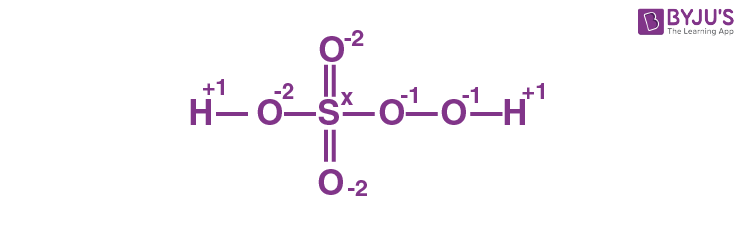
NCERT Solutions for Class 11 Chemistry- Chapter 8 Redox Reactions Q.5

Then,

2(+1) + 1(x) + 5(-2) = 0

2 + x – 10 = 0

x = +8

But the oxidation no. of S cannot be +8 as S has 6 valence electrons. Therefore, the oxidation no. of S cannot be more than +6.

The structure of

\(\begin{array}{l}H_{ 2 }SO_{ 5 }\end{array} \)

Now,

2(+1) + 1(x) + 3(-2) + 2(-1) = 0

2 + x – 6 – 2 = 0

x = +6

Therefore, the oxidation no. of S is +6.


For

\(\begin{array}{l}Cr_{ 2 }O_{ 7 }^{ 2- }\end{array} \)

Let x be the oxidation no. of Cr.

Oxidation no. of O= -2

Then,

2(x) + 7(-2) = -2

2x -14 = -2

x = +6

There is no fallacy about the oxidation no. of Cr in

\(\begin{array}{l}Cr_{ 2 }O_{ 7 }^{ 2- }\end{array} \)

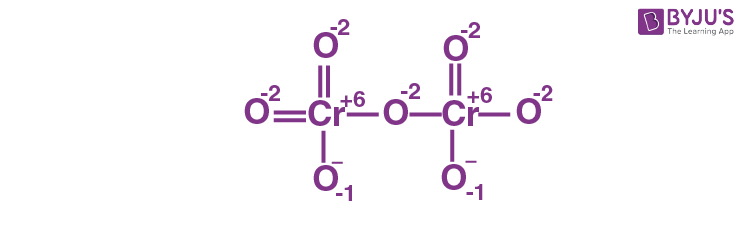
The structure of

\(\begin{array}{l}Cr_{ 2 }O_{ 7 }^{ 2- }\end{array} \)

Each of the two Cr atoms has the oxidation no. of +6.

NCERT Solutions for Class 11 Chemistry- Chapter 8 Redox Reactions Q.5-1

For

\(\begin{array}{l}NO_{ 3 }^{ – }\end{array} \)

Let x be the oxidation no. of N.

Oxidation no. of O= -2

Then,

1(x) + 3(-2) = -1

x – 6 = -1

x = +5

There is no fallacy about the oxidation no. of N in

\(\begin{array}{l}NO_{ 3 }^{ – }\end{array} \)

The structure of

\(\begin{array}{l}NO_{ 3 }^{ – }\end{array} \)

NCERT Solutions for Class 11 Chemistry- Chapter 8 Redox Reactions Q.5-2

Nitrogen atom has the oxidation no. of +5.


Q6Written answer

Write formulas for the following compounds:

(a) Mercury (II) chloride          (b) Nickel (II) sulphate

(c) Tin (IV) oxide                          (d) Thallium (I) sulphate

(e) Iron (III) sulphate                (f) Chromium (III) oxide


Show solutionHide solution
Worked solution

(a) Mercury (II) chloride

\(\begin{array}{l}HgCl_{ 2 }\end{array} \)


(b) Nickel (II) sulphate

\(\begin{array}{l}NiSO_{ 4 }\end{array} \)


(c) Tin (IV) oxide

\(\begin{array}{l}SnO_{ 2 }\end{array} \)


(d) Thallium (I) sulphate

\(\begin{array}{l}Tl_{ 2 }SO_{ 4 }\end{array} \)


(e) Iron (III) sulphate

\(\begin{array}{l}Fe_{ 2 }(SO_{ 4 })_{ 3 }\end{array} \)


(f) Chromium (III) oxide

\(\begin{array}{l}Cr_{ 2 }O_{ 3 }\end{array} \)


Q7Written answer

Suggest a list of the substances where carbon can exhibit oxidation states from –4 to +4 and nitrogen from –3 to +5.


Show solutionHide solution
Worked solution

The compound where carbon has oxidation no. from -4 to +4 is as given below in the table:

Compounds Oxidation no. of carbon
\(\begin{array}{l}CH_{ 2 }Cl_{ 2 }\end{array} \)
0
\(\begin{array}{l}HC\equiv CH\end{array} \)
-1
\(\begin{array}{l}ClC\equiv CCl\end{array} \)
+1
\(\begin{array}{l}CH_{ 3 }Cl\end{array} \)
-2
\(\begin{array}{l}CHCl_{ 3 }\end{array} \)
, CO
+2
\(\begin{array}{l}H_{ 3 }C-CH_{ 3 }\end{array} \)
-3
\(\begin{array}{l}Cl_{ 3 }C-CCl_{ 3 }\end{array} \)
+3
\(\begin{array}{l}CH_{ 4 }\end{array} \)
-4
\(\begin{array}{l}CCl_{ 4 }\end{array} \)
,
\(\begin{array}{l}CO_{ 2 }\end{array} \)
+4


Compounds Oxidation no. of nitrogen
\(\begin{array}{l}N_{ 2 }\end{array} \)
0
\(\begin{array}{l}N_{ 2 }H_{ 2 }\end{array} \)
-1
\(\begin{array}{l}N_{ 2 }O\end{array} \)
+1
\(\begin{array}{l}N_{ 2 }H_{ 4 }\end{array} \)
-2
\(\begin{array}{l}NO\end{array} \)
+2
\(\begin{array}{l}NH_{ 3 }\end{array} \)
-3
\(\begin{array}{l}N_{ 2 }O_{ 3 }\end{array} \)
+3
\(\begin{array}{l}NO_{ 2 }\end{array} \)
+4
\(\begin{array}{l}N_{ 2 }O_{ 5 }\end{array} \)
+5
Q8Written answer

While sulphur dioxide and hydrogen peroxide can act as oxidising as well as reducing agents in their reactions, ozone and nitric acid act only as oxidants. Why?


Show solutionHide solution
Worked solution

In sulphur dioxide (

\(\begin{array}{l}SO_{ 2 }\end{array} \)

Hence,

\(\begin{array}{l}SO_{ 2 }\end{array} \)


In hydrogen peroxide (

\(\begin{array}{l}H_{ 2 }O_{ 2 }\end{array} \)

Therefore,

\(\begin{array}{l}H_{ 2 }O_{ 2 }\end{array} \)


In ozone (

\(\begin{array}{l}O_{ 3 }\end{array} \)

Therefore,

\(\begin{array}{l}O_{ 3 }\end{array} \)


In nitric acid (

\(\begin{array}{l}HNO_{ 3 }\end{array} \)

Therefore,

\(\begin{array}{l}HNO_{ 3 }\end{array} \)


Q9Written answer

Consider the reactions:

(a)

\(\begin{array}{l}6 \; CO_{ 2 \; (g) } \; + \; 6 \; H_{ 2 }O_{ (l) } \; \rightarrow \; C_{ 6 }H_{ 12 }O_{ 6 \; (aq) } \; + \; 6 \; O_{ 2 \; (g) }\end{array} \)

(b)

\(\begin{array}{l}O_{ 3 \; (g) } \; + H_{ 2 }O_{ 2 \; (l) } \; \rightarrow \; H_{ 2 }O_{ (l) } \; + \; 2 \; O_{ 2 \; (g) }\end{array} \)

Why it is more appropriate to write these reactions as :

(a)

\(\begin{array}{l}6 \; CO_{ 2 \; (g) } \; + \; 12 \; H_{ 2 }O_{ (l) } \; \rightarrow \; C_{ 6 }H_{ 12 }O_{ 6 \; (aq) } \; + \; 6 \; H_{ 2 }O_{ (l) } \; + \; 6 \; O_{ 2 \; (g) }\end{array} \)

(b)

\(\begin{array}{l}O_{ 3 \; (g) } \; + H_{ 2 }O_{ 2 \; (l) } \; \rightarrow \; H_{ 2 }O_{ (l) } \; + \; O_{ 2 \; (g) } \; + \; O_{ 2 \; (g) }\end{array} \)

Also suggest a technique to investigate the path of the above (a) and (b) redox reactions


Show solutionHide solution
Worked solution

(a)

Step 1 :

\(\begin{array}{l}H_{ 2 }O\end{array} \)
\(\begin{array}{l}H_{ 2 }\end{array} \)
\(\begin{array}{l}O_{ 2 }\end{array} \)
\(\begin{array}{l}2 \; H_{ 2 }O_{ (l) } \; \rightarrow \; 2 \; H_{ 2 \; (g) } \; + \; O_{ 2 \; (g) }\end{array} \)

Step 2 :

The

\(\begin{array}{l}H_{ 2 }\end{array} \)
\(\begin{array}{l}CO_{ 2 }\end{array} \)
\(\begin{array}{l}6 \; CO_{ 2 \; (g) } \; + \; 12 \; H_{ 2 \; (g) } \; \rightarrow \; C_{ 6 }H_{ 12 }O_{ 6 \; (s) } \; + \; 6 \; H_{ 2 }O_{ (l) }\end{array} \)

The net reaction is as given below:

\(\begin{array}{l}2 \; H_{ 2 }O_{ (l) } \; \rightarrow \; 2 \; H_{ 2 \; (g) } \; + \; O_{ 2 \; (g) }\end{array} \)
\(\begin{array}{l}6 \; CO_{ 2 \; (g) } \; + \; 12 \; H_{ 2 \; (g) } \; \rightarrow \; C_{ 6 }H_{ 12 }O_{ 6 \; (s) } \; + \; 6 \; H_{ 2 }O_{ (l) }\end{array} \)

————————————————————————————————————————–

\(\begin{array}{l}6 \; CO_{ 2 \; (g) } \; + \; 12 \; H_{ 2 }O_{ (l) } \; \rightarrow \; C_{ 6 }H_{ 12 }O_{ 6 \; (g) } \; + \; 6 \; H_{ 2 }O_{ (l) } \; + \; 6 \; O_{ 2 \; (g) }\end{array} \)


This is the suitable way to write the reaction as the reaction also produces water molecules in the photosynthesis process.

The path can be found with the help of radioactive

\(\begin{array}{l}H_{ 2 }O^{ 18 }\end{array} \)
\(\begin{array}{l}H_{ 2 }O\end{array} \)


(b)

Step 1 :

\(\begin{array}{l}O_{ 2 }\end{array} \)
\(\begin{array}{l}O_{ 3 }\end{array} \)
\(\begin{array}{l}H_{ 2 }O_{ 2 }\end{array} \)
\(\begin{array}{l}O_{ 2 }\end{array} \)


\(\begin{array}{l}O_{ 3 }\end{array} \)
\(\begin{array}{l}O_{ 2 }\end{array} \)

Step 2 :

\(\begin{array}{l}H_{ 2 }O_{ 2 }\end{array} \)
\(\begin{array}{l}H_{ 2 }O\end{array} \)
\(\begin{array}{l}O_{ 2 }\end{array} \)


\(\begin{array}{l}O_{ 3 \; (g) } \; \rightarrow \; O_{ 2 \; (g) } \; + \; O_{ (g) }\;\end{array} \)


\(\begin{array}{l}\;H_{ 2 }O_{ 2 \; (l) } \; + \; O_{ (g) } \; \rightarrow \; H_{ 2 }O_{ (l) } \; + \; O_{ 2 \; (g) }\end{array} \)

———————————————————————————————-

\(\begin{array}{l}H_{ 2 }O_{ 2 \; (l) } \; + \; O_{ 3 \; (g) } \; \rightarrow \; H_{ 2 }O_{ (l) } \; + \; O_{ 2 \; (g) } \; + \; O_{ 2 \; (g) }\end{array} \)


The path can be found with the help of

\(\begin{array}{l}H_{ 2 }O_{ 2 }^{ 18 }\end{array} \)
\(\begin{array}{l}O_{ 3 }^{ 18 }\end{array} \)


Q10Written answer

The compound AgF2 is unstable compound. However, if formed, the compound acts as a very strong oxidising agent. Why?


Show solutionHide solution
Worked solution

The oxidation no. of Ag in

\(\begin{array}{l}AgF_{ 2 }\end{array} \)
\(\begin{array}{l}Ag^{ + }\end{array} \)
\(\begin{array}{l}AgF_{ 2 }\end{array} \)