Assign oxidation number to the underlined elements in each of the following species:
(a)
(b)
(c)
(d)
(e)
(f)
(g)
(h)
Show solutionHide solution
(a)
Let x be the oxidation no. of P.
Oxidation no. of Na = +1
Oxidation no. of H = +1
Oxidation no. of O = -2

Then,
1(+1) + 2(+1) + 1(x) + 4(-2) = 0
1 + 2 + x -8 = 0
x = +5
Therefore, oxidation no. of P is +5.
(b)

Let x be the oxidation no. of S.
Oxidation no. of Na = +1
Oxidation no. of H = +1
Oxidation no. of O = -2
Then,
1(+1) + 1(+1) + 1(x) + 4(-2) = 0
1 + 1 + x -8 = 0
x = +6
Therefore, oxidation no. of S is +6.
(c)

Let x be the oxidation no. of P.
Oxidation no. of H = +1
Oxidation no. of O = -2
Then,
4(+1) + 2(x) + 7(-2) = 0
4 + 2x – 14 = 0
2x = +10
x = +5
Therefore, oxidation no. of P is +5.
(d)

Let x be the oxidation no. of Mn.
Oxidation no. of K = +1
Oxidation no. of O = -2
Then,
2(+1) + x + 4(-2) = 0
2 + x – 8 = 0
x = +6
Therefore, oxidation no. of Mn is +6.
(e)

Let x be the oxidation no. of O.
Oxidation no. of Ca = +2
Then,
(+2) + 2(x) = 0
2 + 2x = 0
2x = -2
x = -1
Therefore, oxidation no. of O is -1.
(f)

Let x be the oxidation no. of B.
Oxidation no. of Na = +1
Oxidation no. of H = -1
Then,
1(+1) + 1(x) + 4(-1) = 0
1 + x -4 = 0
x = +3
Therefore, oxidation no. of B is +3.
(g)

Let x be the oxidation no. of S.
Oxidation no. of H = +1
Oxidation no. of O = -2
Then,
2(+1) + 2(x) + 7(-2) = 0
2 + 2x – 14 = 0
2x = +12
x = +6
Therefore, oxidation no. of S is +6.
(h)
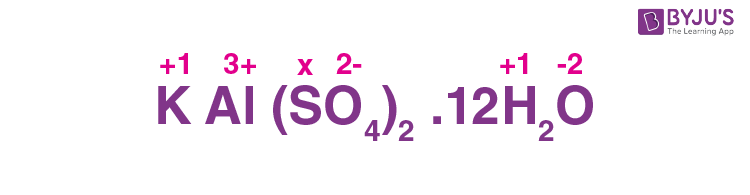
Let x be the oxidation no. of S.
Oxidation no. of K = +1
Oxidation no. of Al = +3
Oxidation no. of O= -2
Oxidation no. of H = +1
Then,
1(+1) + 1(+3) + 2(x) + 8(-2) + 24(+1) + 12(-2) = 0
1 + 3 + 2x – 16 + 24 – 24 = 0
2x = +12
x = +6
Therefore, oxidation no. of S is +6.
OR
Ignore the water molecules because it is neutral. Then, the summation of the oxidation no. of all atoms of water molecules can be taken as 0. Hence, ignore the water molecule.
1(+1) + 1(+3) + 2(x) + 8(-2) = 0
1 + 3 + 2x -16 = 0
2x = 12
x = +6
Therefore, oxidation no. of S is +6.