My Cart
Your Cart 0

    Your cart is empty.

  • Total (Amount) ₹0.00
NCERT · Class 11 · Chemistry

Chapter 4: Chemical Bonding and Molecular Structure

Practice each question, then open the answer or worked solution.

Questions

40 questions
Q11Written answer

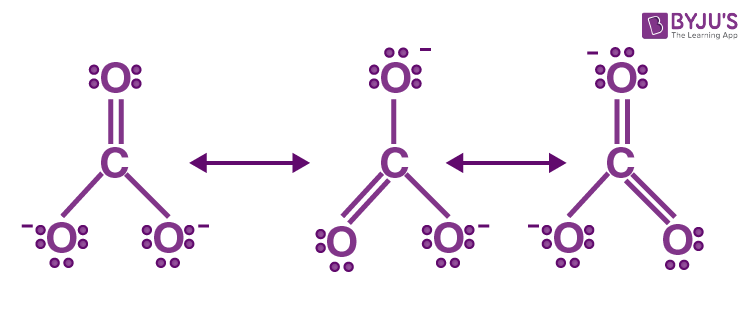
Explain the important aspects of resonance with reference to the CO32− ion.

Show solutionHide solution
Worked solution

Experimental results shows that, all the C-O bond in

\(\begin{array}{l}CO_{3}^{2-}\end{array} \)

Thus, it is inefficient to represent

\(\begin{array}{l}CO_{3}^{2-}\end{array} \)

Thus, the resonance structures of

\(\begin{array}{l}CO_{3}^{2-}\end{array} \)
NCERT Solutions for Class 11 Chemistry- Chapter 4 Chemical Bonding and Molecular Structure image 26


Q12Written answer

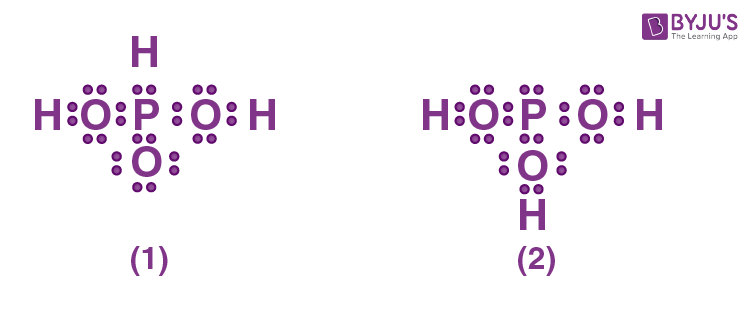
H3PO3 can be represented by structures 1 and 2 shown below. Can these two structures be taken as the canonical forms of the resonance hybrid representing H3PO3? If not, give reasons for the same. 

Show solutionHide solution
Worked solution

NCERT Solutions for Class 11 Chemistry- Chapter 4 Chemical Bonding and Molecular Structure image 27

In the given structures, the position of atoms is changed, so we cannot take the 2 given structures as a canonical form of resonance hybrid which represents H3PO3.


Q13Written answer

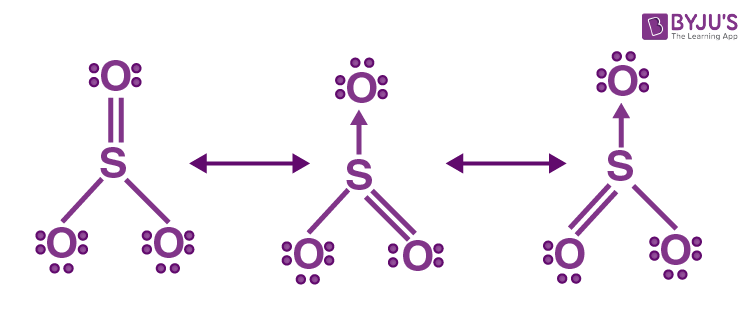
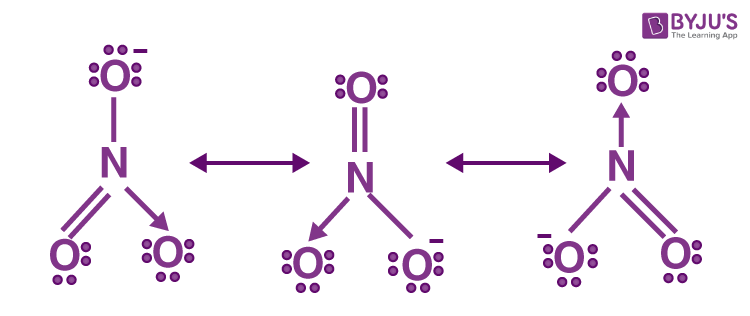
Write the resonance structures for SO3, NO2, and NO3–.

Show solutionHide solution
Worked solution

SO3

NCERT Solutions for Class 11 Chemistry- Chapter 4 Chemical Bonding and Molecular Structure image 28

NO2

NCERT Solutions for Class 11 Chemistry- Chapter 4 Chemical Bonding and Molecular Structure image 29

\(\begin{array}{l}NO_{3}^{-}\end{array} \)

NCERT Solutions for Class 11 Chemistry- Chapter 4 Chemical Bonding and Molecular Structure image 30


Q14Written answer

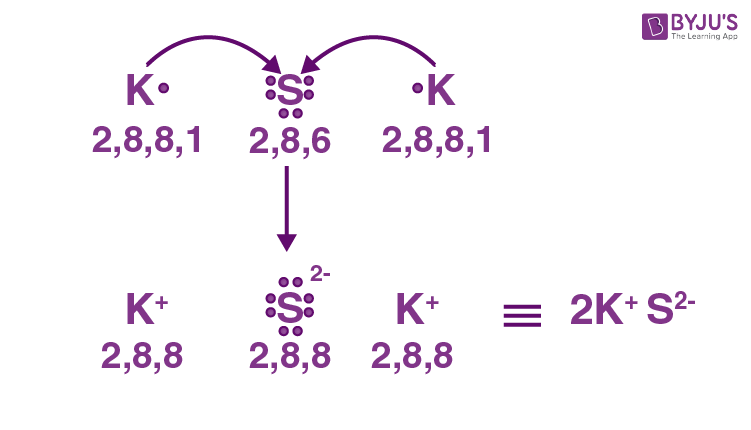
Use Lewis symbols to show electron transfer between the following atoms to form cations and anions :

(i) K and S 

(ii) Ca and O

(iii) Al and N.

Show solutionHide solution
Worked solution

(i) K and S

Electronic configurations of S and K are:

S: 2, 8, 6

K: 2, 8, 8, 1

Here, it is clear that K has 1 more electron than the nearest inert gas, i.e., Ne, whereas S needs 2 electrons to complete its octet. Thus, the transfer of electrons takes place in the following way,

NCERT Solutions for Class 11 Chemistry- Chapter 4 Chemical Bonding and Molecular Structure image 31


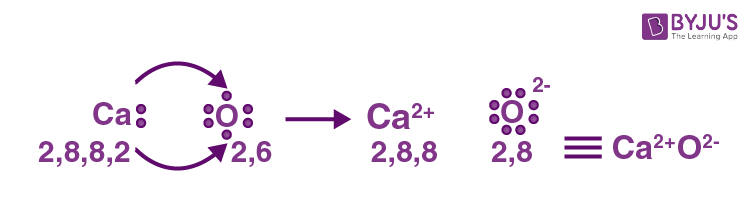
(ii) Ca and  O

Electronic configurations of O and Ca are:

O: 2, 6

Ca: 2, 8, 8, 2

Here, it is clear that Ca has 2  more electrons than the nearest inert gas Ar, whereas O needs 2 electrons to complete its octet. Thus, the transfer of electrons takes place in the following way,

NCERT Solutions for Class 11 Chemistry- Chapter 4 Chemical Bonding and Molecular Structure image 32


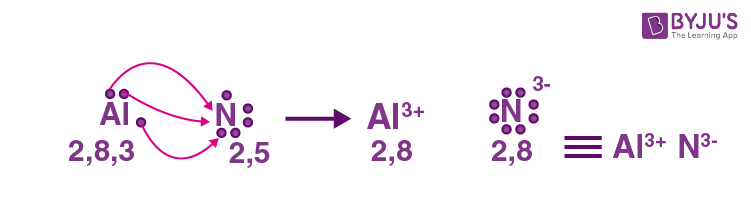
(iii) Al and N

Electronic configurations of N and Al are:

N: 2, 5

Al: 2, 8, 3

Here, it is clear that Al has 3 more electrons than the nearest inert gas Ne, whereas N needs 3 electrons to complete its octet. Thus, the transfer of electrons takes place in the following way,

NCERT Solutions for Class 11 Chemistry- Chapter 4 Chemical Bonding and Molecular Structure image 33


Q15Written answer

Although both CO2 and H2O are triatomic molecules, the shape of the H2O molecule is bent while that of CO2 is linear. Explain this on the basis of dipole moment.

Show solutionHide solution
Worked solution

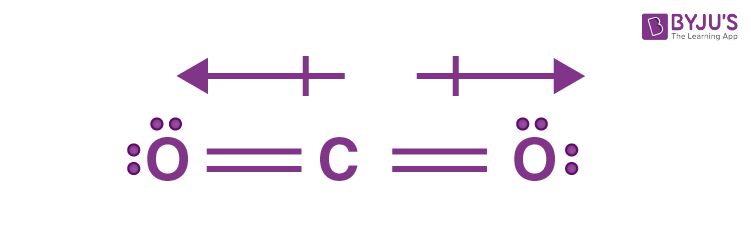
Experimental results show that the dipole moment of CO2 is 0. And it is possible only if the shape of the molecule is linear as dipole moments of a bond between C-O are equal and opposite. So, it nullifies each other.

NCERT Solutions for Class 11 Chemistry- Chapter 4 Chemical Bonding and Molecular Structure image 34

\(\begin{array}{l}∴ Resultant,\; \mu = 0\end{array} \)

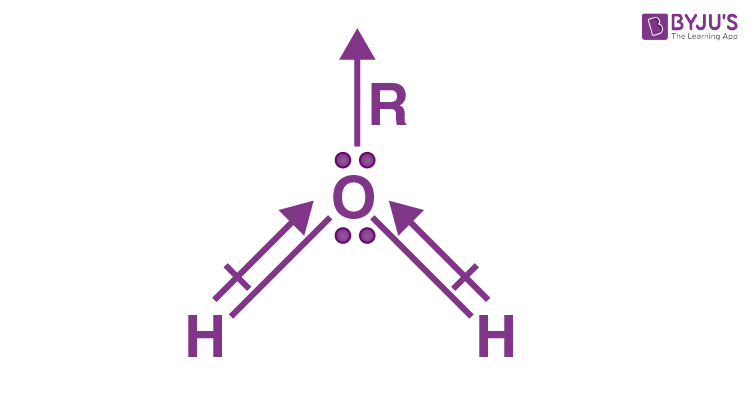
H2O has 1.84 D dipole moment. The value of dipole moments indicates that the structure of water molecule is bent as dipole moments of the bond between O-H are unequal.

NCERT Solutions for Class 11 Chemistry- Chapter 4 Chemical Bonding and Molecular Structure image 35


Q16Written answer

Write the significance/applications of dipole moment.

Show solutionHide solution
Worked solution

The following are some of the key significance of the dipole moment:

  • The molecule’s shape can be determined. Symmetrical molecules, such as linear, have zero dipole moments, whereas non-symmetrical molecules take on varied shapes, such as bent or angular.
  • In order to determine the polarity of molecules. The polarity will be greater if the dipole moment is greater, and vice versa.
  • We can say that if a molecule has zero dipole moment, it is non-polar, and if it has some polar character, it is non-polar.
Q17Written answer

Define electronegativity. How does it differ from electron gain enthalpy?

Show solutionHide solution
Worked solution

“Electronegativity is the ability of an atom in a chemical compound to attract a bond pair of electrons towards itself”.

Sr. No Electronegativity Electron affinity
1 A tendency to attract the shared pairs of electrons for an atom which is in a chemical compound is its electronegativity. A tendency to gain electrons for an isolated gaseous atom is its electron gain enthalpy.
2 It varies according to the element with which it is bounded. It does not vary according to the element with which it is bounded.
3 It is not constant for any element. It is constant for an element.
4 It is not a measurable quantity. It is a measurable quantity.


Q18Written answer

Explain with the help of suitable example polar covalent bond.

Show solutionHide solution
Worked solution

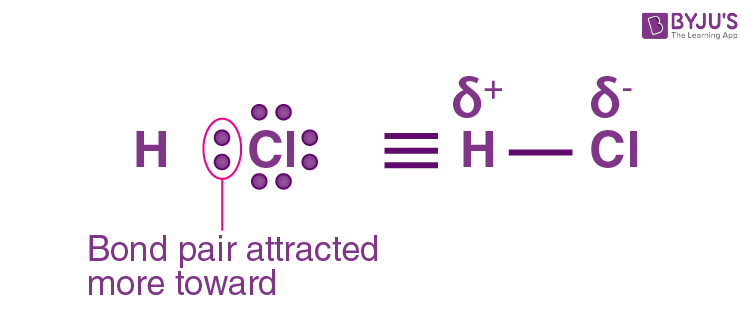
When two unique atoms having distinct electronegativities join to form a covalent bond, the bond pair of electrons are not shared equally. The nucleus of an atom having greater electro-negativity attracts the bond pair. So, the electron distribution gets distorted and an electronegativity atom attracts the electron cloud.

Thus, the electronegative element gets slightly negatively charged and on the other hand, the other atom gets slightly positively charged. As a result of this, two opposite poles are developed in a molecule, and this type of bond formed is termed a ‘polar covalent bond’.

E.g. HCl is having a polar covalent bond. In HCl, Cl- atom has more electronegativity than H- atom. Thus, bond pair shifts towards Cl- atom and because of that, it acquires a positive charge.

NCERT Solutions for Class 11 Chemistry- Chapter 4 Chemical Bonding and Molecular Structure image 37

Q19Written answer

Arrange the bonds in order of increasing ionic character in the molecules: LiF, K2O, N2, SO2, and ClF3.

Show solutionHide solution
Worked solution

The ionic character of a molecule depends on the difference in electronegativity between constituents atoms. So, the higher the difference is, the higher the ionic character of a molecule will be.

So, the required order of ionic character of the given molecules is

N2< SO2< ClF3< K2O <LiF.


Q20Written answer

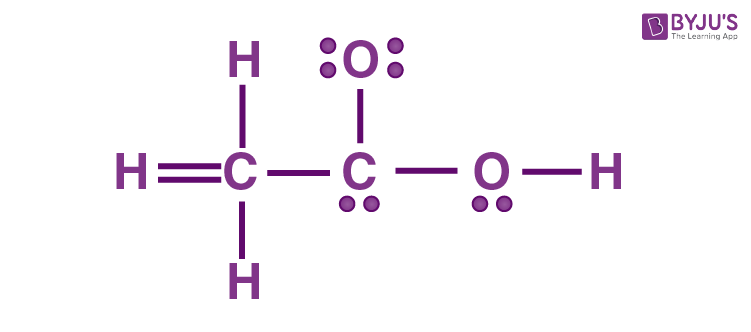
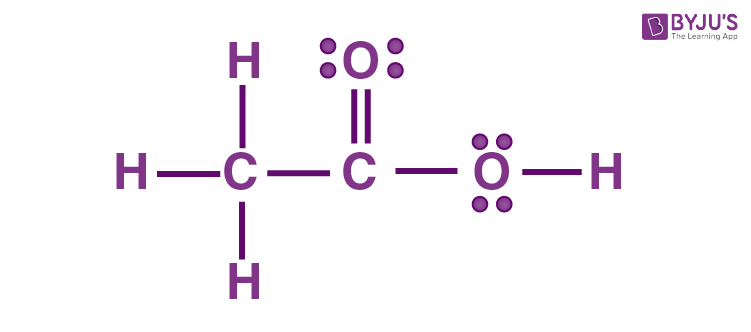
The skeletal structure of CH3COOH as shown below is correct, but some of the bonds are shown incorrectly. Write the correct Lewis structure for acetic acid.

Show solutionHide solution
Worked solution

NCERT Solutions for Class 11 Chemistry- Chapter 4 Chemical Bonding and Molecular Structure image 38

Correct Lewis structure of CH3COOH is given below:

NCERT Solutions for Class 11 Chemistry- Chapter 4 Chemical Bonding and Molecular Structure image 39