My Cart
Your Cart 0

    Your cart is empty.

  • Total (Amount) ₹0.00
NCERT · Class 11 · Biology

Chapter 6: Anatomy of Flowering Plants

Practice each question, then open the answer or worked solution.

Questions

12 questions
Q1Written answer

State the location and function of different types of meristems.

Show solutionHide solution
Worked solution

The location and function of different types of meristems are as follows:

Meristem Location Function
1. Apical meristem Root and shoot tips Forms primary tissue and increases the length of the plant
2. Intercalary meristem Above and below the stem nodes and leaf bases Helps in the growth of leaves and internodes
3. Secondary meristem At the periphery of roots and stem Helps in increasing the thickness of the plant
Q2Written answer

Cork cambium forms tissues that form the cork. Do you agree with this statement? Explain.

Show solutionHide solution
Worked solution

Yes, cork cambium forms tissues that, in turn, form the cork. When the stem increases in girth, another meristematic tissue known as phellogen or cork cambium grows in the cortex region of the stem. This phellogen cuts off cells on both sides. The outer cells differentiate into the phellem or the cork, while the inner cells differentiate into the phelloderm or secondary cortex. The cork is impermeable to water because of suberin, rendering protection to the tissues underneath.

Q3Written answer

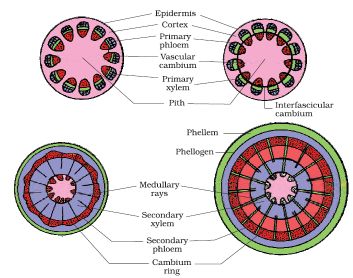
Explain the process of secondary growth in the stems of woody angiosperms with the help of schematic diagrams. What is its significance?

Show solutionHide solution
Worked solution

The primary xylem and phloem exhibit the presence of a strip of cambium in woody dicot roots known as the interfascicular cambium, which is formed from the cells of the medullary rays connecting the interfascicular cambium. Hence, the continuous cambium ring is formed. The cambium separates from the newly formed cells on either side, while the cells found towards the exterior differentiate into the secondary phloem. The cells detach towards the pith giving rise to the secondary xylem. The secondary xylem is synthesised in excess compared to the secondary phloem.

When there is secondary growth in plants, the girth of the plants increases, along with an increase in the water content and nutrients in order to assist the ever-growing leaves, rendering support to the plants.

NCERT solutions Biology chapter 6 - image 1

Q4Written answer

Draw illustrations to bring out the anatomical difference between

(a) Monocot root and Dicot root (b) Monocot stem and Dicot stem.

Show solutionHide solution
Worked solution

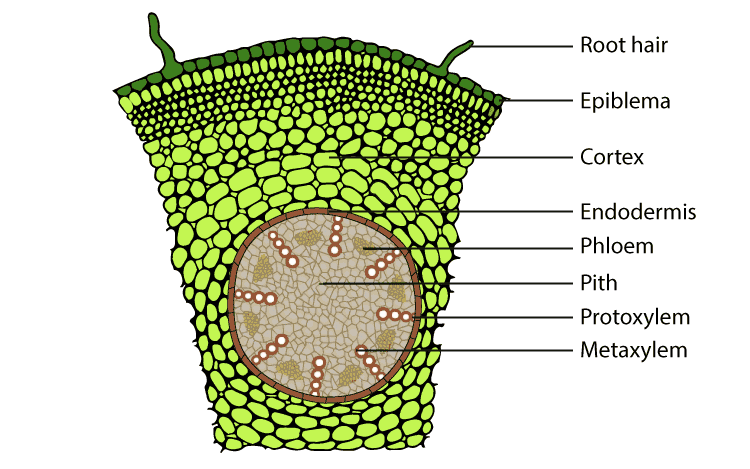
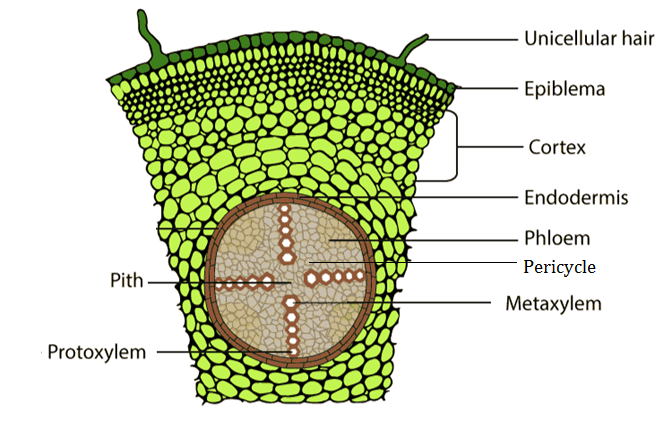
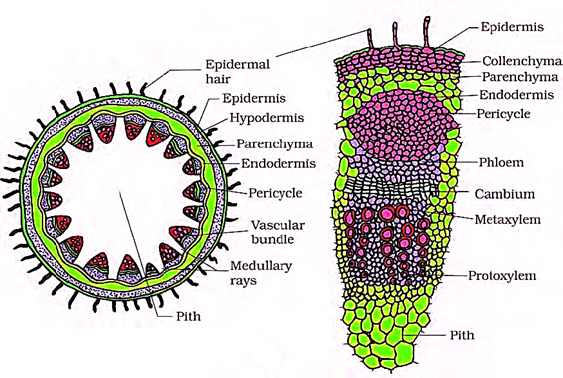
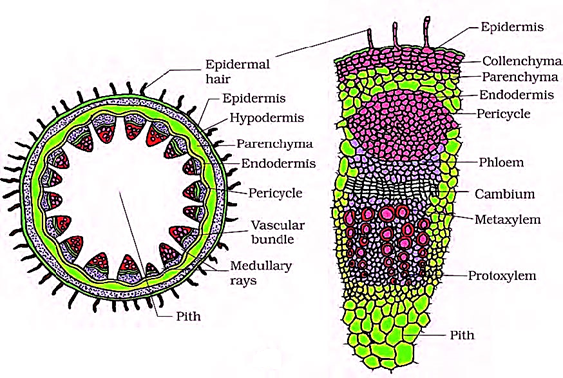
(a) Monocot root and Dicot root

Monocot root

NCERT solutions Biology chapter 6 - image 2

Dicot root

NCERT solutions Biology chapter 6 - image 3

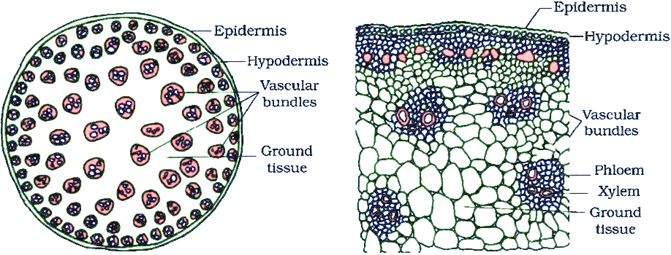
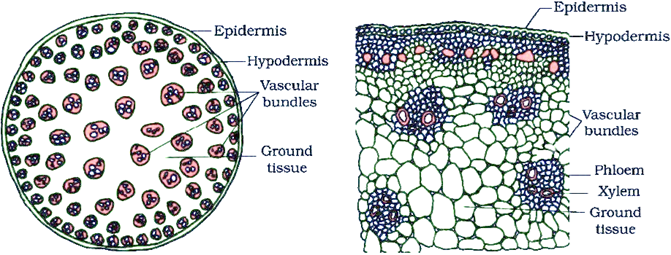
(b) Monocot stem and Dicot stem

Monocot stem

NCERT solutions Biology chapter 6 - image 4

Dicot stem

NCERT solutions Biology chapter 6 - image 5

Q5Written answer

Cut a transverse section of the young stem of a plant from your school garden and observe it under a microscope. How would you ascertain whether it is a monocot stem or a dicot stem? Give reasons.

Show solutionHide solution
Worked solution

The following characteristics can be used to distinguish if it is a monocot or a dicot stem:

Dicot stem Monocot stem
Vascular bundles are arranged in a ring Vascular bundles are scattered
Vascular bundles are open Have closed Vascular bundles with a bundle sheath.
Presence of collateral, conjoint and open vascular bundles with a strip of cambium between the xylem and phloem Presence of collateral, conjoint and closed vascular bundles dispersed in the ground tissue that contains the parenchyma
Ground tissue can be differentiated into the parenchyma, collenchyma, endodermis, pith and pericycle. Medullary rays are found between the vascular bundles Phloem parenchyma is absent, and water-containing cavities are present

Monocot stem

NCERT solutions Biology chapter 6 - image 6

Dicot stem

NCERT solutions Biology chapter 6 - image 7

Q6Written answer

The transverse section of a plant material shows the following anatomical features – (a) the vascular bundles are conjoint, scattered and surrounded by sclerenchymatous bundle sheaths. (b) phloem parenchyma is absent. What will you identify it as?

Show solutionHide solution
Worked solution

The traverse section is of Monocot stem. It is because the vascular bundles are dispersed in monocot stems. The phloem parenchyma is not found.

Q7Written answer

Why are the xylem and phloem called complex tissues?

Show solutionHide solution
Worked solution

Xylem and Phloem are called complex tissues because they are made of more than one type of cells which work together as a unit to perform the function. Xylem transports water, while phloem transports food.

Q8Written answer

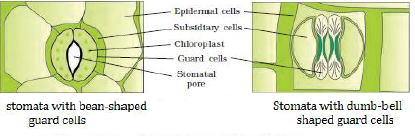
What is the stomatal apparatus? Explain the structure of stomata with a labelled diagram.

Show solutionHide solution
Worked solution

Stomata are structures present in the epidermis of leaves. Stomata regulate the process of transpiration and gaseous exchange. Each stoma is composed of two bean-shaped cells known as guard cells which enclose the stomatal pores.

Guard cells are dumbbell-shaped, where their outer wall is thin, and the inner wall is highly thickened. These structures possess chloroplasts and regulate the closing and opening of the stomata. The epidermal cells near the guard cells, in some cases, become specialised in their structure, shape and size; they are referred to as subsidiary cells. The guard cells, the stomatal aperture and girdling subsidiary cells are collectively referred to as the stomatal apparatus.

NCERT solutions Biology chapter 6 - image 8

Q9Written answer

Name the three basic tissue systems in flowering plants. Give the tissue names under each system.

Show solutionHide solution
Worked solution

Following are the three basic tissue systems in flowering plants:

Epidermal tissue system

The epidermal tissue system includes the epidermis and epidermal appendages. The epidermis comprises epidermal cells and guard cells, while the epidermal appendages include root hair, stem hair, stinging hair and glandular hair.

The ground tissue system

The ground tissue system is made up of simple tissues such as parenchyma, collenchyma and sclerenchyma.

Vascular tissue system

The vascular tissue system consists of complex tissues such as Xylem, phloem and vascular cambium.

Q10Written answer

How is the study of plant anatomy useful to us?

Show solutionHide solution
Worked solution

The study of plant anatomy is useful to us in the following ways:

  • To understand structural adaptations in plants to different climatic conditions.
  • Helpful in identifying monocots, dicots and gymnosperms.
  • Physiological conditions can be studied, which helps in crop improvement.
  • The study of plant fibres, such as flax, jute, etc., helps in their commercial exploitation, as it enables the prediction of the strength of wood which can be utilised to its potential.