My Cart
Your Cart 0

    Your cart is empty.

  • Total (Amount) ₹0.00
NCERT · Class 11 · Accountancy

Chapter 7: Depreciation, Provisions and Reserves

Practice each question, then open the answer or worked solution.

Long Answers for NCERT Accountancy Solutions Class 11 Chapter 7

6 questions
Q1Written answer

Explain the concept of depreciation. What is the need for charging depreciation and what are the causes of depreciation?

Show solutionHide solution
Worked solution

Any fixed asset that is acquired by a business is subjected to wear and tear and obsolescence over time. This decrease in monetary value is calculated by a measure in accounting called depreciation.

Depreciation is needed for the following reasons:

1. Determining actual profit or loss: Actual profit and loss can be determined only when all losses and expenses are added to P & L Account. Assets are used in business to earn revenues, the cost is charged as depreciation in P & L Account (Profit & Loss Account).

2. Provide a fair view of financial statements: Assets will be shown at inflated values as the charge for depreciation is not added. So it will lead to the balance sheet not showing a fair view of the financial statements.

3. Cost of production: Cost of production includes the depreciation charged on the plant, machinery and other similar assets. If depreciation is not charged the cost of production will be uneven, which will reduce the profit.

4. Distribution of dividend from profit: If no depreciation is charged, then overestimation of profit takes place, which leads to profit being circulated as dividend. It leads to the movement of capital away from the business.

5. Funds used for replacement of assets: Depreciation charged for assets will help in meeting the expense for replacing assets in future.

6. Tax consideration: The P & L account will reflect less profit if depreciation is charged, which results in paying less taxes for the business.

The major causes of depreciation are listed below:

1. Regular use: Regular use of assets leads to deterioration which reduces the value of such assets.

  1. Expiry with time: Assets, whether used or not, will show a decline in their effective life with the passage of time. Rain, wind and other Natural forces bring about the deterioration of the asset.
  2. Obsolescence: Technological advances will make the current assets obsolete in future

4. Legal rights Expiry: The value of an asset becomes zero after its useful life. This is known as depreciation in accounting terms.

  1. Accident: The value of an asset can be permanently reduced due to some accident which can include fire, natural calamity etc.
Q2Written answer

Discuss in detail the straight-line method and written down value method of depreciation. Distinguish between the two and also give situations where they are useful.

Straight Line method

Show solutionHide solution
Worked solution

It is one of the simplest methods of calculating depreciation. It is charged on the original cost of the asset at a constant rate.

Depreciation is calculated using the formulae:

Annual Depreciation expense = (Asset cost – Residual Value) / Useful life of the asset

Advantages of the Straight-Line Method

  1. Simple calculation required
  2. The value of an asset can be made zero after its useful life.
  3. Comparing P & L accounts every year is easy as an equal amount is charged as depreciation.
  4. It is suitable for assets which require fewer repairs.

Straight-Line Method limitations

  1. More burden on P & L account as the asset becomes older and requires repair and maintenance.
  2. An asset can become zero value even when it is in useful condition.

Straight-Line Method benefits

  1. Useful for assets which require fewer repairs and maintenance.
  2. Useful if an asset is used continuously.

Written Down Value Method

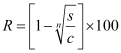
The rate of depreciation is calculated on the diminishing value of the asset. It is also known as the reducing balance method.

The rate of depreciation is calculated using the formulae:

Rate of Depreciation

Where,

R = depreciation rate

n = Assets useful life that can be expected

s = scrap value

c= cost of an asset

Written Down Value Method Advantages

  1. Depreciation is charged more in the initial years as assets will be more useful during the early years.
  2. As assets will require more repair in the later stages, the collective load of depreciation and repairs on the profit and loss account will remain equal over the years.
  3. Approved for tax calculations
  4. Loss arising from obsolescence can be greatly reduced as most of the cost is recovered in the initial years.

Written Down Value Method Limitations

  1. Determining the rate of depreciation is difficult.
  2. The book value never reaches zero in this method, as depreciation cannot be fully written off.
  3. Businesses may find it difficult to gather prices for the replacement of assets as most of the depreciation is charged in the early years, and that amount is used in the business.

Written Down Value Method Uses

  1. Suitable for assets having long useful life.
  2. Convenient for assets that require greater maintenance costs and repairs in the later years.

Difference between Straight Line Method and Written Down Value Method

Basis of Comparison Straight Line Method Written Down Value Method
How it is calculated The actual cost of an asset is taken as the basis for calculating Depreciation Reducing the balance is the basis of calculating depreciation. Reducing balance is also known as book value
How depreciation is charged A fixed amount is charged every year till the effective life of the asset Depreciation is charged based on the written down value of the asset every year till the effective life of the asset
Value of Asset It becomes zero at the end of the effective life of the asset and is written off It never becomes zero and hence not completely written off.
Asset Suitability Assets such as buildings and lands which require less repair and have fewer chances of becoming obsolete are suitable for this method Assets requiring frequent repair like machinery, plant and car.
Impact of Depreciation and repairs on P & L account Increases every year Remains constant every year
Q3Written answer

Describe in detail two methods of recording depreciation. Also give the necessary journal entries.

Show solutionHide solution
Worked solution

Here are some methods by which depreciation can be recorded:

  1. Depreciation charged to asset account: In this method, the depreciation is deducted from the depreciable cost of the asset, which gets credited to the asset account and debited to the profit and loss account.

Journal entries for depreciation are shown below:

Depreciation charged to the asset account

Depreciation A/c Dr.
To Assets A/c
(Depreciation charged to Assets Account)

Closing of Depreciation Account

Profit and Loss A/c Dr.
To Depreciation A/c
(Depreciation transferred to P& L Account)
  1. Provision created for depreciation account− In this method amount of depreciation is debited to the depreciation account and credited to the provision for the depreciation account. The depreciation amount gets transferred to P & L account at the end of the year.

The following journal entries are made:

Charging (crediting) Depreciation to Provision for depreciation account

Depreciation A/c Dr.
To Provision for Depreciation A/c
(Charged Depreciation)

For charging depreciation to P & L account

Profit and Loss A/c Dr.
To Depreciation A/c
(Depreciation charged to Profit and Loss Account)

After  the sale of an asset, the accumulated depreciation gets credited to the Asset account with the following entry:

Provision for Depreciation A/c Dr.
To Asset A/c
(Accumulated depreciation gets debited to Assets Account)
Q4Written answer

Explain determinants of the amount of depreciation.

Show solutionHide solution
Worked solution

The basic factors affecting the amount of depreciation are as follows:

1. Cost of asset: Depreciation of an asset is directly proportional to the cost of the asset, and the cost of a fixed asset is calculated by adding the cost of acquisition, installation etc. Hence, cost is an important factor for affecting depreciation.

2. Estimated useful life: Every fixed asset has a useful life till which it can be used for a business. After that, it will not be of any use to the business. Hence, the useful life of an asset is also a factor in determining depreciation.

3. Estimated scrap value: Every asset has a scrap value or salvage value. It is also known as the net residual value or sale value of the asset at the end of its useful life. If the net residual value is more, it will help in reducing the amount of depreciation and vice versa. Thus, net residual value is also one of the factors affecting the amount of depreciation.

After 10 years, furniture is sold at ₹ 5,000. So, depreciation will be:

Depreciation (p.a.) = (Original cost – Scrap Value)
Estimated Life of Asset (years)
= (40,000 – 5,000)
10
=3,500/annum
Q5Written answer

Name and explain different types of reserves in details.

Show solutionHide solution
Worked solution

Reserves: Reserves are created from the profits of the business. It helps in fortifying the financial position of a business and also helps in the growth of the company.

Reserves are classified into two types:

  1. Revenue Reserve: Revenue reserve is created from revenue profit. It can be of two types: a) General and b) Specific Purpose

a. General Reserve: The purpose for which reserves are created is not specified. Such reserves are called General Reserves. These reserves can be utilized for the growth of a business.

b. Specific Reserve: A specific reserve is created with the intent of utilizing for a specific purpose in the business.

Following are some examples:

i. Dividend Equalisation Reserve

ii. Debenture Redemption Reserve

  1. Capital Reserve: Reserve which is created out of capital profit, such as the sale of some fixed asset, is known as a capital reserve. Here are some examples of capital reserves:

i. Premium on issue of debentures

ii. Premium on issue of shares

iii. Profit on sale of fixed assets

iv. Profit prior to incorporation

v. Profit on redemption of debentures

3. Secret Reserves− An amount that leads to undervaluing the assets of an organization or overestimation of liabilities is called a secret reserve. It is created with the purpose of hiding business profits from competitive organizations or competitors.

Q6Written answer

What are provisions? How are they created? Give accounting treatment in case of provision for doubtful Debts.

Show solutionHide solution
Worked solution

The actual amount of expenses or losses for the current accounting period cannot be determined with certainty as they have not been incurred yet. The net profit of the business can only be arrived at after making a provision for such expenses or losses. A few examples of provisions are mentioned below:

  1. Provision for depreciation
  2. Provision for taxation
  3. Provision for bad and doubtful debts
  4. Provision for discount on debtors

Provisions are created by debiting the Profit and Loss Account on estimate basis. It is created on the basis of past experiences. A business may experience common losses, such as the depreciation of fixed assets, taxation, etc., every year, which are known, their exact amount in future periods is unknown.

Therefore, a business always creates a provision based on certain percentage every year, which is purely based on the intuition and past experiences. These undetermined liabilities in form of provisions are kept aside, which will help future business activities, undisturbed from the future losses.

Accounting treatment for provision for doubtful debts is:

Profit and Loss A/c Dr.
To Provision for Doubtful Debts
(Provision for doubtful debts made)