(i) Write the electron-dot structures for sodium and oxygen.
(ii) Show the formation of Na2O and MgO by the transfer of electrons.
(iii) What are the ions present in these compounds?
Show solutionHide solution
Solution: (i) Sodium:

Oxygen:

(ii) Formation of Magnesium oxide:
When magnesium reacts with oxygen, the magnesium atom transfers its two outermost electrons to an oxygen atom. By losing two electrons, the magnesium atoms form a magnesium ion (Mg2+), and by gaining two electrons, the oxygen atom forms an oxide ion (O2-).
Mg: +
 → MgO
→ MgO
Formation of Sodium oxide:
Two sodium atoms transfer their 2 outermost electrons to an oxygen atom. By losing two electrons, the two sodium atoms form sodium ions (2Na+). And by gaining two electrons, the oxygen atom forms an oxide ion (O2-).
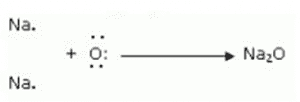
(iii) The ions present in sodium oxide compound (Na2O) are sodium ions (2Na+) and oxide ions (O2-).
The ions present in Magnesium oxide compound (MgO) are magnesium ions Mg2+ and oxide ions (O2-).