My Cart
Your Cart 0

    Your cart is empty.

  • Total (Amount) ₹0.00
NCERT · Class 10 · Science

Chapter 1: Chemical reactions and equations

Practice each question, then open the answer or worked solution.

Exercise Questions

Textbook page 14-16 · 20 questions
Q11Written answer

Why are decomposition reactions called the opposite of Combination reactions? Write equations for decomposition reactions.

Show solutionHide solution
Worked solution

Combination reaction is said to be the reaction between two or more molecules to form a larger molecule; whereas the decomposition reaction is defined as the splitting of larger molecules into two or more smaller molecules. This essentially explains that the decomposition reaction is the opposite of the combination reaction.

In most cases, the decomposition reaction is endothermic since the heat from the surrounding or induced heat is used to break the bonds of the larger molecule. A few examples of decomposition reactions are

ZnCO3 → ZnO + CO2

CaCO3 + Energy → CaO + CO2

2HgO → 2Hg + O2

Q12Written answer

Write one equation each for decomposition reactions in which energy is supplied in the form of heat, light or electricity.

Show solutionHide solution
Worked solution

(a) Thermal decomposition reaction (Thermolysis)

Decomposition of potassium chlorate: When heated strongly, potassium chlorate decomposes into potassium chloride and oxygen. This reaction is used for the preparation of oxygen.

2KClO3 + Heat → 2KCl + 3O2

(b) Electrolytic decomposition reaction (Electrolysis)

Decomposition of sodium chloride: On passing electricity through molten sodium chloride, it decomposes into sodium and chlorine.

NCERT Solution Class 10 Science Chapter 1-1

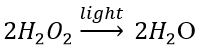
(c) Photodecomposition reaction (Photolysis)

Decomposition of hydrogen peroxide: In the presence of light, hydrogen peroxide decomposes into water and oxygen.

NCERT Solution Class 10 Science Chapter 1-2

Q13Written answer

What is the difference between displacement and double displacement reactions? Write relevant equations for the above.

Show solutionHide solution
Worked solution

A displacement reaction is one when a more reactive substance displaces a less reactive one from its salt solution, whereas a double displacement reaction is one where a mutual exchange of ions happens between two compounds.

In a displacement reaction, only a single displacement takes place, whereas in the double displacement reaction, as the name suggests, two displacement takes place between the molecules.

Example:

Displacement reaction

Mg + 2HCl → MgCl2 + H2

Double displacement reaction

2KBr + BaI2 → 2KI + BaBr2

Q14Written answer

In the refining of Silver, the recovery of silver from Silver nitrate solution involves displacement reaction by Copper metal. Write down the reaction involved.

Show solutionHide solution
Worked solution

Cu(s) + 2AgNO3(aq) → Cu(NO3)2(aq) + 2Ag(s)

Q15Written answer

What do you mean by a precipitation reaction? Explain by giving examples.

Show solutionHide solution
Worked solution

When two solutions containing soluble salts are combined, a double displacement reaction takes place in which the ions are exchanged between the compounds. When one of such compounds formed is in solid form (that is insoluble in aqua), then it settles down at the bottom of the container. This solid is known as the precipitate and the respective reaction is termed as the precipitation reaction. A few examples of precipitation reactions are

CdSO4(aq) + K2S(aq) → CdS(s) + K2SO4(aq)

2NaOH(aq) + MgCl2(aq) → 2NaCl(aq) + Mg(OH)2(s)

Q16Written answer

Explain the following in terms of the gain of oxygen with two examples each.

(a) Oxidation

(b) Reduction

Show solutionHide solution
Worked solution

(a) In a chemical reaction, when the oxygen is added to the element to form its respective oxide it is the element being oxidised. Example:

4Na(s) + O2(g) → 2Na2O(s)

H2S + O2 → H2O + SO2

(b) In a chemical reaction, when the oxygen is removed from the compound, then it is said to be reduced. Example:

CuO(s) + H2(g) → Cu(s) + H2O(l)

2HgO → 2Hg + O2

Q17Written answer

A shiny brown coloured element ‘X’ on heating in the air becomes black in colour. Name the element ‘X’ and the black-coloured compound formed.

Show solutionHide solution
Worked solution

The shiny brown-coloured element is Copper metal (Cu). When the metal is heated in air, it reacts with atmospheric oxygen to form copper oxide. Hence, the black-coloured compound is copper oxide.

2Cu(s) + O2(g) → 2CuO(s)

Q18Written answer

Why do we apply paint on iron articles?

Show solutionHide solution
Worked solution

Iron articles are painted to prevent them from rusting. When left unpainted, the metal surface comes in contact with the atmospheric oxygen and in the presence of moisture it from Iron(III) oxide. But if painted, the surface does not come in contact with moisture and air, thus prevents Rusting.

Q19Written answer

Oil and Fat containing food items are flushed with Nitrogen. Why?

Show solutionHide solution
Worked solution

The main purpose of flushing Nitrogen into food packets that contain oil and fat items is to prevent Rancidity which occurs when the oil or fat reacts with the oxygen letting out an unpleasant smell and taste. Therefore, by flushing Nitrogen, an unreactive surrounding is created, thus preventing rancidity.

Q20Written answer

Explain the following terms with one example each.

(a) Corrosion

(b) Rancidity

Show solutionHide solution
Worked solution

(a) Corrosion is a process where a refined metal is oxidised by atmospheric oxygen to form a more stable compound, such as oxides. The metal gradually degrades during the corrosion process. Rusting of iron is a good example of corrosion where the iron is converted to Iron oxide. Millions of dollars are spent annually in preventing rusting from bridges and other monuments.

(b) The condition produced by the aerial oxidation of the oil and fat present in the food material that produces an unpleasant taste and smell. The rancidity is retarded when the food is kept inside the refrigerator since the low temperature does not promote the oxidation reaction.