Difficulty distribution
How the classified questions are distributed by difficulty.
20questions
Not classified
20
100%
Your cart is empty.
Practice Wave Optics - Optics - Physics previous year questions organised from real papers, with year-wise coverage and clear topic navigation.
Every graph below is calculated only from this selection.
Year-wise coverage for Wave Optics. Each bar uses a separate theme-derived color.
How the classified questions are distributed by difficulty.
MCQ, numerical, multiple-select and other formats found in these papers.
Top subjects by unique question coverage.
Top topics across the included previous year papers.
Top subtopics inside this exact selection.
Question coverage for the most populated papers. Every active PYP paper remains listed below.
Newest papers appear first. Sort by year, question coverage or name.
| Paper | Year / session | Questions in this view | Open |
|---|---|---|---|
| WB JEE 2026 | 2026 | 2 | View paper |
| WB JEE 2026 | 2026 | 2 | View paper |
| WB JEE 2025 | 2025 | 1 | View paper |
| WB JEE 2024 | 2024 | 2 | View paper |
| WB JEE 2023 | 2023 | 3 | View paper |
| WB JEE 2022 | 2022 | 2 | View paper |
| WB JEE 2021 | 2021 | 1 | View paper |
| WB JEE 2020 | 2020 | 2 | View paper |
| WB JEE 2019 | 2019 | 2 | View paper |
| WB JEE 2018 | 2018 | 1 | View paper |
| WB JEE 2017 | 2017 | 1 | View paper |
| WB JEE 2016 | 2016 | 1 | View paper |
Practice every matching question in batches of 20, with every available option.
In Young's double slit experiment with a monochromatic light, maximum intensity is 4 times the minimum intensity in the interference pattern. What is the ratio of the intensities of the two interfering waves?
In a Young's double slit experiment, the intensity of light at a point on the screen where the path difference between the interfering waves is \(\lambda\), (\(\lambda\) being the wavelength of light used) is I. The intensity at a point where the path difference is \({\lambda \over 4}\) will be (assume two waves have same amplitude)
An interference pattern is obtained with two coherent sources of intensity ratio n : 1. The ratio \(\mathrm{{{{I_{\max }} - {I_{\min }}} \over {{I_{\max }} + {I_{\min }}}}}\) will be maximum if
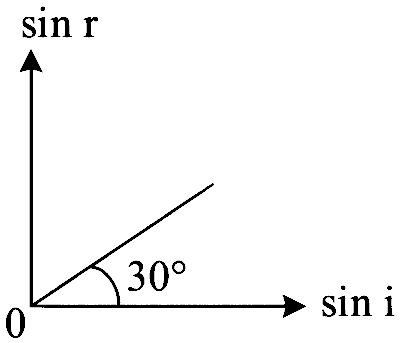
A ray of monochromatic light is incident on the plane surface of separation between two media \(\mathrm{X}\) and \(\mathrm{Y}\) with angle of incidence '\(\mathrm{i}\)' in medium $\mathrm{X}$ and angle of refraction 'r' in medium Y. The given graph shows the relation between \(\sin \mathrm{i}\) and \(\sin \mathrm{r}\). If \(\mathrm{V}_{X}\) and \(\mathrm{V}_{Y}\) are the velocities of the ray in media X and Y respectively, then which of the following is true?
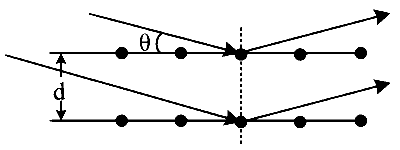
X-rays of wavelength \(\lambda\) gets reflected from parallel planes of atoms in a crystal with spacing d between two planes as shown in the figure. If the two reflected beams interfere constructively, then the condition for maxima will be, (n is the order of interference fringe)
Light of wavelength \(6000 \mathop A\limits^o\) is incident on a thin glass plate of r.i. 1.5 such that the angle of refraction into the plate is \(60^{\circ}\). Calculate the smallest thickness of the plate which will make dark fringe by reflected beam interference.
In a single-slit diffraction experiment, the slit is illuminated by light of two wavelengths \(\lambda_1\) and \(\lambda_2\). It is observed that the \(2^{\text {nd }}\) order diffraction minimum for \(\lambda_1\) coincides with the \(3^{\text {rd }}\) diffraction minimum for \(\lambda_2\). Then
A single slit diffraction pattern is obtained using a beam of red light. If red light is replaced by blue light then
Beyond what distance,the ray optics is sufficiently valid when the aperture is 6 mm wide and the wavelength is $6000 \mathop {\rm{A}}\limits^{\rm{o}}$ ?
Two points of monochromatic and coherent sources of light of wavelength $\lambda$ each, are placed as shown in figure. The initial phase difference between the sources is zero, $(D \gg d)$. Mark the correct statement(s).
