Difficulty distribution
How the classified questions are distributed by difficulty.
13questions
Not classified
13
100%
Your cart is empty.
Practice Rotational Motion - Mechanics - Physics previous year questions organised from real papers, with year-wise coverage and clear topic navigation.
Every graph below is calculated only from this selection.
Year-wise coverage for Rotational Motion. Each bar uses a separate theme-derived color.
How the classified questions are distributed by difficulty.
MCQ, numerical, multiple-select and other formats found in these papers.
Top subjects by unique question coverage.
Top topics across the included previous year papers.
Top subtopics inside this exact selection.
Question coverage for the most populated papers. Every active PYP paper remains listed below.
Newest papers appear first. Sort by year, question coverage or name.
| Paper | Year / session | Questions in this view | Open |
|---|---|---|---|
| WB JEE 2026 | 2026 | 2 | View paper |
| WB JEE 2026 | 2026 | 2 | View paper |
| VITEEE 2025 | 2025 | 1 | View paper |
| WB JEE 2024 | 2024 | 3 | View paper |
| WB JEE 2023 | 2023 | 1 | View paper |
| WB JEE 2021 | 2021 | 1 | View paper |
| WB JEE 2020 | 2020 | 2 | View paper |
| WB JEE 2008 | 2008 | 1 | View paper |
Practice every matching question in batches of 20, with every available option.
A mouse of mass m jumps on the outside edge of a rotating ceiling fan of moment of inertia I and radius R. The fractional loss of angular velocity of the fan as a result is,
A small sphere of mass m and radius r slides down the smooth surface of a large hemispherical bowl of radius R. If the sphere starts sliding from rest, the total kinetic energy of the sphere at the lowest point \(\mathrm{A}\) of the bowl will be [given, moment of inertia of sphere \(=\frac{2}{5} \mathrm{mr}^2\)]

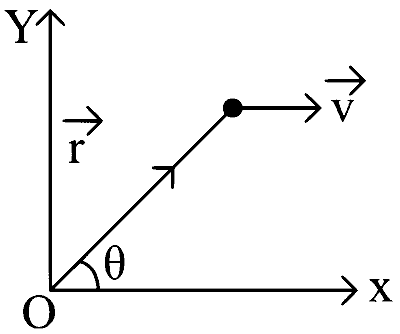
The position vector of a particle of mass \(\mathrm{m}\) moving with a constant velocity \(\vec{v}\) is given by \(\vec{r}=x(t) \hat{i}+b \hat{j}\), where \(\mathrm{b}\) is a constant. At an instant, \(\vec{r}\) makes an angle \(\theta\) with the \(x\)-axis as shown in the figure. The variation of the angular momentum of the particle about the origin with \(\theta\) will be


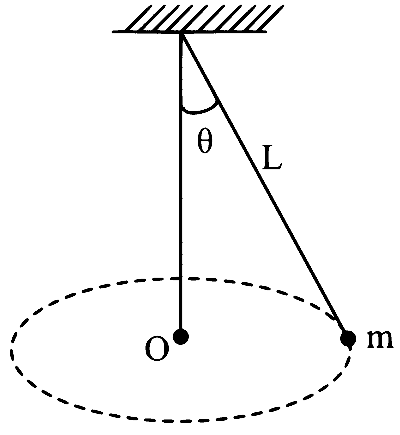
A small ball of mass m is suspended from the ceiling of a floor by a string of length \(\mathrm{L}\). The ball moves along a horizontal circle with constant angular velocity \(\omega\), as shown in the figure. The torque about the centre (O) of the horizontal circle is
If the rotational kinetic energy of a body is increased by $300 \%$, then the percentage increase in its angular momentum will be
Two point objects of masses 1.5 g and 2.5 g respectively are at a distance of 16 cm apart, the centre of gravity is at a distance x from the object of mass 1.5 gm where x is
The moment of inertia of a thin disc about axes $a, b, c, d$ are $\mathbf{I}_1, \mathbf{I}_2, \mathbf{I}_3$ and $\mathbf{I}_4$ respectively,as shown in figure.If the moment of inertia about an axis passing through the centre and perpendicular to the plane of the disc is I then,

A uniform $\operatorname{rod} A B$ is suspended from a point $P$ ,at a variable distance $x$ ,from $A$ ,as shown in figure. To make the rod horizontal,a mass'$m$'is suspended from its end $A$ .Which set of variables will give a straight line when they are plotted?