Difficulty distribution
How the classified questions are distributed by difficulty.
18questions
Not classified
18
100%
Your cart is empty.
Practice Motion - Mechanics - Physics previous year questions organised from real papers, with year-wise coverage and clear topic navigation.
Every graph below is calculated only from this selection.
Year-wise coverage for Motion. Each bar uses a separate theme-derived color.
How the classified questions are distributed by difficulty.
MCQ, numerical, multiple-select and other formats found in these papers.
Top subjects by unique question coverage.
Top topics across the included previous year papers.
Top subtopics inside this exact selection.
Question coverage for the most populated papers. Every active PYP paper remains listed below.
Newest papers appear first. Sort by year, question coverage or name.
| Paper | Year / session | Questions in this view | Open |
|---|---|---|---|
| WB JEE 2026 | 2026 | 2 | View paper |
| WB JEE 2026 | 2026 | 2 | View paper |
| VITEEE 2025 | 2025 | 3 | View paper |
| WB JEE 2025 | 2025 | 2 | View paper |
| WB JEE 2024 | 2024 | 1 | View paper |
| WB JEE 2021 | 2021 | 2 | View paper |
| WB JEE 2020 | 2020 | 1 | View paper |
| WB JEE 2019 | 2019 | 2 | View paper |
| WB JEE 2016 | 2016 | 2 | View paper |
| WB JEE 2008 | 2008 | 1 | View paper |
Practice every matching question in batches of 20, with every available option.
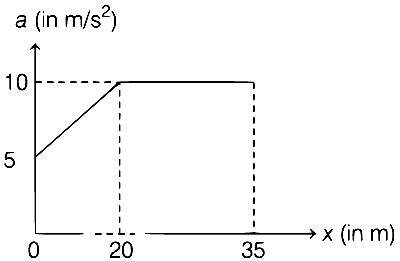


The acceleration-time graph of a particle moving in a straight line is shown in the figure. If the initial velocity of the particle is zero then the velocity-time graph of the particle will be
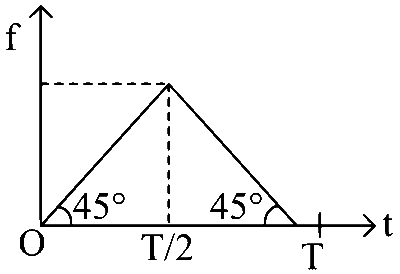


Ruma reached the metro station and found that the escalator was not working. She walked up the stationary escalator with velocity $v_1$ in time $t_1$. On other day if she remains stationary on the escalator moving with velocity $v_2$, then escalator takes her up in time $t_2$. The time taken by her to walk up with velocity $v_1$ on the moving escalator will be
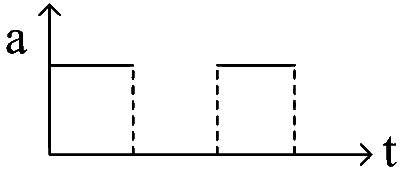
Acceleration-time $(a-t)$ graph of a body is shown in the figurd. Corresponding velocity-time $(v-t)$ graph is


The velocity of a particle moving in a straight line varies with time in such a manner that $v$ versus $t$ graph is velocity is $v_m$ and the total time of motion is $t_0$

(i) Average velocity of the particle is $\frac{\pi}{4} v_m$
(ii) Such motion cannot be realized in practical terms
Choose the correct option on the basis of above two statements.
The height $y$ and the distance $x$ along the horizontal plane of a projectile on a certain planet (with no surrounding atmosphere) are given by $y=8 t-5 t^2 \mathrm{~m}$ and $x=6 t \mathrm{~m}$, where $t$ is in seconds. The velocity with which the projectile is projected is
A ball is projected horizontally with a velocity of $5 \mathrm{~ms}^{-1}$ from the top of a building 19.6 m high. How long will the ball take to hit the ground?
The distance travelled by an object along a straight line in time t is given by \(s = 3 - 4t + 5{t^2}\), the initial velocity of the object is
Which of the velocity-time $(v-t)$ graph(s) can possibly represent one-dimensional motion of a particle?


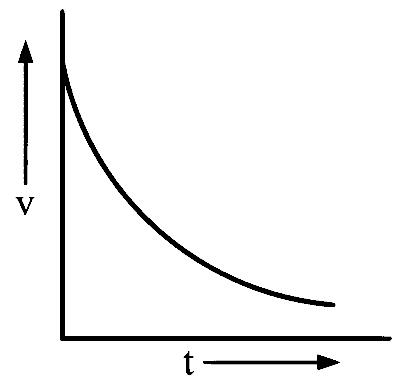
From a tower of height $H$ ,a particle is thrown vertically upwards with a speed $u$ .The time taken by the particle to hit the ground is $n$ times that taken by it to reach the highest point of its path.The relation between $H, u$ and $n$ is