Difficulty distribution
How the classified questions are distributed by difficulty.
2questions
Not classified
2
100%
Your cart is empty.
Practice Fluid Mechanics - Mechanics - Physics previous year questions organised from real papers, with year-wise coverage and clear topic navigation.
Every graph below is calculated only from this selection.
Year-wise coverage for Fluid Mechanics. Each bar uses a separate theme-derived color.
How the classified questions are distributed by difficulty.
MCQ, numerical, multiple-select and other formats found in these papers.
Top subjects by unique question coverage.
Top topics across the included previous year papers.
Top subtopics inside this exact selection.
Question coverage for the most populated papers. Every active PYP paper remains listed below.
Newest papers appear first. Sort by year, question coverage or name.
| Paper | Year / session | Questions in this view | Open |
|---|---|---|---|
| VITEEE 2025 | 2025 | 2 | View paper |
Practice every matching question in batches of 20, with every available option.
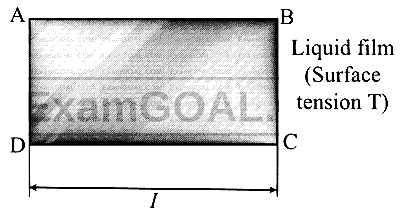
A liquid film is formed over a frame $A B C D$ as shown in figure. Wire $C D$ can slide without friction. Maximum value of mass that can be hanged from $C D$ without breaking the liquid film is
A car of mass 500 kg is lifted by a hydraulic jack that consist of two pistons. If the diameter of large and small pistons are 2 m and 20 cm , respectively. Then force required (in N ) to lift the car by smaller piston is (take, $g=10 \mathrm{~m} / \mathrm{s}^2$ )