Difficulty distribution
How the classified questions are distributed by difficulty.
17questions
Not classified
17
100%
Your cart is empty.
Practice Electromagnetic Induction - Electricity - Physics previous year questions organised from real papers, with year-wise coverage and clear topic navigation.
Every graph below is calculated only from this selection.
Year-wise coverage for Electromagnetic Induction. Each bar uses a separate theme-derived color.
How the classified questions are distributed by difficulty.
MCQ, numerical, multiple-select and other formats found in these papers.
Top subjects by unique question coverage.
Top topics across the included previous year papers.
Top subtopics inside this exact selection.
Question coverage for the most populated papers. Every active PYP paper remains listed below.
Newest papers appear first. Sort by year, question coverage or name.
| Paper | Year / session | Questions in this view | Open |
|---|---|---|---|
| WB JEE 2026 | 2026 | 2 | View paper |
| WB JEE 2026 | 2026 | 2 | View paper |
| WB JEE 2024 | 2024 | 1 | View paper |
| WB JEE 2023 | 2023 | 4 | View paper |
| WB JEE 2022 | 2022 | 1 | View paper |
| WB JEE 2021 | 2021 | 2 | View paper |
| WB JEE 2020 | 2020 | 2 | View paper |
| WB JEE 2018 | 2018 | 1 | View paper |
| WB JEE 2016 | 2016 | 1 | View paper |
| WB JEE 2008 | 2008 | 1 | View paper |
Practice every matching question in batches of 20, with every available option.


In a closed circuit there is only a coil of inductance L and resistance 100 \(\Omega\). The coil is situated in a uniform magnetic field. All on a sudden, the magnetic flux linked with the circuit changes by 5 Weber. What amount of charge will flow in the circuit as a result?
A charged particle of charge q and mass m is placed at a distance 2R from the centre of a vertical cylindrical region of radius R where magnetic field varies as \(\vec{B}=\left(4 t^{2}-2 t+6\right) \hat{k}\), where t is time. Then which of the following statements is/are true?
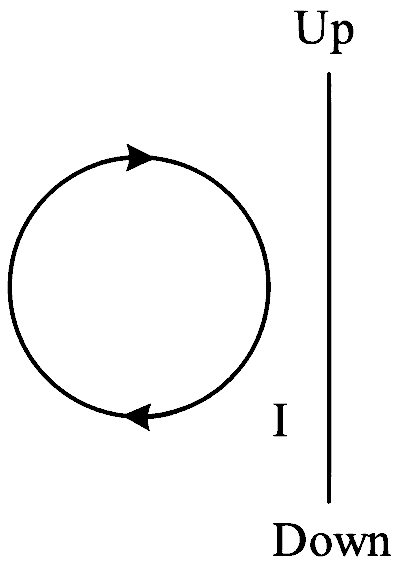
A circular coil is placed near a current carrying conductor, both lying on the plane of the paper. The current is flowing through the conductor in such a way that the induced current in the loop is clockwise as shown in the figure. The current in the wire is,
The electric field of a plane electromagnetic wave of wave number k and angular frequency \(\omega\) is given \(\vec{E}=E_{0}(\hat{i}+\hat{j}) \sin (k z-\omega t)\). Which of the following gives the direction of the associated magnetic field \(\vec{B}\) ?
A charged particle in a uniform magnetic field \(\vec{B}=B_{0} \hat{k}\) starts moving from the origin with velocity \(v=3 \hat{\mathrm{i}}+4 \hat{\mathrm{k}} ~\mathrm{m} / \mathrm{s}\). The trajectory of the particle and the time \(t\) at which it reaches \(2 \mathrm{~m}\) above \(\mathrm{x}-\mathrm{y}\) plane are,
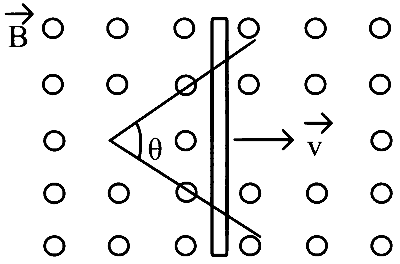
Two straight conducting plates form an angle \(\theta\) where their ends are joined. A conducting bar in contact with the plates and forming an isosceles triangle with them starts at the vertex at time \(t=0\) and moves with constant velocity \(\vec{v}\) to the right as shown in figure. A magnetic field \(\vec{B}\) points out of the page. The magnitude of emf induced at \(t=1\) second will be
Lenz's law of electromagnetic induction corresponds to the
A uniform but time varying magnetic field is present in a circular region of radius ' $R$ '. The magnetic field is perpendicular and into the plane of loop and the magnitude of field is increasing at a constant rate $\alpha$. There is a straight conducting rod of length 2 R placed as shown in figure. The magnitude of induced emf across the rod is

A square of side $L$ lies in the $x-y$ plane,where the magnetic field is given by $B=B_0(2 \hat{i}+3 \hat{j}+4 \hat{k})$ where $B_0$ is constant.The magnetic flux passing through the square is $L$