My Cart
Your Cart 0

    Your cart is empty.

  • Total (Amount) ₹0.00
Previous year question hub

Chemical Kinetics - Physical Chemistry - Chemistry Previous Year Questions

Practice Chemical Kinetics - Physical Chemistry - Chemistry previous year questions organised from real papers, with year-wise coverage and clear topic navigation.

9Papers
8Years
15Questions
1Topics

Chemical Kinetics question pattern

Every graph below is calculated only from this selection.

Questions by year

Year-wise coverage for Chemical Kinetics. Each bar uses a separate theme-derived color.

Difficulty distribution

How the classified questions are distributed by difficulty.

Not classified 15 100%

Question type distribution

MCQ, numerical, multiple-select and other formats found in these papers.

Multiple Choices 15 100%

Subject weightage

Top subjects by unique question coverage.

Chemistry
15 Qs

Most asked topics

Top topics across the included previous year papers.

Physical Chemistry
15 Qs

Subtopic coverage

Top subtopics inside this exact selection.

Chemical Kinetics
15 Qs

Paper coverage

Question coverage for the most populated papers. Every active PYP paper remains listed below.

VITEEE 2025
2 Qs
WB JEE 2025
2 Qs
WB JEE 2024
1 Qs
WB JEE 2023
2 Qs
WB JEE 2022
1 Qs
WB JEE 2021
3 Qs
WB JEE 2020
1 Qs
WB JEE 2019
2 Qs
WB JEE 2018
1 Qs

Included previous year papers

Newest papers appear first. Sort by year, question coverage or name.

PaperYear / sessionQuestions in this viewOpen
VITEEE 202520252View paper
WB JEE 202520252View paper
WB JEE 202420241View paper
WB JEE 202320232View paper
WB JEE 202220221View paper
WB JEE 202120213View paper
WB JEE 202020201View paper
WB JEE 201920192View paper
WB JEE 201820181View paper

All Chemical Kinetics previous year questions

Practice every matching question in batches of 20, with every available option.
1
2018 · Chemistry · Physical Chemistry · Chemical Kinetics
WB JEE 2018
The following equilibrium constants are given

\({N_2} + 3{H_2}\) \(\rightleftharpoons\) \(2N{H_3}\); \({K_1}\)

\({N_2} + {O_2}\) \(\rightleftharpoons\) \(2NO\); \({K_2}\)

\({H_2} + {1 \over 2}{O_2}\) \(\rightleftharpoons\) \({H_2}O\); \({K_3}\)

The equilibrium constant for the oxidation of 2 mole of NH3 to give NO is
A
\({K_1} . {{{K_2}} \over {{K_3}}}\)
B
\({K_2}.{{K_3^3} \over {{K_1}}}\)
C
\({K_2}.{{K_3^2} \over {{K_1}}}\)
D
\(K_2^2.{{K_3^{}} \over {{K_1}}}\)
Open complete paper
2
2019 · Chemistry · Physical Chemistry · Chemical Kinetics
WB JEE 2019
Consider the following two first order reactions occurring at 298 K with same initial concentration of A :

(1) A \(\to\) B; rate constant, k = 0.693 min\(-\)1

(2) A \(\to\) C; half-life, t1/2 = 0.693 min

Choose the correct option.
A
Reaction (1) is faster than reaction (2)
B
Reaction (1) is slower than reaction (2)
C
Both reactions proceed at the same rate.
D
Since two different products are formed, rates cannot be compared.
Open complete paper
3
2019 · Chemistry · Physical Chemistry · Chemical Kinetics
WB JEE 2019
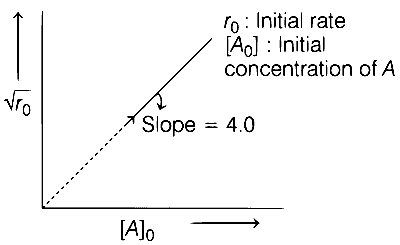
The kinetic study of a reaction like vA \(\to\) P at 300 K provides the following curve, where concentration is taken in mol dm\(-\)3 and time in min.

WB JEE 2019 Chemistry - Chemical Kinetics Question 14 English
Identify the correct order (n) and rate constant (k)
A
n = 0, k = 4.0 mol dm\(-\)3 min\(-\)1
B
n = 1/2, k = 2.0 mol dm\(-\)3/2 min\(-\)1
C
n = 1, k = 8.0 min\(-\)1
D
n = 2, k = 16.0 dm3 mol\(-\)1min\(-\)1
Open complete paper
4
2020 · Chemistry · Physical Chemistry · Chemical Kinetics
WB JEE 2020
For a reaction 2A + B \(\to\) P, when concentration of B alone is doubled, t1/2 does not change and when concentrations of both A and B is doubled, rate increases by a factor of 4. The unit of rate constant is,
A
s-1
B
L mol-1s-1
C
mol L-1s-1
D
L2mol-2s-1
Open complete paper
5
2021 · Chemistry · Physical Chemistry · Chemical Kinetics
WB JEE 2021
The equilibrium constant for the reaction

N2(g) + O2(g) \(\rightleftharpoons\) 2NO(g) is 4 \(\times\) 10\(-\)4 at 2000 K. In presence of a catalyst the equilibrium is attained 10 times faster. Therefore, the equilibrium constant, in presence of the catalyst at 2000 K is
A
4 \(\times\) 10\(-\)4
B
4 \(\times\) 10\(-\)3
C
4 \(\times\) 10\(-\)5
D
2.5 \(\times\) 10\(-\)4
Open complete paper
6
2021 · Chemistry · Physical Chemistry · Chemical Kinetics
WB JEE 2021
Under the same reaction conditions, initial concentration of 1.386 mol dm\(-\)3 of a substance becomes half in 40 s and 20 s through first-order and zero-order kinetics respectively. Ratio \(\left( {{{{k_1}} \over {{k_0}}}} \right)\) of the rate constants for first-order (k1) and zero-order (k0) of the reactions is
A
0.5 mol\(-\)1 dm3
B
0.5 mol dm\(-\)3
C
1.0 mol dm3
D
2.0 mol\(-\)1 dm3
Open complete paper
7
2021 · Chemistry · Physical Chemistry · Chemical Kinetics
WB JEE 2021
2.5 mL 0.4 M weak monoacidic base (Kb = 1 \(\times\) 10\(-\)12 at 25\(^\circ\)C) is titrated with 2/15 M HCl in water at 25\(^\circ\)C. The concentration of H+ at equivalence point is (Kw = 1 \(\times\) 10\(-\)14, at 25\(^\circ\)C)
A
3.7 \(\times\) 10\(-\)13 M
B
3.2 \(\times\) 10\(-\)7 M
C
3.2 \(\times\) 10\(-\)2 M
D
2.7 \(\times\) 10\(-\)2 M
Open complete paper
8
2022 · Chemistry · Physical Chemistry · Chemical Kinetics
WB JEE 2022

Which of the statements are incorrect?

A
pH of a solution of salt of strong acid and weak base is less than 7.
B
pH of a solution of a weak acid and weak base is basic if Kb < Ka.
C
pH of an aqueous solution of 10\(-\)8 (M) HCl is 8.
D
Conjugate acid of NH\(_2^ -\) is NH3.
Open complete paper
9
2023 · Chemistry · Physical Chemistry · Chemical Kinetics
WB JEE 2023

Which of the following would give a linear plot?

(k is the rate constant of an elementary reaction and T is temp. in absolute scale)

A
k vs T
B
k vs 1/T
C
ln k vs T
D
ln k vs 1/T
Open complete paper
10
2023 · Chemistry · Physical Chemistry · Chemical Kinetics
WB JEE 2023

For the reaction A + B \(\to\) C, we have the following data:

Initial concentration of A (in molarity) Initial concentration of B (in molarity) Rate (initial)
(Relevant unit)
1 10 100
1 1 1
10 1 10

The order of the reaction with respect to A and B are

A
Not possible to tell with the given data.
B
First order with respect to both A and B.
C
First order with respect to A and second order with respect to B.
D
Second order with respect to A and first order with respect to B.
Open complete paper
11
2024 · Chemistry · Physical Chemistry · Chemical Kinetics
WB JEE 2024

For a first order reaction with rate constant \(\mathrm{k}\), the slope of the plot of \(\log\) (reactant concentration) against time is

A
k/2.303
B
k
C
\(-\)k/2.303
D
\(-\)k
Open complete paper
12
2025 · Chemistry · Physical Chemistry · Chemical Kinetics
WB JEE 2025

For a chemical reaction, half-life period $\left(t_{\frac{1}{2}}\right)$ is 10 minutes. How much reactant will be left after 20 minutes if one starts with 100 moles of reactant and the order of the reaction be (i) zero, (ii) one and (iii) two?

A
0, 25, 33.33
B
25, 0, 33.33
C
33.33, 25, 0
D
25, 33.33, 0
Open complete paper
13
2025 · Chemistry · Physical Chemistry · Chemical Kinetics
WB JEE 2025

An egg takes 4.0 minutes to boil at sea level where the boiling point of water is $T_1 K$, where as it takes 8.0 minutes to boil on a mountain top where the boiling point of water is $\mathrm{T}_2 \mathrm{~K}$. The activation energy for the reaction that takes place during the boiling of egg is

A
$0.693 \frac{\mathrm{~T}_1-\mathrm{T}_2}{\mathrm{~T}_1 \mathrm{~T}_2}$
B
$0.693 \frac{\mathrm{~T}_2-\mathrm{T}_1}{\mathrm{~T}_1 \mathrm{~T}_2}$
C
$0.693 \mathrm{R} \frac{\mathrm{T}_1 \mathrm{~T}_2}{\mathrm{~T}_2-\mathrm{T}_1}$
D
$0.693 \mathrm{R} \frac{\mathrm{T}_1 \mathrm{~T}_2}{\mathrm{~T}_1-\mathrm{T}_2}$
Open complete paper
14
2025 · Chemistry · Physical Chemistry · Chemical Kinetics
VITEEE 2025

In a first-order reaction, the initial concentration of $A$ is $0.5 \mathrm{~mol} \mathrm{~L}^{-1}$. After 20 minutes, the concentration reduces to $0.4 \mathrm{~mol} \mathrm{~L}^{-1}$. The rate constant is (in $\mathrm{min}^{-1}$ ).

A

0.0051

B

0.0112

C

0.025

D

0.051

Open complete paper
15
2025 · Chemistry · Physical Chemistry · Chemical Kinetics
VITEEE 2025

The activation energy for a reaction is $9.0 \mathrm{kcal} / \mathrm{mol}$. The increase in the rate constant when the temperature is increased from 298 K to 308 K is

A

$10 \%$

B

$100 \%$

C

$50 \%$

D

$64 \%$

Open complete paper