My Cart
Your Cart 0

    Your cart is empty.

  • Total (Amount) ₹0.00
Previous year question hub

Coordination Compounds - Inorganic Chemistry - Chemistry Previous Year Questions

Practice Coordination Compounds - Inorganic Chemistry - Chemistry previous year questions organised from real papers, with year-wise coverage and clear topic navigation.

10Papers
9Years
20Questions
1Topics

Coordination Compounds question pattern

Every graph below is calculated only from this selection.

Questions by year

Year-wise coverage for Coordination Compounds. Each bar uses a separate theme-derived color.

Difficulty distribution

How the classified questions are distributed by difficulty.

Not classified 20 100%

Question type distribution

MCQ, numerical, multiple-select and other formats found in these papers.

Multiple Choices 20 100%

Subject weightage

Top subjects by unique question coverage.

Chemistry
20 Qs

Most asked topics

Top topics across the included previous year papers.

Inorganic Chemistry
20 Qs

Subtopic coverage

Top subtopics inside this exact selection.

Coordination Compounds
20 Qs

Paper coverage

Question coverage for the most populated papers. Every active PYP paper remains listed below.

VITEEE 2025
2 Qs
WB JEE 2025
1 Qs
WB JEE 2024
1 Qs
WB JEE 2023
4 Qs
WB JEE 2022
2 Qs
WB JEE 2021
3 Qs
WB JEE 2020
1 Qs
WB JEE 2019
2 Qs
WB JEE 2018
3 Qs
WB JEE 2017
1 Qs

Included previous year papers

Newest papers appear first. Sort by year, question coverage or name.

PaperYear / sessionQuestions in this viewOpen
VITEEE 202520252View paper
WB JEE 202520251View paper
WB JEE 202420241View paper
WB JEE 202320234View paper
WB JEE 202220222View paper
WB JEE 202120213View paper
WB JEE 202020201View paper
WB JEE 201920192View paper
WB JEE 201820183View paper
WB JEE 201720171View paper

All Coordination Compounds previous year questions

Practice every matching question in batches of 20, with every available option.
1
2017 · Chemistry · Inorganic Chemistry · Coordination Compounds
WB JEE 2017
The number of unpaired electrons in \({[NiC{l_4}]^{2 - }}\), \(Ni{(CO)_4}\) and \({[Cu{(N{H_3})_4}]^{2 + }}\) respectively are
A
2, 2, 1
B
2, 0, 1
C
0, 2, 1
D
2, 2, 0
Open complete paper
2
2018 · Chemistry · Inorganic Chemistry · Coordination Compounds
WB JEE 2018
Ferric ion forms a Prussian blue precipitate due to the formation of
A
\({K_4}[Fe{(CN)_6}]\)
B
\({K_3}[Fe{(CN)_6}]\)
C
\(Fe{(CNS)_3}\)
D
\(F{e_4}{[Fe{(CN)_6}]_3}\)
Open complete paper
3
2018 · Chemistry · Inorganic Chemistry · Coordination Compounds
WB JEE 2018
The main reason that SiCl4 is easily hydrolysed as compared to CCl4 is that
A
Si \(-\) Cl bond is weaker than C \(-\) Cl bond
B
SiCl4 can form hydrogen bonds
C
SiCl4 is covalent
D
Si can extend its coordination number beyond four
Open complete paper
4
2018 · Chemistry · Inorganic Chemistry · Coordination Compounds
WB JEE 2018
Silver chloride dissolves in excess of ammonium hydroxide solution. The cation present in the resulting solution is
A
\({[Ag{(N{H_3})_6}]^ + }\)
B
\({[Ag{(N{H_3})_4}]^ + }\)
C
Ag+
D
\({[Ag{(N{H_3})_2}]^ + }\)
Open complete paper
5
2019 · Chemistry · Inorganic Chemistry · Coordination Compounds
WB JEE 2019
Compounds with spin only magnetic moment equivalent to five unpaired electrons are
A
K4[Mn(CN)6]
B
[Fe(H2O)6]Cl3
C
K3[FeF6]
D
K4[MnF6]
Open complete paper
6
2019 · Chemistry · Inorganic Chemistry · Coordination Compounds
WB JEE 2019
The conductivity measurement of a coordination compound of cobalt (III) shows that it dissociates into 3 ions in solution. The compound is
A
hexaamminecobalt (III) chloride
B
pentaamminesulphatocobalt (III) chloride
C
pentaamminechloridocobalt (III) sulphate
D
pentaamminechlkoridocobalt(III) chloride
Open complete paper
7
2020 · Chemistry · Inorganic Chemistry · Coordination Compounds
WB JEE 2020
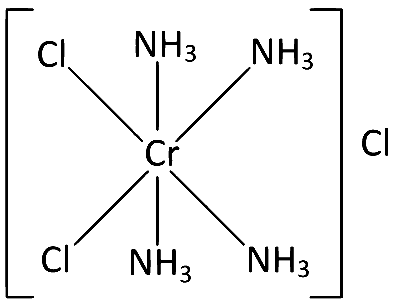
Indicate the correct IUPAC name of the coordination compound shown in the figure.
WB JEE 2020 Chemistry - Coordination Compounds Question 22 English
A
Cis-dichlorotetraminochromium (III) chloride
B
Trans-dichlorotetraminochromium (III) chloride
C
Trans-tetraminedichlorochromium (III) chloride
D
Cis-tetraamminedichlorochromium (III) chloride
Open complete paper
8
2021 · Chemistry · Inorganic Chemistry · Coordination Compounds
WB JEE 2021
Indicate the number of unpaired electrons in K3[Fe(CN)6] and K4[Fe(CN)6].
A
\({K_3}[Fe{(CN)_6}]\) \({K_4}[Fe{(CN)_6}]\)
1 0
B
\({K_3}[Fe{(CN)_6}]\) \({K_4}[Fe{(CN)_6}]\)
5 6
C
\({K_3}[Fe{(CN)_6}]\) \({K_4}[Fe{(CN)_6}]\)
6 5
D
\({K_3}[Fe{(CN)_6}]\) \({K_4}[Fe{(CN)_6}]\)
0 1
Open complete paper
9
2021 · Chemistry · Inorganic Chemistry · Coordination Compounds
WB JEE 2021
A solution is made by a concentrated solution of Co(NO3)2 with a concentrated solution of NaNO2 is 50% acetic acid. A solution of a salt containing metal M is added to the mixture, when a yellow precipitate is formed. Metal 'M' is
A
magnesium
B
sodium
C
potassium
D
zinc
Open complete paper
10
2021 · Chemistry · Inorganic Chemistry · Coordination Compounds
WB JEE 2021
Which of the following compounds have magnetic moment identical with [Cr(H2O)6]3+ ?
A
[Cu(H2O)6]2+
B
[Mn(H2O)6]3+
C
[Fe(H2O)6]3+
D
[Mn(H2O)6]4+
Open complete paper
11
2022 · Chemistry · Inorganic Chemistry · Coordination Compounds
WB JEE 2022

Choose the correct statement for the [Ni(CN)4]2\(-\) complex ion (Atomic no. of Ni = 28)

A
The complex is square planar and paramagnetic.
B
The complex is tetrahedral and diamagnetic.
C
The complex is square planar and diamagnetic.
D
The complex is tetrahedral and paramagnetic.
Open complete paper
12
2022 · Chemistry · Inorganic Chemistry · Coordination Compounds
WB JEE 2022

Sodium nitroprusside is :

A
\(N{a_4}[Fe{(CN)_5}N{O_2}]\)
B
\(N{a_2}[Fe{(CN)_5}NO]\)
C
\(N{a_3}[Fe{(CN)_5}NO]\)
D
\(N{a_4}[Fe{(CN)_5}N{O_3}]\)
Open complete paper
13
2023 · Chemistry · Inorganic Chemistry · Coordination Compounds
WB JEE 2023

Nickel combines with a uninegative monodentate ligand (X\(^-\)) to form a paramagnetic complex [NiX\(_4\)]\(^{2-}\). The hybridisation involved and number of unpaired electrons present in the complex are respectively

A
sp\(^3\), two
B
dsp\(^2\), zero
C
dsp\(^2\), one
D
sp\(^3\), one
Open complete paper
14
2023 · Chemistry · Inorganic Chemistry · Coordination Compounds
WB JEE 2023

Which of the following statements is incorrect?

A
\({[V{F_6}]^{3 - }}\) is paramagnetic with 2 unpaired electrons.
B
\({[CuC{l_4}]^{2 - }}\) is paramagnetic with 1 unpaired electron.
C
\({[Co{(N{H_3})_6}]^{3 + }}\) is diamagnetic
D
\({[Co{F_6}]^{3 - }}\) is paramagnetic with 2 unpaired electrons.
Open complete paper
15
2023 · Chemistry · Inorganic Chemistry · Coordination Compounds
WB JEE 2023

The calculated spin-only magnetic moment values in BM for \(\mathrm{[FeCl_4]^-}\) and \(\mathrm{[Fe(CN)_6]^{3-}}\) are

A
5.9 BM, 1.732 BM
B
4.89 BM, 1.732 BM
C
3.87 BM, 1.732 BM
D
1.732 BM, 2.82 BM
Open complete paper
16
2023 · Chemistry · Inorganic Chemistry · Coordination Compounds
WB JEE 2023

The correct statement about the magnetic properties of \({\left[ {Fe{{(CN)}_6}} \right]^{3 - }}\) and \({\left[ {Fe{F_6}} \right]^{3 - }}\) is

A
Both are paramagnetic
B
Both are diamagnetic
C
\({\left[ {Fe{{(CN)}_6}} \right]^{3 - }}\) is diamagnetic, \({\left[ {Fe{F_6}} \right]^{3 - }}\) is paramagnetic
D
\({\left[ {Fe{{(CN)}_6}} \right]^{3 - }}\) is paramagnetic, \({\left[ {Fe{F_6}} \right]^{3 - }}\) is diamagnetic
Open complete paper
17
2024 · Chemistry · Inorganic Chemistry · Coordination Compounds
WB JEE 2024

Which of the following ion/ions is/are diamagnetic ?

A
\(\left[\mathrm{CoF}_6\right]^{3-}\)
B
\(\left[\mathrm{Co}\left(\mathrm{NH}_3\right)_6\right]^{3+}\)
C
\(\left[\mathrm{Fe}\left(\mathrm{OH}_2\right)_6\right]^{2+}\)
D
\(\left[\mathrm{Fe}(\mathrm{CN})_6\right]^{4-}\)
Open complete paper
18
2025 · Chemistry · Inorganic Chemistry · Coordination Compounds
WB JEE 2025

Identify 'P' and 'Q' in the following reaction
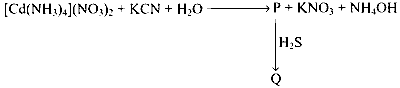
WB JEE 2025 Chemistry - Coordination Compounds Question 5 English

A
$\mathrm{P}=\mathrm{K}_2\left[\mathrm{Cd}(\mathrm{CN})_4\right], \mathrm{Q}=\mathrm{CdS}$
B
$\mathrm{P}=\mathrm{CdS}, \mathrm{Q}=\mathrm{K}_2\left[\mathrm{Cd}(\mathrm{CN})_4\right]$
C
$\mathrm{P}=\mathrm{Cd}\left(\mathrm{NO}_3\right)_2, \mathrm{Q}=\mathrm{CdSO}_4$
D
$\mathrm{P}=\left[\mathrm{Cd}\left(\mathrm{OH}_2\right)_4\right]\left(\mathrm{NO}_3\right)_2, \mathrm{Q}=\left[\mathrm{Cd}\left(\mathrm{NO}_3\right)_4\right]\left(\mathrm{NO}_3\right)_2$
Open complete paper
19
2025 · Chemistry · Inorganic Chemistry · Coordination Compounds
VITEEE 2025

Which of the following complex ions is expected to appear colourless in aqueous solution?

A

$\left[\mathrm{Zn}\left(\mathrm{H}_2 \mathrm{O}\right)_6\right]^{2+}$

B

$\left[\mathrm{Fe}\left(\mathrm{H}_2 \mathrm{O}\right)_6\right]^{3+}$

C

$\left[\mathrm{Cu}\left(\mathrm{NH}_3\right)_4\right]^{2+}$

D

$\left[\mathrm{CoCl}_4\right]^{2-}$

Open complete paper
20
2025 · Chemistry · Inorganic Chemistry · Coordination Compounds
VITEEE 2025

Which of the following complexes can show both facial ( $f a c$ ) and meridional (mer) isomerism?

A

$\left[\mathrm{Co}\left(\mathrm{NH}_3\right)_3 \mathrm{Cl}_3\right]$

B

$\left[\mathrm{Fe}(\mathrm{CN})_6\right]^{3-}$

C

$\left[\mathrm{Cr}\left(\mathrm{H}_2 \mathrm{O}\right)_3 \mathrm{Cl}_3\right]$

D

$\left[\mathrm{Ni}(\mathrm{CO})_4\right]$

Open complete paper