Difficulty distribution
How the classified questions are distributed by difficulty.
15questions
Not classified
15
100%
Your cart is empty.
Practice Heat And Thermodynamics - Mechanics - Physics previous year questions organised from real papers, with year-wise coverage and clear topic navigation.
Every graph below is calculated only from this selection.
Year-wise coverage for Heat And Thermodynamics. Each bar uses a separate theme-derived color.
How the classified questions are distributed by difficulty.
MCQ, numerical, multiple-select and other formats found in these papers.
Top subjects by unique question coverage.
Top topics across the included previous year papers.
Top subtopics inside this exact selection.
Question coverage for the most populated papers. Every active PYP paper remains listed below.
Newest papers appear first. Sort by year, question coverage or name.
| Paper | Year / session | Questions in this view | Open |
|---|---|---|---|
| VITEEE 2024 | 2024 | 3 | View paper |
| VITEEE 2023 | 2023 | 3 | View paper |
| VITEEE 2022 | 2022 | 5 | View paper |
| VITEEE 2021 | 2021 | 4 | View paper |
Practice every matching question in batches of 20, with every available option.
The efficiency of a Carnot engine kept at the temperatures of \(27^{\circ} \mathrm{C}\) and \(127^{\circ} \mathrm{C}\) is
The velocity of sound in a gas is \(1300 \mathrm{~m} / \mathrm{s}\) at STP and specific heat at constant pressure is \(6.84 \mathrm{~cal} \mathrm{~K}^{-1} \mathrm{~mol}^{-1}\). The rms velocity at STP is \((R=1.98 \mathrm{~cal} \mathrm{~K}^{-1} \mathrm{~mol}^{-1})\)
The zeroth law of thermodynamics for three systems \(A, B\) and \(C\) in contact demands that
According to equipartition law of energy each particle in a system of particles have thermal energy \(E\) equal to
An electrically heated coil is immersed in a calorimeter containing \(360 \mathrm{~g}\) of water at \(10^{\circ} \mathrm{C}\). The coil consumes energy at the rate of \(90 \mathrm{~W}\). The water equivalent of calorimeter and coil is \(40 \mathrm{~g}\). The temperature of water after \(10 \mathrm{~min}\) is
If two metallic plates of equal thickness and thermal conductivities \(K_1\) and \(K_2\) are put together face to face and a common plate is constructed, then the equivalent thermal conductivity of this plate will be
From Wien's displacement law, \(\lambda_m T=\) constant \(=0.00289 \mathrm{~m}-\mathrm{K}\)
Radiation from moon givens \(\lambda_m=4700 \mathop A\limits^o\) and another wavelength of \(14 \times 10^{-6} \mathrm{~m}\). Out of the following which conclusion(s) drawn is/are correct with the given information regarding the moon and the sun?
1. Sun radiations are reflected from moon's disc.
2. The temperature of moon's surface is \(207 \mathrm{~K}\)
3. The temperature of the sun is \(6160 \mathrm{~K}\).
If the ratio of specific heat of a gas at constant pressure to that at constant volume is \(\gamma\), the change in internal energy of the given mass of gas, when the volume changes from \(V\) to \(2 V\) at constant pressure \(p\) is
If 2 moles of an ideal monoatomic gas at temperature \(T_0\) is mixed with 4 moles of another ideal monoatomic gas at temperature \(2 T_0\), then the temperature of the mixture is
Two gases occupy two containers \(A\) and \(B\). The gas in \(A\) of volume \(0.20 \mathrm{~m}^3\), exerts a pressure of \(1.40 \mathrm{~MPa}\) and that in \(B\), of volume \(0.30 \mathrm{~m}^3\) exerts a pressure of \(0.7 \mathrm{~MPa}\). The two containers and united by a tube of negligible volume and the gases are allowed to exchange. Then, if the temperature remains constants. the final pressure in the container will be (in MPa).
0.5 mole of an ideal gas at constant temperature \(27^{\circ} \mathrm{C}\) kept inside a cylinder of length \(L\) and cross-section \(A\) closed by a massless piston. The cylinder is attached with a conducting rod of length L\(_1\) cross-section area \((1 / 9) \mathrm{m}^2\) and thermal conductivity \(k_1\) whose other end is maintained at \(0^{\circ} \mathrm{C}\). If piston is moved such that rate of heat flow through the conduction rod is constant then velocity of piston when it is at height \(L / 2\) from the bottom of cylinder is (neglect any kind of heat loss from system)

A copper sphere cools from \(82^{\circ} \mathrm{C}\) to \(50^{\circ} \mathrm{C}\) in 10 minutes and to \(42^{\circ} \mathrm{C}\) in the next \(10 \mathrm{~min}\). Calculate the temperature of the surrounding?
Two different ideal diatomic gases $A$ and $B$ are initially in the same state. $A$ and $B$ are then expanded to same final volume through adiabatic and isothermal process, respectively. If $p_A, p_B$ and $T_A, T_B$ represent the final pressures and temperatures at $A$ and $B$ respectively, then
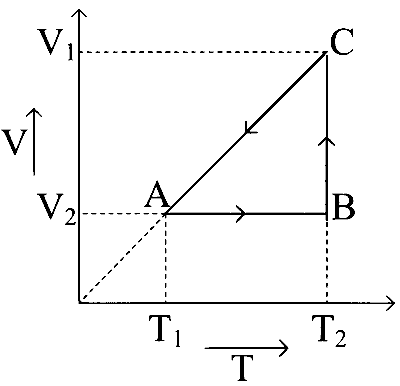
A cyclic process for 1 mole of an ideal is shown in the $V-T$ diagram. The work done in $A B, B C$ and $C A$ respectively is
Variation of internal energy with density of one mole of monoatomic gas is depicted in the below figure, corresponding variation of pressure with volume can be depicted as (assuming the curve is rectangular hyperbola)


