Difficulty distribution
How the classified questions are distributed by difficulty.
8questions
Not classified
8
100%
Your cart is empty.
Practice Current Electricity - Electromagnetism - Physics previous year questions organised from real papers, with year-wise coverage and clear topic navigation.
Every graph below is calculated only from this selection.
Year-wise coverage for Current Electricity. Each bar uses a separate theme-derived color.
How the classified questions are distributed by difficulty.
MCQ, numerical, multiple-select and other formats found in these papers.
Top subjects by unique question coverage.
Top topics across the included previous year papers.
Top subtopics inside this exact selection.
Question coverage for the most populated papers. Every active PYP paper remains listed below.
Newest papers appear first. Sort by year, question coverage or name.
| Paper | Year / session | Questions in this view | Open |
|---|---|---|---|
| VITEEE 2024 | 2024 | 3 | View paper |
| VITEEE 2023 | 2023 | 1 | View paper |
| VITEEE 2021 | 2021 | 4 | View paper |
Practice every matching question in batches of 20, with every available option.
A silver wire of radius \(0.1 \mathrm{~cm}\) carries a current of \(2 \mathrm{~A}\). If the charge density in silver is \(5.86 \times 10^{28} \mathrm{~m}^{-3}\), the drift velocity is
The temperature coefficient of the resistance of a wire is 0.00125 per \({ }^{\circ} \mathrm{C}\). At \(300 \mathrm{~K}\) its resistance is \(1 \Omega\). The resistance of wire will be \(2 \Omega\) at
An electron revolves in a circle at the rate of \(10^{19}\) rounds per second. The equivalent current is \(\left(e=1.6 \times 10^{-19} \mathrm{C}\right)\)
24 cells of emf \(1.5 \mathrm{~V}\) each having internal resistance of \(1 \mathrm{~ohm}\) are connected to an external resistance of \(1.5 \mathrm{~ohms}\). To get maximum current
A constant voltage is applied between the two ends of a uniform metallic wire, Some heat is developed in it. The heat developed is halved if
36 cells each of internal resistance $0.5 \Omega$ and emf 1.5 V each are used to send current through an external circuit of $2 \Omega$ resistor. For getting maximum current, $n$ cells are combined in series in each row. If total number of such rows are $m$, then the value of $(n / m)$ will be
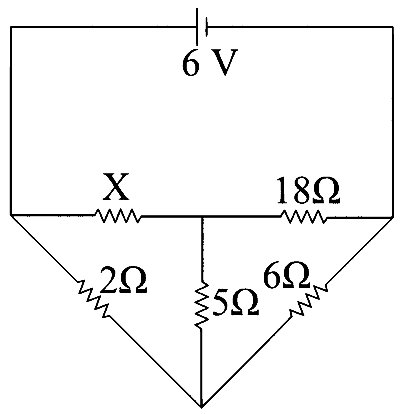
The magnitude of resistance $X$ in the circuit shown below in the figure, when no current flows through the $5 \Omega$ resistor, is
The maximum power rating of a $20 \Omega$ resistor is 2 kW . Then, it cannot be used with 300 V DC source because the