Difficulty distribution
How the classified questions are distributed by difficulty.
18questions
Not classified
18
100%
Your cart is empty.
Practice Alternating Current - Electromagnetism - Physics previous year questions organised from real papers, with year-wise coverage and clear topic navigation.
Every graph below is calculated only from this selection.
Year-wise coverage for Alternating Current. Each bar uses a separate theme-derived color.
How the classified questions are distributed by difficulty.
MCQ, numerical, multiple-select and other formats found in these papers.
Top subjects by unique question coverage.
Top topics across the included previous year papers.
Top subtopics inside this exact selection.
Question coverage for the most populated papers. Every active PYP paper remains listed below.
Newest papers appear first. Sort by year, question coverage or name.
| Paper | Year / session | Questions in this view | Open |
|---|---|---|---|
| TS EAMCET 2023 (Online) 12th May Morning Shift | 2023 | 1 | View paper |
| TS EAMCET 2023 ONLINE 12TH MAY EVENING SHIFT | 2023 | 1 | View paper |
| TS EAMCET 2023 ONLINE 13TH MAY EVENING SHIFT | 2023 | 1 | View paper |
| TS EAMCET 2023 ONLINE 13TH MAY MORNING SHIFT | 2023 | 1 | View paper |
| TS EAMCET 2023 ONLINE 14TH MAY EVENING SHIFT | 2023 | 1 | View paper |
| TS EAMCET 2023 ONLINE 14TH MAY MORNING SHIFT | 2023 | 1 | View paper |
| TS EAMCET 2022 (Online) 19th July Evening Shift | 2022 | 1 | View paper |
| TS EAMCET 2022 (Online) 19th July Morning Shift | 2022 | 1 | View paper |
| TS EAMCET 2022 (Online) 20th July Evening Shift | 2022 | 1 | View paper |
| TS EAMCET 2022 (Online) 20th July Morning Shift | 2022 | 1 | View paper |
| TS EAMCET 2022 ONLINE 18TH JULY EVENING SHIFT | 2022 | 1 | View paper |
| TS EAMCET 2022 ONLINE 18TH JULY MORNING SHIFT | 2022 | 1 | View paper |
| TS EAMCET 2020 (Online) 10th September Evening Shift | 2020 | 1 | View paper |
| TS EAMCET 2020 (Online) 11th September Evening Shift | 2020 | 1 | View paper |
| TS EAMCET 2020 (Online) 11th September Morning Shift | 2020 | 1 | View paper |
| TS EAMCET 2020 (Online) 14th September Evening Shift | 2020 | 1 | View paper |
| TS EAMCET 2020 (Online) 14th September Morning Shift | 2020 | 1 | View paper |
| TS EAMCET 2020 (Online) 14th September Morning Shift | 2020 | 1 | View paper |
Practice every matching question in batches of 20, with every available option.
A $2 \mu \mathrm{~F}$ capacitor is charged to 50 V by a battery. The battery is removed after capacitor if fully charged. At time $t=0$, a 10 mH coil is connected in series with the capacitor. The maximum rate at which the current changes in the circuit is
An AC current is given by the expression, $I(t)=50 \sin (200 \pi t)$ in amperes. The frequency and rms value of the current, respectively are
In an ideal step up transformer, if the input voltage and input power are $V_1$ and $R_1$ respectively and the output voltage and output power are $V_2$ and $P_2$ respectively, then
An alternating emf given by the equation $E=200 \sin (50 \pi t)$ (where, $E$ is in volts and $t$ is in seconds) is applied across a series combination of an inductor and a resistor having inductive reactance $40 \Omega$ and resistance $30 \Omega$ respectively. At time $t=1 \mathrm{~s}$, the power dissipated by the resistor is close to $\left(\cos 53^{\circ}=0.6\right)$
A series $L-C-R$ circuit is connected to an AC source of voltage $150 \sin (80 \pi t)$ volt. If the resistance of the resistor in the circuit is $25 \Omega$ and the impedance in the circuit is $75 \Omega$, the average power dissipated per cycle in the circuit is
A coil has a resistance of $30 \Omega$ and an inductive reactance of $20 \Omega$ at 50 Hz frequency. If an AC source of $200 \mathrm{~V}, 100 \mathrm{~Hz}$ is connected across the coil, the current in the coil is
At very high frequencies, the current ( $i$ ) in the given circuit is
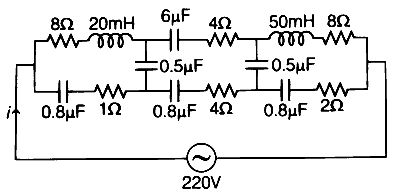
An alternating voltage $\varepsilon=30 \sin 200 t$ (in volts) is applied to the circuit below. The amplitude of the current through the circuit is

The $Q$ value of a series $L-C-R$ circuit with $L=2 \mathrm{H}$, $C=32 \mu \mathrm{~F}, R=20 \Omega$ is
A resistor of resistance of $100 \Omega$ is connected to an AC source $\varepsilon=10 \sin (250 \pi) t$. The energy dissipated as heat during $t=0$ to $t=1 \mathrm{~ms}$ is approximately.
A generator produces a current of 100 A at 4000 V . The voltage is stepped up to $2 \times 10^5 \mathrm{~V}$ by a transformer before being sent on a high voltage transmission line of resistance $50 \Omega$. The percentage of power loss in the transmission line is
A capacitor of capacitance $100 \mu \mathrm{~F}$ and a coil of resistance $20 \Omega$ and inductance 12.5 mH are connected in series with a $220 \mathrm{~V}, \frac{200}{\pi} \mathrm{~Hz}, \mathrm{AC}$ source. The maximum value of instantaneous current in the circuit is
For an $R$ - $L-C$ circuit, driven with voltage of amplitude $V_m$ and frequency $\omega_0=\frac{1}{\sqrt{L C}}$, the current exhibits resonance. The quality factor $Q$ is
The $L-C-R$ circuit shown below is driven by an ideal AC voltage source.

At frequency $f=\frac{1}{2 \pi \sqrt{L C}}$, choose the correct statement.
A $L-C-R$ series circuit is connected to a source of alternating current. At resonance, the applied voltage and the current flowing through the circuit will have a phase difference of
Which one of the following curves represents the variation of impedance ( $Z$ ) with frequency $f$ in a series $L-C-R$ circuit, when connected to an AC source?


