My Cart
Your Cart 0

    Your cart is empty.

  • Total (Amount) ₹0.00
Previous year question hub

Yarn Structure and Properties - Yarn Manufacture, Yarn Structure and Properties - Textile Engineering & Fibre Science Previous Year Questions

Practice Yarn Structure and Properties - Yarn Manufacture, Yarn Structure and Properties - Textile Engineering & Fibre Science previous year questions organised from real papers, with year-wise coverage and clear topic navigation.

13Papers
13Years
21Questions
1Topics

Yarn Structure and Properties question pattern

Every graph below is calculated only from this selection.

Questions by year

Year-wise coverage for Yarn Structure and Properties. Each bar uses a separate theme-derived color.

Difficulty distribution

How the classified questions are distributed by difficulty.

Medium 14 66.7%
Easy 7 33.3%

Question type distribution

MCQ, numerical, multiple-select and other formats found in these papers.

MCQ 16 76.2%
Numerical Answer Type (NAT) 3 14.3%
MSQ 2 9.5%

Subject weightage

Top subjects by unique question coverage.

Textile Engineering & Fibre Science
21 Qs

Most asked topics

Top topics across the included previous year papers.

Yarn Manufacture, Yarn Structure and Properties
21 Qs

Subtopic coverage

Top subtopics inside this exact selection.

Yarn Structure and Properties
21 Qs

Paper coverage

Question coverage for the most populated papers. Every active PYP paper remains listed below.

Textile Engineering & Fibre Science (TF) 2025
1 Qs
Textile Engineering & Fibre Science (TF) 2024
1 Qs
Textile Engineering & Fibre Science (TF) 2023
2 Qs
Textile Engineering & Fibre Science (TF) 2022
1 Qs
Textile Engineering & Fibre Science (TF) 2021
2 Qs
Textile Engineering & Fibre Science (TF) 2018
2 Qs
Textile Engineering & Fibre Science (TF) 2017
2 Qs
Textile Engineering & Fibre Science (TF) 2014
1 Qs
Textile Engineering & Fibre Science (TF) 2013
1 Qs
Textile Engineering & Fibre Science (TF) 2010
2 Qs
Textile Engineering & Fibre Science (TF) 2009
3 Qs
Textile Engineering & Fibre Science (TF) 2008
1 Qs
Textile Engineering & Fibre Science (TF) 2007
2 Qs

Included previous year papers

Newest papers appear first. Sort by year, question coverage or name.

PaperYear / sessionQuestions in this viewOpen
Textile Engineering & Fibre Science (TF) 202520251View paper
Textile Engineering & Fibre Science (TF) 202420241View paper
Textile Engineering & Fibre Science (TF) 202320232View paper
Textile Engineering & Fibre Science (TF) 202220221View paper
Textile Engineering & Fibre Science (TF) 202120212View paper
Textile Engineering & Fibre Science (TF) 201820182View paper
Textile Engineering & Fibre Science (TF) 201720172View paper
Textile Engineering & Fibre Science (TF) 201420141View paper
Textile Engineering & Fibre Science (TF) 201320131View paper
Textile Engineering & Fibre Science (TF) 201020102View paper
Textile Engineering & Fibre Science (TF) 200920093View paper
Textile Engineering & Fibre Science (TF) 200820081View paper
Textile Engineering & Fibre Science (TF) 200720072View paper

All Yarn Structure and Properties previous year questions

Practice every matching question in batches of 20, with every available option.

1
2007 · Textile Engineering & Fibre Science · Yarn Manufacture, Yarn Structure and Properties · Yarn Structure and Properties
Textile Engineering & Fibre Science (TF) 2007

To produce a soft and flexible yarn, one needs

Open complete paper
2
2007 · Textile Engineering & Fibre Science · Yarn Manufacture, Yarn Structure and Properties · Yarn Structure and Properties
Textile Engineering & Fibre Science (TF) 2007

On a classimat, as compared to the yarn fault B2, the fault D3 is

Open complete paper
3
2008 · Textile Engineering & Fibre Science · Yarn Manufacture, Yarn Structure and Properties · Yarn Structure and Properties
Textile Engineering & Fibre Science (TF) 2008

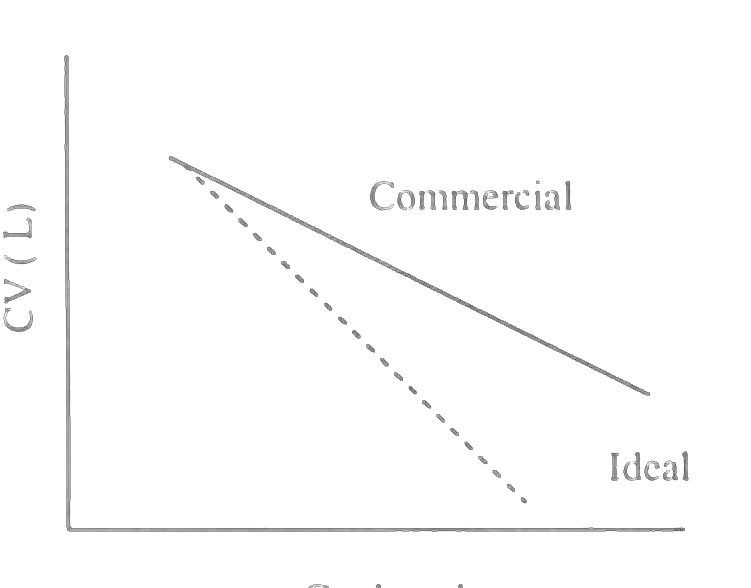
Out of the following four diagrams A, B, C, and D, the correct variance-length (VL) curve for an ideal and commercial yarns is represented by

Open complete paper
4
2009 · Textile Engineering & Fibre Science · Yarn Manufacture, Yarn Structure and Properties · Yarn Structure and Properties
Textile Engineering & Fibre Science (TF) 2009

Hairiness of ring spun yarn increases, when

Open complete paper
5
2009 · Textile Engineering & Fibre Science · Yarn Manufacture, Yarn Structure and Properties · Yarn Structure and Properties
Textile Engineering & Fibre Science (TF) 2009

On drawing and heat setting, the properties of synthetic fibres change such that

Open complete paper
6
2009 · Textile Engineering & Fibre Science · Yarn Manufacture, Yarn Structure and Properties · Yarn Structure and Properties
Textile Engineering & Fibre Science (TF) 2009

The CV% of 3-ply yarn produced using these single yarns will be approximately

Open complete paper
7
2010 · Textile Engineering & Fibre Science · Yarn Manufacture, Yarn Structure and Properties · Yarn Structure and Properties
Textile Engineering & Fibre Science (TF) 2010

The thinnest Classimat fault among the following is

Open complete paper
8
2010 · Textile Engineering & Fibre Science · Yarn Manufacture, Yarn Structure and Properties · Yarn Structure and Properties
Textile Engineering & Fibre Science (TF) 2010
Which of the following statements are NOT true?
(P) Ring spun yarns have higher fibre migration than DREF-2 friction spun yarns
(Q) The rotor spun yarns have uniform twist structure across the cross-section
(R) An jet spun yarn is formed by fibre wrapping
(S) Minimum number of fibres required for a particular count yarn is higher for ring spun yarns as compared to rotor spun yarns
Open complete paper
9
2013 · Textile Engineering & Fibre Science · Yarn Manufacture, Yarn Structure and Properties · Yarn Structure and Properties
Textile Engineering & Fibre Science (TF) 2013
Index of irregularity of yarn is approximately
Open complete paper
10
2014 · Textile Engineering & Fibre Science · Yarn Manufacture, Yarn Structure and Properties · Yarn Structure and Properties
Textile Engineering & Fibre Science (TF) 2014

Consider the following figures. Choose the alternative that represents the correct relation

Open complete paper
11
2017 · Textile Engineering & Fibre Science · Yarn Manufacture, Yarn Structure and Properties · Yarn Structure and Properties
Textile Engineering & Fibre Science (TF) 2017
Pilling resistance of
Open complete paper
12
2017 · Textile Engineering & Fibre Science · Yarn Manufacture, Yarn Structure and Properties · Yarn Structure and Properties
Textile Engineering & Fibre Science (TF) 2017
The tenacity of a two-fold yarn is 1.1 times the tenacity of its component single yarn. The breaking load of the two-fold yarn is X times the breaking load of its single component yarn. Neglecting length contraction due to twist, the value of X, accurate to one decimal place, is __________
Open complete paper
13
2018 · Textile Engineering & Fibre Science · Yarn Manufacture, Yarn Structure and Properties · Yarn Structure and Properties
Textile Engineering & Fibre Science (TF) 2018

Heat-setting of melt-spun and drawn Nylon 6 filament yarn under slack condition leads to increase in its

Open complete paper
14
2018 · Textile Engineering & Fibre Science · Yarn Manufacture, Yarn Structure and Properties · Yarn Structure and Properties
Textile Engineering & Fibre Science (TF) 2018

The technology that produces yarn with the maximum fibre migration is

Open complete paper
15
2021 · Textile Engineering & Fibre Science · Yarn Manufacture, Yarn Structure and Properties · Yarn Structure and Properties
Textile Engineering & Fibre Science (TF) 2021

In Classimat system, the yarn fault H2, as compared to yarn fault C3, is

Open complete paper
16
2021 · Textile Engineering & Fibre Science · Yarn Manufacture, Yarn Structure and Properties · Yarn Structure and Properties
Textile Engineering & Fibre Science (TF) 2021

A 50 tex yarn with mass CV of 12.5 % is produced from staple polyester fibres each of 4.5 denier fineness. The index of irregularity of the yarn, (rounded off to two decimal places), is __________.

Open complete paper
17
2022 · Textile Engineering & Fibre Science · Yarn Manufacture, Yarn Structure and Properties · Yarn Structure and Properties
Textile Engineering & Fibre Science (TF) 2022

Yarn that has helically twisted fibres at the core and belts/wrappers on the surface is

Open complete paper
18
2023 · Textile Engineering & Fibre Science · Yarn Manufacture, Yarn Structure and Properties · Yarn Structure and Properties
Textile Engineering & Fibre Science (TF) 2023
Determine the correctness or otherwise of the following Assertion [a] and Reason [r].
[a]: In boiling water, polyester POY shows higher shrinkage than polyester FDY
[r]: Molecular chain orientation is higher in polyester FDY than in polyester POY
Open complete paper
19
2023 · Textile Engineering & Fibre Science · Yarn Manufacture, Yarn Structure and Properties · Yarn Structure and Properties
Textile Engineering & Fibre Science (TF) 2023

Amongst the Classimat faults A2, B1, D4, H2 and I1, the correct statement(s) is/are

Open complete paper
20
2024 · Textile Engineering & Fibre Science · Yarn Manufacture, Yarn Structure and Properties · Yarn Structure and Properties
Textile Engineering & Fibre Science (TF) 2024
A plied yarn is prepared by twisting two single yarns (A and B). Yarn A has a mean count of 20 tex and a coefficient of variation (CV) of count of 20%. Yarn B has a mean count of 30 tex and a CV of count of 10%. Neglecting twist contraction during plying, the CV (%) of the count of the plied yarn (in integer) is __________.
Open complete paper

Showing 20 of 21 questions