My Cart
Your Cart 0

    Your cart is empty.

  • Total (Amount) ₹0.00
Previous year question hub

Nonwoven Manufacture - Fabric Manufacture, Structure and Properties - Textile Engineering & Fibre Science Previous Year Questions

Practice Nonwoven Manufacture - Fabric Manufacture, Structure and Properties - Textile Engineering & Fibre Science previous year questions organised from real papers, with year-wise coverage and clear topic navigation.

16Papers
16Years
18Questions
1Topics

Nonwoven Manufacture question pattern

Every graph below is calculated only from this selection.

Questions by year

Year-wise coverage for Nonwoven Manufacture. Each bar uses a separate theme-derived color.

Difficulty distribution

How the classified questions are distributed by difficulty.

Easy 10 55.6%
Medium 8 44.4%

Question type distribution

MCQ, numerical, multiple-select and other formats found in these papers.

MCQ 15 83.3%
Numerical Answer Type (NAT) 3 16.7%

Subject weightage

Top subjects by unique question coverage.

Textile Engineering & Fibre Science
18 Qs

Most asked topics

Top topics across the included previous year papers.

Fabric Manufacture, Structure and Properties
18 Qs

Subtopic coverage

Top subtopics inside this exact selection.

Nonwoven Manufacture
18 Qs

Paper coverage

Question coverage for the most populated papers. Every active PYP paper remains listed below.

Textile Engineering and Fibre Science (TF) 2026
1 Qs
Textile Engineering & Fibre Science (TF) 2025
1 Qs
Textile Engineering & Fibre Science (TF) 2024
1 Qs
Textile Engineering & Fibre Science (TF) 2023
1 Qs
Textile Engineering & Fibre Science (TF) 2022
1 Qs
Textile Engineering & Fibre Science (TF) 2021
1 Qs
Textile Engineering & Fibre Science (TF) 2020
1 Qs
Textile Engineering & Fibre Science (TF) 2019
1 Qs
Textile Engineering & Fibre Science (TF) 2018
1 Qs
Textile Engineering & Fibre Science (TF) 2017
2 Qs
Textile Engineering & Fibre Science (TF) 2016
2 Qs
Textile Engineering & Fibre Science (TF) 2015
1 Qs
Textile Engineering & Fibre Science (TF) 2014
1 Qs
Textile Engineering & Fibre Science (TF) 2013
1 Qs
Textile Engineering & Fibre Science (TF) 2008
1 Qs
Textile Engineering & Fibre Science (TF) 2007
1 Qs

Included previous year papers

Newest papers appear first. Sort by year, question coverage or name.

PaperYear / sessionQuestions in this viewOpen
Textile Engineering and Fibre Science (TF) 202620261View paper
Textile Engineering & Fibre Science (TF) 202520251View paper
Textile Engineering & Fibre Science (TF) 202420241View paper
Textile Engineering & Fibre Science (TF) 202320231View paper
Textile Engineering & Fibre Science (TF) 202220221View paper
Textile Engineering & Fibre Science (TF) 202120211View paper
Textile Engineering & Fibre Science (TF) 202020201View paper
Textile Engineering & Fibre Science (TF) 201920191View paper
Textile Engineering & Fibre Science (TF) 201820181View paper
Textile Engineering & Fibre Science (TF) 201720172View paper
Textile Engineering & Fibre Science (TF) 201620162View paper
Textile Engineering & Fibre Science (TF) 201520151View paper
Textile Engineering & Fibre Science (TF) 201420141View paper
Textile Engineering & Fibre Science (TF) 201320131View paper
Textile Engineering & Fibre Science (TF) 200820081View paper
Textile Engineering & Fibre Science (TF) 200720071View paper

All Nonwoven Manufacture previous year questions

Practice every matching question in batches of 20, with every available option.

1
2007 · Textile Engineering & Fibre Science · Fabric Manufacture, Structure and Properties · Nonwoven Manufacture
Textile Engineering & Fibre Science (TF) 2007
Consider the following columns and choose the correct combination from amongst the alternatives A, B, C and D
Group IGroup II
P   Wet laid1   Coarse fibre
Q   Spun lace2   Hollow fibre
R   Spun bonded3   Short fibre
S   Needle punched4   Thermoplastic fibre
5   Very flexible fibre
6   Natural fibre
Open complete paper
2
2008 · Textile Engineering & Fibre Science · Fabric Manufacture, Structure and Properties · Nonwoven Manufacture
Textile Engineering & Fibre Science (TF) 2008
Fibres with a rectangular cross-section are preferred over those with trilobal cross-section for mechanically entangled nonwoven fabric, because rectangular cross-section
Open complete paper
3
2013 · Textile Engineering & Fibre Science · Fabric Manufacture, Structure and Properties · Nonwoven Manufacture
Textile Engineering & Fibre Science (TF) 2013

The nonwoven process which has the highest production rate is

Open complete paper
4
2014 · Textile Engineering & Fibre Science · Fabric Manufacture, Structure and Properties · Nonwoven Manufacture
Textile Engineering & Fibre Science (TF) 2014
A needle-punched nonwoven fabric has 2 mm thickness and 400 g/m² areal density. If the fibre density is 0.9 g/cm³, the volume porosity (%) of the fabric, accurate to the nearest integer, will be ......
Open complete paper
5
2015 · Textile Engineering & Fibre Science · Fabric Manufacture, Structure and Properties · Nonwoven Manufacture
Textile Engineering & Fibre Science (TF) 2015

The technology/ies used for producing SMS fabric is/are

Open complete paper
6
2016 · Textile Engineering & Fibre Science · Fabric Manufacture, Structure and Properties · Nonwoven Manufacture
Textile Engineering & Fibre Science (TF) 2016

In needle punching process, higher punch density CAN NOT cause

Open complete paper
7
2016 · Textile Engineering & Fibre Science · Fabric Manufacture, Structure and Properties · Nonwoven Manufacture
Textile Engineering & Fibre Science (TF) 2016

The least desired feature of fibre in wet laid nonwoven fabric is

Open complete paper
8
2017 · Textile Engineering & Fibre Science · Fabric Manufacture, Structure and Properties · Nonwoven Manufacture
Textile Engineering & Fibre Science (TF) 2017
A perpendicular-laid nonwoven
Open complete paper
9
2017 · Textile Engineering & Fibre Science · Fabric Manufacture, Structure and Properties · Nonwoven Manufacture
Textile Engineering & Fibre Science (TF) 2017
A needle loom, having a needle board with 2000 needles/m, is operating at a stroke frequency of 2000 strokes/min and producing a needle-punched nonwoven fabric at 5 m/min. The punch density, in number of punches per cm2, is__________
Open complete paper
10
2018 · Textile Engineering & Fibre Science · Fabric Manufacture, Structure and Properties · Nonwoven Manufacture
Textile Engineering & Fibre Science (TF) 2018
Compared to filaments in spunbonded nonwovens, those in meltblown nonwovens have
P. Lower orientation of molecular chains
Q. Higher orientation of molecular chains
R. Lower variability in diameter
S. Higher variability in diameter
Open complete paper
11
2019 · Textile Engineering & Fibre Science · Fabric Manufacture, Structure and Properties · Nonwoven Manufacture
Textile Engineering & Fibre Science (TF) 2019
The punch density of a needle-punched nonwoven fabric is 50 punches/cm². If the stroke frequency of needle bed is doubled and the fabric delivery speed is halved, then the punch density (punches/cm²) would be
Open complete paper
12
2020 · Textile Engineering & Fibre Science · Fabric Manufacture, Structure and Properties · Nonwoven Manufacture
Textile Engineering & Fibre Science (TF) 2020

The technology that does NOT produce a nonwoven fabric is

Open complete paper
13
2021 · Textile Engineering & Fibre Science · Fabric Manufacture, Structure and Properties · Nonwoven Manufacture
Textile Engineering & Fibre Science (TF) 2021

The nonwoven technology which uses high-pressure water jets is

Open complete paper
14
2022 · Textile Engineering & Fibre Science · Fabric Manufacture, Structure and Properties · Nonwoven Manufacture
Textile Engineering & Fibre Science (TF) 2022

Consider the following components of a needle:

P. Shank

Q. Beard

R. Barb

S. Latch

The combination of correct components of a needle in a needle punching nonwoven machine is

Open complete paper
15
2023 · Textile Engineering & Fibre Science · Fabric Manufacture, Structure and Properties · Nonwoven Manufacture
Textile Engineering & Fibre Science (TF) 2023
The bonding process followed for production of highloft nonwovens is
Open complete paper
16
2024 · Textile Engineering & Fibre Science · Fabric Manufacture, Structure and Properties · Nonwoven Manufacture
Textile Engineering & Fibre Science (TF) 2024
Determine the correctness or otherwise of the following Assertion [a] and Reason [r]:
[a]: The variability of fibre diameter in melt-blown nonwoven fabric is remarkably higher than that in spunbond nonwoven fabric
[r]: Hot air attenuation in melt-blown process is responsible for high variation in fibre diameter
Open complete paper
17
2025 · Textile Engineering & Fibre Science · Fabric Manufacture, Structure and Properties · Nonwoven Manufacture
Textile Engineering & Fibre Science (TF) 2025
A needlepunching machine has two needle boards which operate sequentially at the same frequency to produce nonwoven with 200 punches/cm². Each needle board has 40000 needles per meter width. If the delivery speed of the machine is \(80\text{ m/min}\), then the frequency (strokes/min) of each needle board (answer in integer) is __________.
Open complete paper
18
2026 · Textile Engineering & Fibre Science · Fabric Manufacture, Structure and Properties · Nonwoven Manufacture
Textile Engineering and Fibre Science (TF) 2026
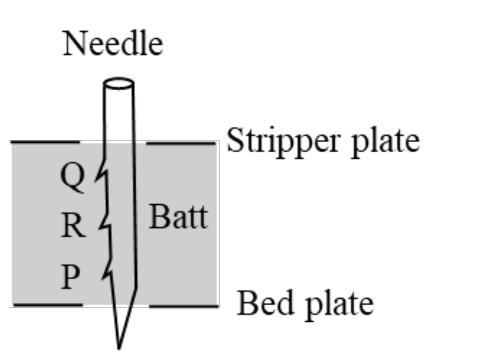
The following figure shows the position of a needle at its lowest position during needlepunching operation. If P, Q and R are barbs on the needle, then which is the correct order of barbs in terms of workload?

Question source image

Open complete paper