My Cart
Your Cart 0

    Your cart is empty.

  • Total (Amount) ₹0.00
Previous year question hub

Numerical Methods - Engineering Mathematics - Textile Engineering & Fibre Science Previous Year Questions

Practice Numerical Methods - Engineering Mathematics - Textile Engineering & Fibre Science previous year questions organised from real papers, with year-wise coverage and clear topic navigation.

14Papers
14Years
20Questions
1Topics

Numerical Methods question pattern

Every graph below is calculated only from this selection.

Questions by year

Year-wise coverage for Numerical Methods. Each bar uses a separate theme-derived color.

Difficulty distribution

How the classified questions are distributed by difficulty.

Easy 13 65%
Medium 7 35%

Question type distribution

MCQ, numerical, multiple-select and other formats found in these papers.

Numerical Answer Type (NAT) 11 55%
MCQ 9 45%

Subject weightage

Top subjects by unique question coverage.

Textile Engineering & Fibre Science
20 Qs

Most asked topics

Top topics across the included previous year papers.

Engineering Mathematics
20 Qs

Subtopic coverage

Top subtopics inside this exact selection.

Numerical Methods
20 Qs

Paper coverage

Question coverage for the most populated papers. Every active PYP paper remains listed below.

Textile Engineering and Fibre Science (TF) 2026
1 Qs
Textile Engineering & Fibre Science (TF) 2025
2 Qs
Textile Engineering & Fibre Science (TF) 2024
2 Qs
Textile Engineering & Fibre Science (TF) 2023
2 Qs
Textile Engineering & Fibre Science (TF) 2022
1 Qs
Textile Engineering & Fibre Science (TF) 2021
1 Qs
Textile Engineering & Fibre Science (TF) 2020
1 Qs
Textile Engineering & Fibre Science (TF) 2019
1 Qs
Textile Engineering & Fibre Science (TF) 2018
1 Qs
Textile Engineering & Fibre Science (TF) 2017
1 Qs
Textile Engineering & Fibre Science (TF) 2016
1 Qs
Textile Engineering & Fibre Science (TF) 2014
2 Qs
Textile Engineering & Fibre Science (TF) 2008
2 Qs
Textile Engineering & Fibre Science (TF) 2007
2 Qs

Included previous year papers

Newest papers appear first. Sort by year, question coverage or name.

PaperYear / sessionQuestions in this viewOpen
Textile Engineering and Fibre Science (TF) 202620261View paper
Textile Engineering & Fibre Science (TF) 202520252View paper
Textile Engineering & Fibre Science (TF) 202420242View paper
Textile Engineering & Fibre Science (TF) 202320232View paper
Textile Engineering & Fibre Science (TF) 202220221View paper
Textile Engineering & Fibre Science (TF) 202120211View paper
Textile Engineering & Fibre Science (TF) 202020201View paper
Textile Engineering & Fibre Science (TF) 201920191View paper
Textile Engineering & Fibre Science (TF) 201820181View paper
Textile Engineering & Fibre Science (TF) 201720171View paper
Textile Engineering & Fibre Science (TF) 201620161View paper
Textile Engineering & Fibre Science (TF) 201420142View paper
Textile Engineering & Fibre Science (TF) 200820082View paper
Textile Engineering & Fibre Science (TF) 200720072View paper

All Numerical Methods previous year questions

Practice every matching question in batches of 20, with every available option.

1
2007 · Textile Engineering & Fibre Science · Engineering Mathematics · Numerical Methods
Textile Engineering & Fibre Science (TF) 2007
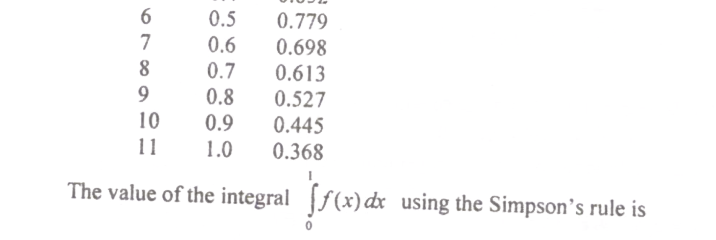
The following table gives the values of a function f(x) at points x_j in an interval [0,1], where j represents the index of the point in the given interval
jx_jf(x_j)
10.01.000
20.10.990
30.20.961
40.30.914
50.40.852
60.50.779
70.60.698
80.70.613
90.80.527
100.90.445
111.00.368

The value of the integral \int_{0}^{1} f(x) \, dx using the Simpson's rule is

Question diagram

Open complete paper
2
2007 · Textile Engineering & Fibre Science · Engineering Mathematics · Numerical Methods
Textile Engineering & Fibre Science (TF) 2007
For the following system of equations
\[ \begin{aligned} 4x_1 + x_2 + x_3 &= 4 \\ x_1 + 4x_2 - 2x_3 &= 4 \\ 3x_1 + 2x_2 - 4x_3 &= 6 \end{aligned} \]
which of the following is the solution, obtained after TWO iterations using Jacobi method
Open complete paper
3
2008 · Textile Engineering & Fibre Science · Engineering Mathematics · Numerical Methods
Textile Engineering & Fibre Science (TF) 2008
The Newton iterative method \(x_{n+1} = x_n - \frac{f(x_n)}{f'(x_n)}\), \(n = 0,1,2,3, ...\), gives the first order approximate root \(x_1\) of the function \(f(x) = x^3 - 6x + 2\) with \(x_0 = 0\) as
Open complete paper
4
2008 · Textile Engineering & Fibre Science · Engineering Mathematics · Numerical Methods
Textile Engineering & Fibre Science (TF) 2008
The trapezoidal rule to evaluate integrals is expressed as \(\int_a^b f(x) dx = \frac{(b-a)}{2} [f(a) + f(b)]\). Using the above expression, evaluate the integral \(\int_0^1 \frac{dx}{1+2x}\) by subdividing the interval \([0,1]\) into two equal parts. The value of this integral is
Open complete paper
5
2014 · Textile Engineering & Fibre Science · Engineering Mathematics · Numerical Methods
Textile Engineering & Fibre Science (TF) 2014
The 51st common term of the two arithmetic sequences 15, 19, 23 …… and 14, 19, 24 ……, is …….
Open complete paper
6
2014 · Textile Engineering & Fibre Science · Engineering Mathematics · Numerical Methods
Textile Engineering & Fibre Science (TF) 2014
\[ \int_0^1 e^x dx \] is evaluated both by Trapezoidal rule and Simpson's 1/3 rule by taking two subintervals. The difference between the results, accurate to the second decimal place, is …….
Open complete paper
7
2016 · Textile Engineering & Fibre Science · Engineering Mathematics · Numerical Methods
Textile Engineering & Fibre Science (TF) 2016

Which of the following is a multi-step numerical method for solving the ordinary differential equation?

Open complete paper
8
2017 · Textile Engineering & Fibre Science · Engineering Mathematics · Numerical Methods
Textile Engineering & Fibre Science (TF) 2017
Using Simpson's 1/3 rule, the value of the integral \( \frac{1}{\pi} \int_{0}^{\pi} (1 + \sqrt{\sin(x)}) dx \), accurate to two decimal places, is __________
Open complete paper
9
2018 · Textile Engineering & Fibre Science · Engineering Mathematics · Numerical Methods
Textile Engineering & Fibre Science (TF) 2018
Starting from the initial point x₀ = 10, if the sequence {xₙ} is generated using Newton Raphson method to compute the root of the equation x⁴ - 600 = 0, then x₂, accurate to two decimal places, is equal to __________
Open complete paper
10
2019 · Textile Engineering & Fibre Science · Engineering Mathematics · Numerical Methods
Textile Engineering & Fibre Science (TF) 2019
The value of the integral \(\frac{6}{\pi} \int_{0}^{\pi/2} \frac{\cos 2x}{1+\sin x} dx\) obtained using Simpson's \(\frac{1}{3}\) rule (rounded off to 2 decimal places) is ____________.
Open complete paper
11
2020 · Textile Engineering & Fibre Science · Engineering Mathematics · Numerical Methods
Textile Engineering & Fibre Science (TF) 2020
Assuming the step size \( h = 1 \), the numerical value of the definite integral \( \int_{0}^{2} \frac{x^2}{1+x^2} dx \) obtained using Trapezoidal rule (rounded off to 2 decimal places) is __________.
Open complete paper
12
2021 · Textile Engineering & Fibre Science · Engineering Mathematics · Numerical Methods
Textile Engineering & Fibre Science (TF) 2021
If the numerical solution of the initial value problem
\( y' = \frac{t^2}{t + y^3}, \; y(0) = 1, \)
is obtained by the Euler’s method with step size of 0.2, then the value of \( y(0.4) \), (rounded off to two decimal places), is __________.
Open complete paper
13
2022 · Textile Engineering & Fibre Science · Engineering Mathematics · Numerical Methods
Textile Engineering & Fibre Science (TF) 2022
Assuming the step size h = 1, the numeric value (rounded off to 2 decimal places) of the definite integral \[ \int_{1}^{3} \frac{x}{1+x} dx \] obtained using Simpson's rule is ______________.
Open complete paper
14
2023 · Textile Engineering & Fibre Science · Engineering Mathematics · Numerical Methods
Textile Engineering & Fibre Science (TF) 2023
The Newton-Raphson method is being used for two iterations to find an approximate solution of the equation $e^x - 1 = 0$ with an initial guess of 1. The difference between the actual and approximate solutions (rounded off to 2 decimal places) is __________.
Open complete paper
15
2023 · Textile Engineering & Fibre Science · Engineering Mathematics · Numerical Methods
Textile Engineering & Fibre Science (TF) 2023
The area under the curve $y = x^2 + 2x$ between $x = 0$ and $x = 4$, using the trapezoidal rule with a step size of one, (in integer) is __________.
Open complete paper
16
2024 · Textile Engineering & Fibre Science · Engineering Mathematics · Numerical Methods
Textile Engineering & Fibre Science (TF) 2024
The approximate value of the integral \[ \int_{2}^{3} \frac{dx}{x} \] using Simpson’s rule with \( h = 0.5 \) is
Open complete paper
17
2024 · Textile Engineering & Fibre Science · Engineering Mathematics · Numerical Methods
Textile Engineering & Fibre Science (TF) 2024
A scientist wants to find the root of the equation \(2x^3 + x^2 - 1 = 0\) lying in (0,1). He applies Secant method only once by taking two initial guesses 0.5 and 0.7. The value of the root is approximately
Open complete paper
18
2025 · Textile Engineering & Fibre Science · Engineering Mathematics · Numerical Methods
Textile Engineering & Fibre Science (TF) 2025
The value of \(a\) for which the Euler method with step size \(h = 0.1\) provides \(y(1.1) = 1.2\) for the following initial value problem is
\[\frac{dy}{dx} = -2xy^a, \quad y(1) = 2\]
Open complete paper
19
2025 · Textile Engineering & Fibre Science · Engineering Mathematics · Numerical Methods
Textile Engineering & Fibre Science (TF) 2025
For a textile industry, the revenue of selling \( x \) ton of yarn is \( R(x) = 4x \) and the cost of producing \( x \) ton of yarn is \( C(x) = 10 + 2x + 3x^{2/3} \). The industry decided to calculate the break-even (when revenue is equal to the cost) for \( x \) ton of yarn using Newton-Rapson method. Assuming the initial break-even of 8 ton, the break-even (ton) after the first iteration is
Open complete paper
20
2026 · Textile Engineering & Fibre Science · Engineering Mathematics · Numerical Methods
Textile Engineering and Fibre Science (TF) 2026
The value of the integral \(\int_{0}^{6} x^2 dx\) calculated using the trapezoidal rule with \(n = 2\) (two subintervals) is __________. (answer in integer)
Open complete paper