My Cart
Your Cart 0

    Your cart is empty.

  • Total (Amount) ₹0.00
Previous year question hub

Multiple and Partial Correlation - Multivariate Analysis - Statistics Previous Year Questions

Practice Multiple and Partial Correlation - Multivariate Analysis - Statistics previous year questions organised from real papers, with year-wise coverage and clear topic navigation.

5Papers
5Years
5Questions
1Topics

Multiple and Partial Correlation question pattern

Every graph below is calculated only from this selection.

Questions by year

Year-wise coverage for Multiple and Partial Correlation. Each bar uses a separate theme-derived color.

Difficulty distribution

How the classified questions are distributed by difficulty.

Medium 5 100%

Question type distribution

MCQ, numerical, multiple-select and other formats found in these papers.

Numerical Answer Type (NAT) 3 60%
MCQ 2 40%

Subject weightage

Top subjects by unique question coverage.

Statistics
5 Qs

Most asked topics

Top topics across the included previous year papers.

Multivariate Analysis
5 Qs

Subtopic coverage

Top subtopics inside this exact selection.

Multiple and Partial Correlation
5 Qs

Paper coverage

Question coverage for the most populated papers. Every active PYP paper remains listed below.

Statistics (ST) 2025
1 Qs
Statistics (ST) 2022
1 Qs
Statistics (ST) 2021
1 Qs
Statistics (ST) 2020
1 Qs
Statistics (ST) 2019
1 Qs

Included previous year papers

Newest papers appear first. Sort by year, question coverage or name.

PaperYear / sessionQuestions in this viewOpen
Statistics (ST) 202520251View paper
Statistics (ST) 202220221View paper
Statistics (ST) 202120211View paper
Statistics (ST) 202020201View paper
Statistics (ST) 201920191View paper

All Multiple and Partial Correlation previous year questions

Practice every matching question in batches of 20, with every available option.

1
2019 · Statistics · Multivariate Analysis · Multiple and Partial Correlation
Statistics (ST) 2019
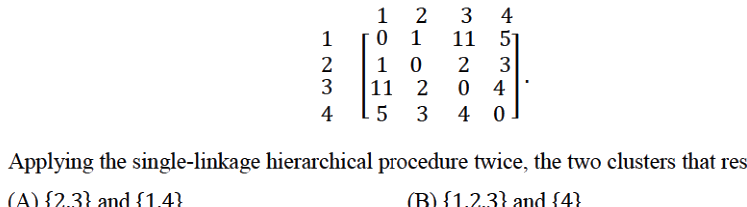
Consider the objects {1,2,3,4} with the distance matrix
1234
101115
21023
311204
45340
Applying the single-linkage hierarchical procedure twice, the two clusters that result are

Question diagram

Open complete paper
2
2020 · Statistics · Multivariate Analysis · Multiple and Partial Correlation
Statistics (ST) 2020
Let \(\underline{X} = (X_1, X_2, X_3)\) be a random vector following \(N_3(\underline{0}, \Sigma)\) distribution, where \[ \Sigma = \begin{bmatrix} 1 & \frac{1}{3} & \frac{1}{3} \\ \frac{1}{3} & 1 & \frac{1}{3} \\ \frac{1}{3} & \frac{1}{3} & 1 \end{bmatrix}. \] Then the partial correlation coefficient between \(X_2\) and \(X_3\), with fixed \(X_1\), equals ____________________ (correct up to two decimal places).
Open complete paper
3
2021 · Statistics · Multivariate Analysis · Multiple and Partial Correlation
Statistics (ST) 2021
Let \((Y, X_1, X_2)\) be a random vector with mean vector \(\begin{pmatrix} 5 \\ 2 \\ 0 \end{pmatrix}\) and variance-covariance matrix \(\begin{bmatrix} 10 & 0.5 & -0.5 \\ 0.5 & 7 & 1.5 \\ -0.5 & 1.5 & 2 \end{bmatrix}\). Then the value of the multiple correlation coefficient between \(Y\) and its best linear predictor on \(X_1\) and \(X_2\) equals __________ (round off to 2 decimal places).
Open complete paper
4
2022 · Statistics · Multivariate Analysis · Multiple and Partial Correlation
Statistics (ST) 2022
Let \(\boldsymbol{X} = \begin{pmatrix} X_1 \\ X_2 \\ X_3 \end{pmatrix}\) follow \(N_3(\boldsymbol{\mu}, \boldsymbol{\Sigma})\) with \(\boldsymbol{\mu} = \begin{pmatrix} 2 \\ -3 \\ 2 \end{pmatrix}\) and \(\boldsymbol{\Sigma} = \begin{bmatrix} 4 & -1 & 1 \\ -1 & 2 & a \\ 1 & a & 2 \end{bmatrix}\), where \(a \in \mathbb{R}\). Suppose that the partial correlation coefficient between \(X_2\) and \(X_3\), keeping \(X_1\) fixed, is \(\frac{5}{7}\). Then \(a\) is equal to
Open complete paper
5
2025 · Statistics · Multivariate Analysis · Multiple and Partial Correlation
Statistics (ST) 2025
Let \((X_1, X_2, X_3)^T\) have the following distribution \(N_3\left(\begin{pmatrix} 0 \\ 0 \\ 0 \end{pmatrix}, \begin{pmatrix} 1 & 0.4 & 0 \\ 0.4 & 1 & 0.6 \\ 0 & 0.6 & 1 \end{pmatrix}\right)\) Then the value of the partial correlation coefficient between \(X_1\) and \(X_2\) given \(X_3\) is __________ (rounded off to two decimal places).
Open complete paper