My Cart
Your Cart 0

    Your cart is empty.

  • Total (Amount) ₹0.00
Previous year question hub

Eigenvalues, Diagonalization and Quadratic Forms - Matrix Theory: - Statistics Previous Year Questions

Practice Eigenvalues, Diagonalization and Quadratic Forms - Matrix Theory: - Statistics previous year questions organised from real papers, with year-wise coverage and clear topic navigation.

8Papers
8Years
30Questions
1Topics

Eigenvalues, Diagonalization and Quadratic Forms question pattern

Every graph below is calculated only from this selection.

Questions by year

Year-wise coverage for Eigenvalues, Diagonalization and Quadratic Forms. Each bar uses a separate theme-derived color.

Difficulty distribution

How the classified questions are distributed by difficulty.

Medium 21 70%
Easy 7 23.3%
Hard 2 6.7%
Question type distribution

MCQ, numerical, multiple-select and other formats found in these papers.

MCQ 17 56.7%
MSQ 7 23.3%
Numerical Answer Type (NAT) 6 20%

Subject weightage

Top subjects by unique question coverage.

Statistics
30 Qs

Most asked topics

Top topics across the included previous year papers.

Matrix Theory:
30 Qs

Subtopic coverage

Top subtopics inside this exact selection.

Eigenvalues, Diagonalization and Quadratic Forms
30 Qs

Paper coverage

Question coverage for the most populated papers. Every active PYP paper remains listed below.

Statistics (ST) 2026
3 Qs
Statistics (ST) 2025
5 Qs
Statistics (ST) 2024
4 Qs
Statistics (ST) 2023
2 Qs
Statistics (ST) 2022
4 Qs
Statistics (ST) 2021
4 Qs
Statistics (ST) 2020
3 Qs
Statistics (ST) 2019
5 Qs

Included previous year papers

Newest papers appear first. Sort by year, question coverage or name.

PaperYear / sessionQuestions in this viewOpen
Statistics (ST) 202620263View paper
Statistics (ST) 202520255View paper
Statistics (ST) 202420244View paper
Statistics (ST) 202320232View paper
Statistics (ST) 202220224View paper
Statistics (ST) 202120214View paper
Statistics (ST) 202020203View paper
Statistics (ST) 201920195View paper

All Eigenvalues, Diagonalization and Quadratic Forms previous year questions

Practice every matching question in batches of 20, with every available option.

1
2019 · Statistics · Matrix Theory: · Eigenvalues, Diagonalization and Quadratic Forms
Statistics (ST) 2019
Let \(A\) be a \(6 \times 6\) complex matrix with \(A^3 \neq \mathbf{0}\) and \(A^4 = \mathbf{0}\). Then the number of Jordan blocks of \(A\) is
Open complete paper
2
2019 · Statistics · Matrix Theory: · Eigenvalues, Diagonalization and Quadratic Forms
Statistics (ST) 2019
The minimal polynomial of the matrix \(\begin{bmatrix} 1 & 1 & 2 & 0 \\ 0 & 2 & 1 & 0 \\ 0 & 0 & 1 & 0 \\ 0 & 0 & 0 & 2 \end{bmatrix}\) is
Open complete paper
3
2019 · Statistics · Matrix Theory: · Eigenvalues, Diagonalization and Quadratic Forms
Statistics (ST) 2019
The matrix \(\begin{bmatrix} 1 & x & z \\ 0 & 2 & y \\ 0 & 0 & 1 \end{bmatrix}\) is diagonalizable when \((x, y, z)\) equals
Open complete paper
4
2019 · Statistics · Matrix Theory: · Eigenvalues, Diagonalization and Quadratic Forms
Statistics (ST) 2019
Let \( A \) be a \( n \times n \) positive semi-definite matrix with eigenvalues \( \lambda_1 \geq \cdots \geq \lambda_n \), and with \( \alpha \) as the maximum diagonal entry. We can find a vector \( x \) such that \( x^T x = 1 \), where \( t \) denotes the transpose, and
Open complete paper
5
2019 · Statistics · Matrix Theory: · Eigenvalues, Diagonalization and Quadratic Forms
Statistics (ST) 2019
Let \(I\) be the \(4 \times 4\) identity matrix and \(v = (1, 2, 3, 4)^t\), where \(t\) denotes the transpose. Then the determinant of \(I + vv^t\) is equal to ...
Open complete paper
6
2020 · Statistics · Matrix Theory: · Eigenvalues, Diagonalization and Quadratic Forms
Statistics (ST) 2020
Let \(M\) be a \(3 \times 3\) non-zero idempotent matrix and let \(I_3\) denote the \(3 \times 3\) identity matrix. Then which of the following statements is FALSE?
Open complete paper
7
2020 · Statistics · Matrix Theory: · Eigenvalues, Diagonalization and Quadratic Forms
Statistics (ST) 2020
Consider the linear transformation \( T: \mathbb{C}^3 \to \mathbb{C}^3 \) defined by
\[ T((x, y, z)) = \left( x, \; \frac{\sqrt{3}}{2} y - \frac{1}{2} z, \; \frac{1}{2} y + \frac{\sqrt{3}}{2} z \right), \]
where \( \mathbb{C} \) is the set of all complex numbers and \( \mathbb{C}^3 = \mathbb{C} \times \mathbb{C} \times \mathbb{C} \). Which of the following statements is TRUE?
Open complete paper
8
2020 · Statistics · Matrix Theory: · Eigenvalues, Diagonalization and Quadratic Forms
Statistics (ST) 2020
Let \( M \) be a \( 4 \times 4 \) matrix with \( (x - 1)^2 (x - 3)^2 \) as its minimal polynomial. Then, which of the following statements is FALSE?
Open complete paper
9
2021 · Statistics · Matrix Theory: · Eigenvalues, Diagonalization and Quadratic Forms
Statistics (ST) 2021
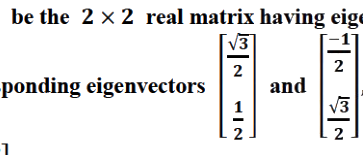
Let $A$ be the $2 \times 2$ real matrix having eigenvalues $1$ and $-1$, with corresponding eigenvectors $\begin{bmatrix} \frac{\sqrt{3}}{2} \\ \frac{1}{2} \end{bmatrix}$ and $\begin{bmatrix} -\frac{1}{2} \\ \frac{\sqrt{3}}{2} \end{bmatrix}$, respectively. If $A^{2021} = \begin{bmatrix} a & b \\ c & d \end{bmatrix}$, then $a + b + c + d$ equals ________ (round off to 2 decimal places).

Question diagram

Open complete paper
10
2021 · Statistics · Matrix Theory: · Eigenvalues, Diagonalization and Quadratic Forms
Statistics (ST) 2021
Let \( M \) be the collection of all \( 3 \times 3 \) real symmetric positive definite matrices. Consider the set \[ S = \left\{ A \in M : A^{50} - \frac{1}{4} A^{48} = 0 \right\}, \] where \( 0 \) denotes the \( 3 \times 3 \) zero matrix. Then the number of elements in \( S \) equals
Open complete paper
11
2021 · Statistics · Matrix Theory: · Eigenvalues, Diagonalization and Quadratic Forms
Statistics (ST) 2021
Let \( A \) be a \( 3 \times 3 \) real matrix such that \( I_3 + A \) is invertible and let \( B = (I_3 + A)^{-1} (I_3 - A) \), where \( I_3 \) denotes the \( 3 \times 3 \) identity matrix. Then which one of the following statements is true?
Open complete paper
12
2021 · Statistics · Matrix Theory: · Eigenvalues, Diagonalization and Quadratic Forms
Statistics (ST) 2021
Let \( Y \) follow \( N_8(\underline{0}, I_8) \) distribution, where \( I_8 \) is the \( 8 \times 8 \) identity matrix. Let \( \underline{Y}^T \Sigma_1 \underline{Y} \) and \( \underline{Y}^T \Sigma_2 \underline{Y} \) be independent and follow central chi-square distributions with \( 3 \) and \( 4 \) degrees of freedom, respectively, where \( \Sigma_1 \) and \( \Sigma_2 \) are \( 8 \times 8 \) matrices and \( \underline{Y}^T \) denotes transpose of \( \underline{Y} \). Then which of the following statements is/are true?
P : \( \Sigma_1 \) and \( \Sigma_2 \) are idempotent.
Q : \( \Sigma_1 \Sigma_2 = \underline{0} \), where \( \underline{0} \) is the \( 8 \times 8 \) zero matrix.
Open complete paper
13
2022 · Statistics · Matrix Theory: · Eigenvalues, Diagonalization and Quadratic Forms
Statistics (ST) 2022
Let \( M \) be a \( 2 \times 2 \) real matrix such that \( (I + M)^{-1} = I - \alpha M \), where \( \alpha \) is a non-zero real number and \( I \) is the \( 2 \times 2 \) identity matrix. If the trace of the matrix \( M \) is 3, then the value of \( \alpha \) is
Open complete paper
14
2022 · Statistics · Matrix Theory: · Eigenvalues, Diagonalization and Quadratic Forms
Statistics (ST) 2022
Let \( M \) be a \( 3 \times 3 \) real symmetric matrix with eigenvalues \( -1, 1, 2 \) and the corresponding unit eigenvectors \( u, v, w \), respectively. Let \( x \) and \( y \) be two vectors in \( \mathbb{R}^3 \) such that \( Mx = u + 2(v + w) \) and \( M^2y = u - (v + 2w) \). Considering the usual inner product in \( \mathbb{R}^3 \), the value of \( |x + y|^2 \), where \( |x + y| \) is the length of the vector \( x + y \), is
Open complete paper
15
2022 · Statistics · Matrix Theory: · Eigenvalues, Diagonalization and Quadratic Forms
Statistics (ST) 2022
Let \(M\) be any \(3 \times 3\) symmetric matrix with eigenvalues 1, 2 and 3. Let \(N\) be any \(3 \times 3\) matrix with real eigenvalues such that \(MN + N^T M = 3I\), where \(I\) is the \(3 \times 3\) identity matrix. Then which of the following cannot be eigenvalue(s) of the matrix \(N\)?
Open complete paper
16
2022 · Statistics · Matrix Theory: · Eigenvalues, Diagonalization and Quadratic Forms
Statistics (ST) 2022

Let M be a 3 × 2 real matrix having a singular value decomposition as M = USVT, where the matrix S = , U is a 3 × 3 orthogonal matrix, and V is a 2 × 2 orthogonal matrix. Then which of the following statements is/are true?

Open complete paper
17
2023 · Statistics · Matrix Theory: · Eigenvalues, Diagonalization and Quadratic Forms
Statistics (ST) 2023
Let \( A \) be a \( 3 \times 3 \) real matrix having eigenvalues \( 1, 0 \), and \( -1 \). If \( B = A^2 + 2A + I_3 \), where \( I_3 \) is the \( 3 \times 3 \) identity matrix, then which one of the following statements is true?
Open complete paper
18
2023 · Statistics · Matrix Theory: · Eigenvalues, Diagonalization and Quadratic Forms
Statistics (ST) 2023
Let \( A \) be an \( n \times n \) real matrix. Consider the following statements.
(I)    If \( A \) is symmetric, then there exists \( c \geq 0 \) such that \( A + cI_n \) is symmetric and positive definite, where \( I_n \) is the \( n \times n \) identity matrix.
(II)    If \( A \) is symmetric and positive definite, then there exists a symmetric and positive definite matrix \( B \) such that \( A = B^2 \).
Which of the above statements is/are true?
Open complete paper
19
2024 · Statistics · Matrix Theory: · Eigenvalues, Diagonalization and Quadratic Forms
Statistics (ST) 2024
Let \( A \) be a \( 3 \times 3 \) real matrix and let \( I_3 \) be the \( 3 \times 3 \) identity matrix. Which one of the following statements is NOT true?
Open complete paper
20
2024 · Statistics · Matrix Theory: · Eigenvalues, Diagonalization and Quadratic Forms
Statistics (ST) 2024
Let \( A \) be an \( n \times n \) real matrix. Which of the following statements is/are true?
Open complete paper

Showing 20 of 30 questions