My Cart
Your Cart 0

    Your cart is empty.

  • Total (Amount) ₹0.00
Previous year question hub

Advanced Manufacturing - Manufacturing Processes II - Production & Industrial Engineering Previous Year Questions

Practice Advanced Manufacturing - Manufacturing Processes II - Production & Industrial Engineering previous year questions organised from real papers, with year-wise coverage and clear topic navigation.

16Papers
14Years
37Questions
1Topics

Advanced Manufacturing question pattern

Every graph below is calculated only from this selection.

Questions by year

Year-wise coverage for Advanced Manufacturing. Each bar uses a separate theme-derived color.

Difficulty distribution

How the classified questions are distributed by difficulty.

Easy 26 70.3%
Medium 11 29.7%

Question type distribution

MCQ, numerical, multiple-select and other formats found in these papers.

MCQ 29 78.4%
Numerical Answer Type (NAT) 8 21.6%

Subject weightage

Top subjects by unique question coverage.

Production & Industrial Engineering
37 Qs

Most asked topics

Top topics across the included previous year papers.

Manufacturing Processes II
37 Qs

Subtopic coverage

Top subtopics inside this exact selection.

Advanced Manufacturing
37 Qs

Paper coverage

Question coverage for the most populated papers. Every active PYP paper remains listed below.

Production & Industrial Engineering (PI) 2022
3 Qs
Production & Industrial Engineering (PI) 2021
2 Qs
Production & Industrial Engineering (PI) 2020
3 Qs
Production & Industrial Engineering (PI) 2018
3 Qs
Production & Industrial Engineering (PI) 2017
3 Qs
Production & Industrial Engineering (PI) 2016
2 Qs
Production & Industrial Engineering (PI) 2014
2 Qs
Production & Industrial Engineering (PI) 2013 [Session 1]
2 Qs
Production & Industrial Engineering (PI) 2013 [Session 2]
2 Qs
Production & Industrial Engineering (PI) 2013 [Session 4]
2 Qs
Production & Industrial Engineering (PI) 2012
1 Qs
Production & Industrial Engineering (PI) 2011
3 Qs
Production & Industrial Engineering (PI) 2010
4 Qs
Production & Industrial Engineering (PI) 2009
2 Qs
Production & Industrial Engineering (PI) 2008
1 Qs
Production & Industrial Engineering (PI) 2007
2 Qs

Included previous year papers

Newest papers appear first. Sort by year, question coverage or name.

PaperYear / sessionQuestions in this viewOpen
Production & Industrial Engineering (PI) 202220223View paper
Production & Industrial Engineering (PI) 202120212View paper
Production & Industrial Engineering (PI) 202020203View paper
Production & Industrial Engineering (PI) 201820183View paper
Production & Industrial Engineering (PI) 201720173View paper
Production & Industrial Engineering (PI) 201620162View paper
Production & Industrial Engineering (PI) 201420142View paper
Production & Industrial Engineering (PI) 2013 [Session 1]20132View paper
Production & Industrial Engineering (PI) 2013 [Session 2]20132View paper
Production & Industrial Engineering (PI) 2013 [Session 4]20132View paper
Production & Industrial Engineering (PI) 201220121View paper
Production & Industrial Engineering (PI) 201120113View paper
Production & Industrial Engineering (PI) 201020104View paper
Production & Industrial Engineering (PI) 200920092View paper
Production & Industrial Engineering (PI) 200820081View paper
Production & Industrial Engineering (PI) 200720072View paper

All Advanced Manufacturing previous year questions

Practice every matching question in batches of 20, with every available option.

1
2007 · Production & Industrial Engineering · Manufacturing Processes II · Advanced Manufacturing
Production & Industrial Engineering (PI) 2007
Which one of the following process conditions leads to higher MRR in ECM process?
Open complete paper
2
2007 · Production & Industrial Engineering · Manufacturing Processes II · Advanced Manufacturing
Production & Industrial Engineering (PI) 2007
In an Abrasive Jet Machining process, if \( Q \) = flow rate of the abrasives and \( d \) = the mean diameter of the abrasive grain, then material removal rate is proportional to
Open complete paper
3
2008 · Production & Industrial Engineering · Manufacturing Processes II · Advanced Manufacturing
Production & Industrial Engineering (PI) 2008
In an electro chemical machining (ECM) operation, a square hole of dimensions 5 mm × 5 mm is drilled in a block of copper. The current used is 5000 A. Atomic weight of copper is 63 and valency of dissolution is 1. Faraday’s constant is 96500 Coulomb. The material removal rate (in g/s) is
Open complete paper
4
2009 · Production & Industrial Engineering · Manufacturing Processes II · Advanced Manufacturing
Production & Industrial Engineering (PI) 2009
A titanium sheet of 5.0 mm thickness is cut by wire-cut EDM process using a wire of 1.0 mm diameter. A uniform spark gap of 0.5 mm on both sides of the wire is maintained during cutting operation. If the feed rate of the wire into the sheet is 20 mm/min, the material removal rate (in mm²/min) will be
Open complete paper
5
2010 · Production & Industrial Engineering · Manufacturing Processes II · Advanced Manufacturing
Production & Industrial Engineering (PI) 2010

Ultrasonic machines, used in material removal processes, require ultrasonic transducers. The transducers work on different working principles. One of the working principles of such ultrasonic transducers is based on

Open complete paper
6
2010 · Production & Industrial Engineering · Manufacturing Processes II · Advanced Manufacturing
Production & Industrial Engineering (PI) 2010
Keeping all other parameters unchanged, the tool wear in electrical discharge machining (EDM) would be less if the tool material has
Open complete paper
7
2011 · Production & Industrial Engineering · Manufacturing Processes II · Advanced Manufacturing
Production & Industrial Engineering (PI) 2011
Which of the following welding processes results in the smallest heat affected zone?
Open complete paper
8
2011 · Production & Industrial Engineering · Manufacturing Processes II · Advanced Manufacturing
Production & Industrial Engineering (PI) 2011
While removing material from iron (atomic weight = 56, valency = 2 and density = 7.8 g/cc) by electrochemical machining, a metal removal rate of 2 cc/min is desired. The current (in A) required for achieving this material removal rate is
Open complete paper
9
2012 · Production & Industrial Engineering · Manufacturing Processes II · Advanced Manufacturing
Production & Industrial Engineering (PI) 2012

In abrasive jet machining, as the distance between the nozzle tip and the work surface increases, the material removal rate

Open complete paper
10
2013 · Production & Industrial Engineering · Manufacturing Processes II · Advanced Manufacturing
Production & Industrial Engineering (PI) 2013 [Session 1]

During the electrochemical machining (ECM) of iron (atomic weight = 56, valency = 2) at current of 1000 A with 90% current efficiency, the material removal rate was observed to be 0.26 gm/s. If Titanium (atomic weight = 48, valency = 3) is machined by the ECM process at the current of 2000 A with 90% current efficiency, the expected material removal rate in gm/s will be

Open complete paper
11
2013 · Production & Industrial Engineering · Manufacturing Processes II · Advanced Manufacturing
Production & Industrial Engineering (PI) 2013 [Session 1]
In water jet machining, the water jet is issued through a 0.3 mm diameter orifice at a pressure of 400 MPa. The density of water is 1000 kg/m³. The coefficient of discharge is 1.0. Neglecting all losses during water jet formation through the orifice, the power of the water jet in kW is
Open complete paper
12
2013 · Production & Industrial Engineering · Manufacturing Processes II · Advanced Manufacturing
Production & Industrial Engineering (PI) 2013 [Session 4]
In water jet machining, the water jet is issued through a 0.3 mm diameter orifice at a pressure of 400 MPa. The density of water is 1000 \( kg/m^3 \). The coefficient of discharge is 1.0. Neglecting all losses during water jet formation through the orifice, the power of the water jet in kW is
Open complete paper
13
2014 · Production & Industrial Engineering · Manufacturing Processes II · Advanced Manufacturing
Production & Industrial Engineering (PI) 2014

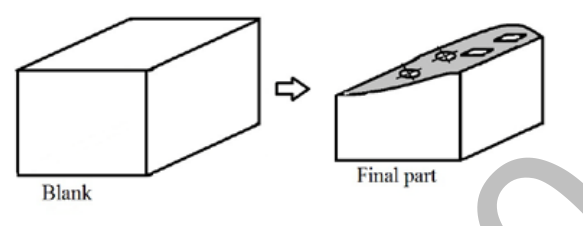
Find the correct combination of manufacturing processes to produce the part, shown in figure, from a blank (holes shown are with square and circular cross-sections).

Source question diagram

Open complete paper
14
2014 · Production & Industrial Engineering · Manufacturing Processes II · Advanced Manufacturing
Production & Industrial Engineering (PI) 2014
A hard ceramic marble, having density (ρ) of 3000 kg/m³ and diameter (d) of 0.025 m, is dropped accidentally from a static weather balloon at a height of 1 km above the roof of a greenhouse. The flow stress of roof material (σ) is 2.5 GPa. The marble hits and creates an indentation on the roof. Assume that the principle of creation of indentation is the same as that in case of abrasive jet machining (AJM). The acceleration due to gravity (g) is 10 m/s². If V is the velocity, in m/s, of the marble at the time it hits the greenhouse, the indentation depth (δ = 1000 × √(ρ/6σ) × d × V), in mm, is ______
Open complete paper
15
2016 · Production & Industrial Engineering · Manufacturing Processes II · Advanced Manufacturing
Production & Industrial Engineering (PI) 2016
Consider the following statements.
(P) Electrolyte is used in Electro-chemical machining.
(Q) Electrolyte is used in Electrical discharge machining.
(R) Abrasive-slurry is used in Ultrasonic machining.
(S) Abrasive-slurry is used in Abrasive jet machining.
Among the above statements, the correct ones are
Open complete paper
16
2016 · Production & Industrial Engineering · Manufacturing Processes II · Advanced Manufacturing
Production & Industrial Engineering (PI) 2016
In abrasive water jet machining, the velocity of water at the exit of the orifice, before mixing with abrasives, is 800 m/s. The mass flow rate of water is 3.4 kg/min. The abrasives are added to the water jet at a rate of 0.6 kg/min with negligible velocity. Assume that at the end of the focusing tube, abrasive particles and water come out with equal velocity. Consider that there is no air in the abrasive water jet. Assuming conservation of momentum, the velocity (in m/s) of the abrasive water jet at the end of the focusing tube is ________.
Open complete paper
17
2017 · Production & Industrial Engineering · Manufacturing Processes II · Advanced Manufacturing
Production & Industrial Engineering (PI) 2017
In chemical machining, the etch factor is expressed as
Open complete paper
18
2017 · Production & Industrial Engineering · Manufacturing Processes II · Advanced Manufacturing
Production & Industrial Engineering (PI) 2017
A surface of 30 mm × 30 mm of an iron block is machined using electrochemical machining process. The atomic weight and valency of iron is 55.85 and 2, respectively. The density of iron is 7,860 kg/m³. If input current is 1,000 A and Faraday’s constant is 96,540 Coulombs, then the feed rate (in mm/min) is __________ (up to two decimal places).
Open complete paper
19
2017 · Production & Industrial Engineering · Manufacturing Processes II · Advanced Manufacturing
Production & Industrial Engineering (PI) 2017
An electron beam welding process uses 15 mA beam current at an accelerating voltage of 150 kV. The energy released per second by the beam (in J) is ______________(up to one decimal place).
(1 Ampere = 6.28 × 10¹⁸ electrons per second, 1 eV = 1.6 × 10⁻¹⁹ J)
Open complete paper
20
2018 · Production & Industrial Engineering · Manufacturing Processes II · Advanced Manufacturing
Production & Industrial Engineering (PI) 2018

To make holes of 0.5 mm diameter and 30 mm depth in a mild steel component, the most suitable process is

Open complete paper

Showing 20 of 30 questions