My Cart
Your Cart 0

    Your cart is empty.

  • Total (Amount) ₹0.00
Previous year question hub

Joining of Materials - Manufacturing Processes I - Production & Industrial Engineering Previous Year Questions

Practice Joining of Materials - Manufacturing Processes I - Production & Industrial Engineering previous year questions organised from real papers, with year-wise coverage and clear topic navigation.

19Papers
19Years
39Questions
1Topics

Joining of Materials question pattern

Every graph below is calculated only from this selection.

Questions by year

Year-wise coverage for Joining of Materials. Each bar uses a separate theme-derived color.

Difficulty distribution

How the classified questions are distributed by difficulty.

Easy 20 51.3%
Medium 18 46.2%
Hard 1 2.6%
Question type distribution

MCQ, numerical, multiple-select and other formats found in these papers.

MCQ 29 74.4%
Numerical Answer Type (NAT) 10 25.6%

Subject weightage

Top subjects by unique question coverage.

Production & Industrial Engineering
39 Qs

Most asked topics

Top topics across the included previous year papers.

Manufacturing Processes I
39 Qs

Subtopic coverage

Top subtopics inside this exact selection.

Joining of Materials
39 Qs

Paper coverage

Question coverage for the most populated papers. Every active PYP paper remains listed below.

Production and Industrial Engineering (PI) 2026
2 Qs
Production & Industrial Engineering (PI) 2025
1 Qs
Production & Industrial Engineering (PI) 2024
1 Qs
Production & Industrial Engineering (PI) 2023
2 Qs
Production & Industrial Engineering (PI) 2022
1 Qs
Production & Industrial Engineering (PI) 2021
2 Qs
Production & Industrial Engineering (PI) 2020
1 Qs
Production & Industrial Engineering (PI) 2019
1 Qs
Production & Industrial Engineering (PI) 2018
2 Qs
Production & Industrial Engineering (PI) 2017
1 Qs
Production & Industrial Engineering (PI) 2016
2 Qs
Production & Industrial Engineering (PI) 2014
2 Qs
Production & Industrial Engineering (PI) 2013 [Session 2]
1 Qs
Production & Industrial Engineering (PI) 2012
1 Qs
Production & Industrial Engineering (PI) 2011
2 Qs
Production & Industrial Engineering (PI) 2010
5 Qs
Production & Industrial Engineering (PI) 2009
7 Qs
Production & Industrial Engineering (PI) 2008
3 Qs
Production & Industrial Engineering (PI) 2007
2 Qs

Included previous year papers

Newest papers appear first. Sort by year, question coverage or name.

PaperYear / sessionQuestions in this viewOpen
Production and Industrial Engineering (PI) 202620262View paper
Production & Industrial Engineering (PI) 202520251View paper
Production & Industrial Engineering (PI) 202420241View paper
Production & Industrial Engineering (PI) 202320232View paper
Production & Industrial Engineering (PI) 202220221View paper
Production & Industrial Engineering (PI) 202120212View paper
Production & Industrial Engineering (PI) 202020201View paper
Production & Industrial Engineering (PI) 201920191View paper
Production & Industrial Engineering (PI) 201820182View paper
Production & Industrial Engineering (PI) 201720171View paper
Production & Industrial Engineering (PI) 201620162View paper
Production & Industrial Engineering (PI) 201420142View paper
Production & Industrial Engineering (PI) 2013 [Session 2]20131View paper
Production & Industrial Engineering (PI) 201220121View paper
Production & Industrial Engineering (PI) 201120112View paper
Production & Industrial Engineering (PI) 201020105View paper
Production & Industrial Engineering (PI) 200920097View paper
Production & Industrial Engineering (PI) 200820083View paper
Production & Industrial Engineering (PI) 200720072View paper

All Joining of Materials previous year questions

Practice every matching question in batches of 20, with every available option.

1
2007 · Production & Industrial Engineering · Manufacturing Processes I · Joining of Materials
Production & Industrial Engineering (PI) 2007
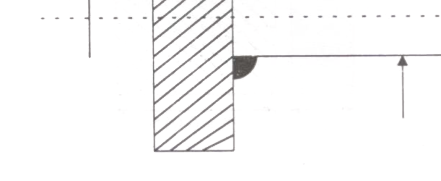
The figure below shows the cross-section of circular fillet weld joining a cylindrical steel pin to a steel plate. If the pin is subjected to a pure torsional load, the shear stress (MPa) occurring at the throat of the weld is

Question diagram

Open complete paper
2
2007 · Production & Industrial Engineering · Manufacturing Processes I · Joining of Materials
Production & Industrial Engineering (PI) 2007
The D.C. power source for arc welding has the characteristic \( 3V + I = 240 \), where V = Voltage and I = Current in amp. For maximum arc power at the electrode, voltage should be set at
Open complete paper
3
2008 · Production & Industrial Engineering · Manufacturing Processes I · Joining of Materials
Production & Industrial Engineering (PI) 2008
Which pair among the following solid state welding processes uses heat from an external source?
P - Diffusion welding; Q - Friction welding; R - Ultrasonic welding; S - Forge welding
Open complete paper
4
2008 · Production & Industrial Engineering · Manufacturing Processes I · Joining of Materials
Production & Industrial Engineering (PI) 2008
Aluminium strips of 2 mm thickness are joined together by resistance spot welding process by applying an electric current of 6000 A for 0.15 sec. The heat required for melting aluminium is 2.9 J/mm³. The diameter and the thickness of weld nugget are found to be 5 mm and 2.5 mm, respectively. Assuming the electrical resistance to be 75 micro-ohms, the percentage of total energy utilized in forming the weld nugget is
Open complete paper
5
2009 · Production & Industrial Engineering · Manufacturing Processes I · Joining of Materials
Production & Industrial Engineering (PI) 2009
Which of the following powders should be fed for effective oxy-fuel cutting of stainless steel ?
Open complete paper
6
2009 · Production & Industrial Engineering · Manufacturing Processes I · Joining of Materials
Production & Industrial Engineering (PI) 2009
Autogenous gas tungsten arc welding of a steel plate is carried out with welding current of 500 A, voltage of 20 V, and weld speed of 20 mm/min. Consider the heat transfer efficiency from the arc to the weld pool as 90%. The heat input per unit length (in kJ /mm) is
Open complete paper
7
2009 · Production & Industrial Engineering · Manufacturing Processes I · Joining of Materials
Production & Industrial Engineering (PI) 2009
Heat (in Joules) used for producing weld nugget will be (assuming 100% heat transfer efficiency)
Open complete paper
8
2009 · Production & Industrial Engineering · Manufacturing Processes I · Joining of Materials
Production & Industrial Engineering (PI) 2009
Heat (in Joules) dissipated to the base metal will be (neglecting all other heat losses)
Open complete paper
9
2010 · Production & Industrial Engineering · Manufacturing Processes I · Joining of Materials
Production & Industrial Engineering (PI) 2010
Two steel bars, each of diameter 10 mm, are coaxially friction welded, end to end, at an axial pressure of 200 MPa and at a rotational speed of 4000 rpm. The coefficient of friction between the mating faces of the rotating bars is 0.50. The torque is assumed to act at the 3/4th radius of the rotating bar. The power (in kW) consumed at the interface for welding is
Open complete paper
10
2010 · Production & Industrial Engineering · Manufacturing Processes I · Joining of Materials
Production & Industrial Engineering (PI) 2010
During a steady gas metal arc welding with direct current electrode positive polarity, the welding current, voltage and weld speed are 150 A, 30 V and 6 m/min, respectively. A metallic wire electrode of diameter 1.2 mm is being fed at a constant rate of 12 m/min. The density, specific heat and melting temperature of the wire electrode are 7000 kg/m³, 500 J/kgK and 1530°C, respectively. Assume the ambient temperature to be 30°C and neglect the latent heat of melting. Further, consider that two-third of the total electrical power is available for melting of the wire electrode. The melting efficiency (in percentage) of the wire electrode is
Open complete paper
11
2010 · Production & Industrial Engineering · Manufacturing Processes I · Joining of Materials
Production & Industrial Engineering (PI) 2010
During a steady gas metal arc welding with direct current electrode positive polarity, the welding current, voltage and weld speed are 150 A, 30 V and 6 m/min, respectively. A metallic wire electrode of diameter 1.2 mm is being fed at a constant rate of 12 m/min. The density, specific heat and melting temperature of the wire electrode are 7000 kg/m³, 500 J/kg°C and 1530°C, respectively. Assume the ambient temperature to be 30°C and neglect the latent heat of melting. Further, consider that two-third of the total electrical power is available for melting of the wire electrode. The melting efficiency (in percentage) of the wire electrode is
Open complete paper
12
2010 · Production & Industrial Engineering · Manufacturing Processes I · Joining of Materials
Production & Industrial Engineering (PI) 2010
A 1 m long cylindrical shaft of diameter 100 mm is joined to the wall by means of fillet weld as shown in the following figure. The shaft is designed to carry a torque of 5 kNm at the free end. If the allowable shear stress of the weld material is 80 MPa, then the minimum value of the size, L (shown in the following figure), of the fillet (in mm) is
Open complete paper
13
2011 · Production & Industrial Engineering · Manufacturing Processes I · Joining of Materials
Production & Industrial Engineering (PI) 2011
In resistance seam welding, the electrode is in the form of a
Open complete paper
14
2012 · Production & Industrial Engineering · Manufacturing Processes I · Joining of Materials
Production & Industrial Engineering (PI) 2012
In a DC arc welding operation, the voltage-arc length characteristic was obtained as \(V_{arc} = 20 + 5l\) where the arc length \(l\) was varied between \(5 mm\) and \(7 mm\). Here \(V_{arc}\) denotes the arc voltage in Volts. The arc current was varied from \(400 A\) to \(500 A\). Assuming linear power source characteristic, the open circuit voltage and the short circuit current for the welding operation are
Open complete paper
15
2013 · Production & Industrial Engineering · Manufacturing Processes I · Joining of Materials
Production & Industrial Engineering (PI) 2013 [Session 2]
A single riveted lap joint of two similar plates as shown in the figure below has the following geometrical and material details.
plate width \( w = 200 \, mm \)
plate thickness \( t = 5 \, mm \)
number of rivets \( n = 3 \)
rivet diameter \( d_r = 10 \, mm \)
rivet hole diameter \( d_h = 11 \, mm \)
allowable tensile stress of plate \( \sigma_p = 200 \, MPa \)
allowable bearing stress of rivet \( \sigma_c = 150 \, MPa \)
If the plates are to be designed to avoid tearing failure, the maximum permissible load \( P \) in \( kN \) is
Open complete paper
16
2014 · Production & Industrial Engineering · Manufacturing Processes I · Joining of Materials
Production & Industrial Engineering (PI) 2014

Brazing and Soldering are

Open complete paper
17
2014 · Production & Industrial Engineering · Manufacturing Processes I · Joining of Materials
Production & Industrial Engineering (PI) 2014
In an arc welding operation, carried out with a power source maintained at 40 volts and 400 amperes, the consumable electrode melts and just fills the gap between the metal plates to be butt-welded. The heat transfer efficiency for the process is 0.8, melting efficiency is 0.3 and the heat required to melt the electrode is 20 J/mm³. If the travel speed of the electrode is 4 mm/s, the cross-sectional area, in mm², of the weld joint is ______
Open complete paper
18
2016 · Production & Industrial Engineering · Manufacturing Processes I · Joining of Materials
Production & Industrial Engineering (PI) 2016
In linear gas tungsten arc welding of two plates of the same material, the peak temperature \(T\) (in K) is given as \(T = \frac{C_1 q}{\alpha}\), where \(q\) is the heat input per unit length (in J/m) of weld, \(\alpha\) is the thermal diffusivity (in m²/s) of the plate materials and \(C_1\) is a constant independent of process parameters and material types. Two welding cases are given below. Case I: \(V = 15\) V, \(I = 200\) A, \(v = 5\) mm/s, \(k = 150\) W/mK, \(\rho = 3000\) kg/m³, \(C = 900\) J/kg·K Case II: \(V = 15\) V, \(I = 300\) A, \(v = 10\) mm/s, \(k = 50\) W/mK, \(\rho = 8000\) kg/m³, \(C = 450\) J/kg·K where, \(V\) is welding voltage, \(I\) is welding current, \(v\) is welding speed, and \(k\), \(\rho\) and \(C\) refer to the thermal conductivity, the density and the specific heat of the plate materials, respectively. Consider that electrical energy is completely converted to thermal energy. All other conditions remain same. The ratio of the peak temperature in Case I to that in Case II is
Open complete paper
19
2016 · Production & Industrial Engineering · Manufacturing Processes I · Joining of Materials
Production & Industrial Engineering (PI) 2016
Two flat steel sheets, each of 2.5 mm thickness, are being resistance spot welded using a current of 6000 A and weld time of 0.2 s. The contact resistance at the interface between the two sheets is 200 μΩ and the specific energy to melt steel is 10×109 J/m3. A spherical melt pool of diameter 4 mm is formed at the interface due to the current flow. Consider that electrical energy is completely converted to thermal energy. The ratio of the heat used for melting to the total resistive heat generated is ______.
Open complete paper
20
2017 · Production & Industrial Engineering · Manufacturing Processes I · Joining of Materials
Production & Industrial Engineering (PI) 2017
In gas tungsten arc welding process, the material coated on pure tungsten electrode to enhance its current carrying capacity is
Open complete paper

Showing 20 of 33 questions