My Cart
Your Cart 0

    Your cart is empty.

  • Total (Amount) ₹0.00
Previous year question hub

Thermal and Fluids Engineering - General Engineering - Production & Industrial Engineering Previous Year Questions

Practice Thermal and Fluids Engineering - General Engineering - Production & Industrial Engineering previous year questions organised from real papers, with year-wise coverage and clear topic navigation.

18Papers
16Years
105Questions
1Topics

Thermal and Fluids Engineering question pattern

Every graph below is calculated only from this selection.

Questions by year

Year-wise coverage for Thermal and Fluids Engineering. Each bar uses a separate theme-derived color.

Difficulty distribution

How the classified questions are distributed by difficulty.

Easy 60 57.1%
Medium 44 41.9%
Hard 1 1%
Question type distribution

MCQ, numerical, multiple-select and other formats found in these papers.

MCQ 77 73.3%
Numerical Answer Type (NAT) 28 26.7%

Subject weightage

Top subjects by unique question coverage.

Production & Industrial Engineering
105 Qs

Most asked topics

Top topics across the included previous year papers.

General Engineering
105 Qs

Subtopic coverage

Top subtopics inside this exact selection.

Thermal and Fluids Engineering
105 Qs

Paper coverage

Question coverage for the most populated papers. Every active PYP paper remains listed below.

Production & Industrial Engineering (PI) 2023
1 Qs
Production & Industrial Engineering (PI) 2022
1 Qs
Production & Industrial Engineering (PI) 2021
6 Qs
Production & Industrial Engineering (PI) 2020
6 Qs
Production & Industrial Engineering (PI) 2019
17 Qs
Production & Industrial Engineering (PI) 2018
2 Qs
Production & Industrial Engineering (PI) 2017
4 Qs
Production & Industrial Engineering (PI) 2016
6 Qs
Production & Industrial Engineering (PI) 2014
3 Qs
Production & Industrial Engineering (PI) 2013 [Session 1]
3 Qs
Production & Industrial Engineering (PI) 2013 [Session 2]
3 Qs
Production & Industrial Engineering (PI) 2013 [Session 4]
3 Qs
Production & Industrial Engineering (PI) 2012
8 Qs
Production & Industrial Engineering (PI) 2011
8 Qs
Production & Industrial Engineering (PI) 2010
6 Qs
Production & Industrial Engineering (PI) 2009
6 Qs
Production & Industrial Engineering (PI) 2008
15 Qs
Production & Industrial Engineering (PI) 2007
7 Qs

Included previous year papers

Newest papers appear first. Sort by year, question coverage or name.

PaperYear / sessionQuestions in this viewOpen
Production & Industrial Engineering (PI) 202320231View paper
Production & Industrial Engineering (PI) 202220221View paper
Production & Industrial Engineering (PI) 202120216View paper
Production & Industrial Engineering (PI) 202020206View paper
Production & Industrial Engineering (PI) 2019201917View paper
Production & Industrial Engineering (PI) 201820182View paper
Production & Industrial Engineering (PI) 201720174View paper
Production & Industrial Engineering (PI) 201620166View paper
Production & Industrial Engineering (PI) 201420143View paper
Production & Industrial Engineering (PI) 2013 [Session 1]20133View paper
Production & Industrial Engineering (PI) 2013 [Session 2]20133View paper
Production & Industrial Engineering (PI) 2013 [Session 4]20133View paper
Production & Industrial Engineering (PI) 201220128View paper
Production & Industrial Engineering (PI) 201120118View paper
Production & Industrial Engineering (PI) 201020106View paper
Production & Industrial Engineering (PI) 200920096View paper
Production & Industrial Engineering (PI) 2008200815View paper
Production & Industrial Engineering (PI) 200720077View paper

All Thermal and Fluids Engineering previous year questions

Practice every matching question in batches of 20, with every available option.

1
2007 · Production & Industrial Engineering · General Engineering · Thermal and Fluids Engineering
Production & Industrial Engineering (PI) 2007
Oil in a hydraulic cylinder is compressed from an initial volume of 2 m³ to 1.96 m³. If the pressure of oil in the cylinder changes from 40 MPa to 80 MPa during compression, the bulk modulus of elasticity of oil is
Open complete paper
2
2007 · Production & Industrial Engineering · General Engineering · Thermal and Fluids Engineering
Production & Industrial Engineering (PI) 2007
A cylindrical tank is filled with water as shown in the Figure below. The force required to close the discharge tube at the bottom of the tank is

Question diagram

Open complete paper
3
2007 · Production & Industrial Engineering · General Engineering · Thermal and Fluids Engineering
Production & Industrial Engineering (PI) 2007
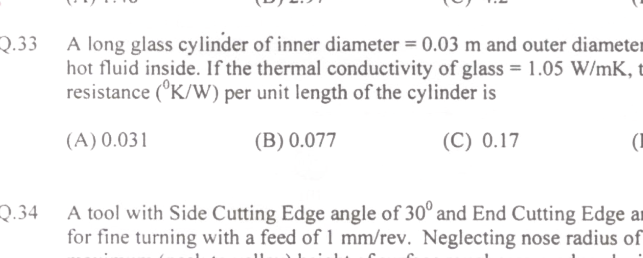
A long glass cylinder of inner diameter = 0.03 m and outer diameter = 0.05 m carries hot fluid inside. If the thermal conductivity of glass = 1.05 W/mK, the thermal resistance (°K/W) per unit length of the cylinder is
Open complete paper
4
2007 · Production & Industrial Engineering · General Engineering · Thermal and Fluids Engineering
Production & Industrial Engineering (PI) 2007
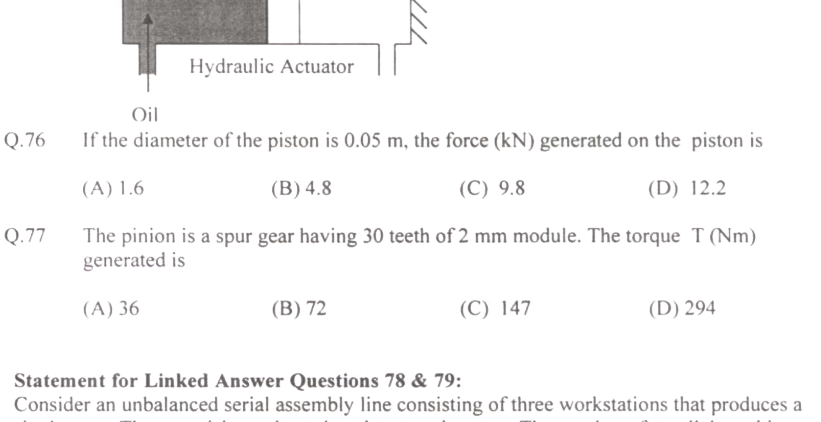
If the diameter of the piston is 0.05 m, the force (kN) generated on the piston is

Question diagram

Open complete paper
5
2007 · Production & Industrial Engineering · General Engineering · Thermal and Fluids Engineering
Production & Industrial Engineering (PI) 2007
Statement for Linked Answer Questions 76 & 77:
In the setup shown below, 2kW power is supplied by oil flowing into the cylinder of the hydraulic actuator at the rate of 400 × 10-6 m3/s.
If the diameter of the piston is 0.05 m, the force (kN) generated on the piston is
Open complete paper
6
2008 · Production & Industrial Engineering · General Engineering · Thermal and Fluids Engineering
Production & Industrial Engineering (PI) 2008
Consider a steady, reversible flow process in a system with one inlet stream and one outlet stream. Potential and kinetic energy effects are negligibly small. Given: \(v\) – specific volume and \(p\) – pressure of the system. The net work done by the system per unit mass flow rate is
Open complete paper
7
2008 · Production & Industrial Engineering · General Engineering · Thermal and Fluids Engineering
Production & Industrial Engineering (PI) 2008
A refrigerator, operating in a room at a temperature of 29.5°C, maintains the refrigerated space at 2°C. The maximum possible COP of the refrigerator is
Open complete paper
8
2008 · Production & Industrial Engineering · General Engineering · Thermal and Fluids Engineering
Production & Industrial Engineering (PI) 2008
Consider a steady, reversible flow process in a system with one inlet stream and one outlet stream. Potential and kinetic energy effects are negligibly small. Given: $v$ = specific volume and $p$ = pressure of the system. The net work done by the system per unit mass flow rate is
Open complete paper
9
2008 · Production & Industrial Engineering · General Engineering · Thermal and Fluids Engineering
Production & Industrial Engineering (PI) 2008
Two pipes of uniform section but different diameters carry water at the same volumetric flow rate. Water properties are the same in the two pipes. The Reynolds number, based on the pipe diameter,
Open complete paper
10
2008 · Production & Industrial Engineering · General Engineering · Thermal and Fluids Engineering
Production & Industrial Engineering (PI) 2008
A single cylinder compression ignition engine, operating on the air-standard diesel cycle, has a mean effective pressure of 1.0 MPa and a compression ratio of 21. The engine has a clearance volume of 5x10⁻⁵ m3. The heat added at constant pressure is 2.0 kJ. The thermal efficiency of the engine is
Open complete paper
11
2008 · Production & Industrial Engineering · General Engineering · Thermal and Fluids Engineering
Production & Industrial Engineering (PI) 2008
An industrial gas (cp = 1 kJ/kgK) enters a parallel-flow heat exchanger at 250°C with a flow rate of 2 kg/s to heat a water stream. The water stream (cp = 4 kJ/kgK) enters the heat exchanger at 50°C with a flow rate of 1 kg/s. The heat exchanger has an effectiveness of 0.75. The gas stream exit temperature will be
Open complete paper
12
2008 · Production & Industrial Engineering · General Engineering · Thermal and Fluids Engineering
Production & Industrial Engineering (PI) 2008
Oil is being pumped through a straight pipe. The pipe length, diameter and volumetric flow rate are all doubled in a new arrangement. The pipe friction factor, however, remains constant. The ratio of pipe frictional losses in the new arrangement to that in the original configuration would be
Open complete paper
13
2008 · Production & Industrial Engineering · General Engineering · Thermal and Fluids Engineering
Production & Industrial Engineering (PI) 2008
Air flows steadily at low speed through a horizontal nozzle, which discharges the air into the atmosphere. The area at the nozzle inlet and outlet are 0.1 m2 and 0.02 m2, respectively. If the air density remains constant at 1.0 kg/m3, the gauge pressure (in kPa) required at the nozzle inlet to produce an outlet speed of 50 m/s would be
Open complete paper
14
2008 · Production & Industrial Engineering · General Engineering · Thermal and Fluids Engineering
Production & Industrial Engineering (PI) 2008
Heat is being transferred convectively from a cylindrical nuclear reactor fuel rod of 50 mm diameter to water at 75 °C. Under steady state condition, the rate of heat generation within the fuel element is 5x10⁷ W/m3 and the convection heat transfer coefficient is 1 kW/m2K. The outer surface temperature of the fuel element would be
Open complete paper
15
2008 · Production & Industrial Engineering · General Engineering · Thermal and Fluids Engineering
Production & Industrial Engineering (PI) 2008
Air flows steadily at low speed through a horizontal nozzle, which discharges the air into the atmosphere. The area at the nozzle inlet and outlet are 0.1 m² and 0.02 m², respectively. If the air density remains constant at 1.0 kg/m³, the gauge pressure (in kPa) required at the nozzle inlet to produce an outlet speed of 50 m/s would be
Open complete paper
16
2008 · Production & Industrial Engineering · General Engineering · Thermal and Fluids Engineering
Production & Industrial Engineering (PI) 2008
Heat is being transferred convectively from a cylindrical nuclear reactor fuel rod of 50 mm diameter to water at 75 °C. Under steady state condition, the rate of heat generation within the fuel element is 5x10⁷ W/m³ and the convection heat transfer coefficient is 1 kW/m²K. The outer surface temperature of the fuel element would be
Open complete paper
17
2008 · Production & Industrial Engineering · General Engineering · Thermal and Fluids Engineering
Production & Industrial Engineering (PI) 2008
Statement for Linked Answer Questions 76 and 77:
A wall is heated uniformly at a volumetric heat generation rate of 1 kW/m³. The temperature distribution across the 1m thick wall at a certain instant of time is given by :
\(T(x) = a + bx + cx^2\)
where \(a = 900 °C\), \(b = -300 °C/m\), and \(c = -50 °C/m²\).
The wall has an area of 10 m² (as shown in the figure) and a thermal conductivity of 40 W/mK.
The rate of heat transfer (in kW) into the wall (at x=0) is
Open complete paper
18
2008 · Production & Industrial Engineering · General Engineering · Thermal and Fluids Engineering
Production & Industrial Engineering (PI) 2008
Statement for Linked Answer Questions 76 and 77:
A wall is heated uniformly at a volumetric heat generation rate of 1 kW/m³. The temperature distribution across the 1m thick wall at a certain instant of time is given by :
\(T(x) = a + bx + cx^2\)
where \(a = 900 °C\), \(b = -300 °C/m\), and \(c = -50 °C/m²\).
The wall has an area of 10 m² (as shown in the figure) and a thermal conductivity of 40 W/mK.
The rate of change of energy storage (in kW) in the wall is
Open complete paper
19
2009 · Production & Industrial Engineering · General Engineering · Thermal and Fluids Engineering
Production & Industrial Engineering (PI) 2009
Which of the following processes is NOT executed by an ideal Rankine cycle with no superheat ?
Open complete paper
20
2009 · Production & Industrial Engineering · General Engineering · Thermal and Fluids Engineering
Production & Industrial Engineering (PI) 2009
The pressure drop for laminar flow of a liquid in a smooth pipe at normal temperature and pressure is
Open complete paper

Showing 20 of 93 questions