My Cart
Your Cart 0

    Your cart is empty.

  • Total (Amount) ₹0.00
Previous year question hub

Rigid-body Dynamics - Classical Mechanics - Physics Previous Year Questions

Practice Rigid-body Dynamics - Classical Mechanics - Physics previous year questions organised from real papers, with year-wise coverage and clear topic navigation.

11Papers
11Years
17Questions
1Topics

Rigid-body Dynamics question pattern

Every graph below is calculated only from this selection.

Questions by year

Year-wise coverage for Rigid-body Dynamics. Each bar uses a separate theme-derived color.

Difficulty distribution

How the classified questions are distributed by difficulty.

Medium 9 52.9%
Easy 7 41.2%
Hard 1 5.9%
Question type distribution

MCQ, numerical, multiple-select and other formats found in these papers.

MCQ 13 76.5%
Numerical Answer Type (NAT) 3 17.6%
MSQ 1 5.9%

Subject weightage

Top subjects by unique question coverage.

Physics
17 Qs

Most asked topics

Top topics across the included previous year papers.

Classical Mechanics
17 Qs

Subtopic coverage

Top subtopics inside this exact selection.

Rigid-body Dynamics
17 Qs

Paper coverage

Question coverage for the most populated papers. Every active PYP paper remains listed below.

Physics (PH) 2026
3 Qs
Physics (PH) 2023
1 Qs
Physics (PH) 2019
1 Qs
Physics (PH) 2018
1 Qs
Physics (PH) 2017
1 Qs
Physics (PH) 2015
1 Qs
Physics (PH) 2013
1 Qs
Physics (PH) 2012
1 Qs
Physics (PH) 2011
2 Qs
Physics (PH) 2008
3 Qs
Physics (PH) 2007
2 Qs

Included previous year papers

Newest papers appear first. Sort by year, question coverage or name.

PaperYear / sessionQuestions in this viewOpen
Physics (PH) 202620263View paper
Physics (PH) 202320231View paper
Physics (PH) 201920191View paper
Physics (PH) 201820181View paper
Physics (PH) 201720171View paper
Physics (PH) 201520151View paper
Physics (PH) 201320131View paper
Physics (PH) 201220121View paper
Physics (PH) 201120112View paper
Physics (PH) 200820083View paper
Physics (PH) 200720072View paper

All Rigid-body Dynamics previous year questions

Practice every matching question in batches of 20, with every available option.

1
2007 · Physics · Classical Mechanics · Rigid-body Dynamics
Physics (PH) 2007
Consider a vector \(\vec{p} = 2 \hat{i} + 3 \hat{j} + 2 \hat{k}\) in the coordinate system \((\hat{i}, \hat{j}, \hat{k})\). The axes are rotated anti-clockwise about the Y axis by an angle of \(60^0\). The vector \(\vec{p}\) in the rotated coordinate system \((\hat{i}', \hat{j}', \hat{k}')\) is
Open complete paper
2
2007 · Physics · Classical Mechanics · Rigid-body Dynamics
Physics (PH) 2007
The moment of inertia of a uniform sphere of radius \( r \) about an axis passing through its centre is given by \( \frac{2}{5} \left( \frac{4 \pi}{3} r^3 \rho \right) \). A rigid sphere of uniform mass density \( \rho \) and radius \( R \) has two smaller spheres of radius \( R/2 \) hollowed out of it, as shown in the figure. The moment of inertia of the resulting body about the Y axis is
Open complete paper
3
2008 · Physics · Classical Mechanics · Rigid-body Dynamics
Physics (PH) 2008
A rigid body is rotating about its centre of mass, fixed at the origin, with an angular velocity \(\vec{\omega}\) and angular acceleration \(\vec{\alpha}\). If the torque acting on it is \(\vec{\tau}\) and its angular momentum is \(\vec{L}\), the rate of change of its kinetic energy is
Open complete paper
4
2008 · Physics · Classical Mechanics · Rigid-body Dynamics
Physics (PH) 2008
The moment of inertia tensor of a rigid body is given by \(I = \begin{pmatrix} 8 & 0 & -4 \\ 0 & 4 & 0 \\ -4 & 0 & 8 \end{pmatrix}\). The magnitude of the moment of inertia about an axis \(\hat{n} = \left(\frac{1}{2}, \frac{\sqrt{3}}{2}, 0\right)\) is
Open complete paper
5
2008 · Physics · Classical Mechanics · Rigid-body Dynamics
Physics (PH) 2008

A hoop of radius R is pivoted at a point on the circumference. The period of small oscillations in the plane of the hoop is

Open complete paper
6
2011 · Physics · Classical Mechanics · Rigid-body Dynamics
Physics (PH) 2011
A heavy symmetrical top is rotating about its own axis of symmetry (the z-axis). If I1, I2 and I3 are the principal moments of inertia along x, y and z axes respectively, then
Open complete paper
7
2011 · Physics · Classical Mechanics · Rigid-body Dynamics
Physics (PH) 2011
A heavy symmetrical top is rotating about its own axis of symmetry (the z-axis). If \( I_1, I_2 \) and \( I_3 \) are the principal moments of inertia along x, y and z axes respectively, then
Open complete paper
8
2012 · Physics · Classical Mechanics · Rigid-body Dynamics
Physics (PH) 2012
Two uniform thin rods of equal length, $L$, and masses $M_1$ and $M_2$ are joined together along the length. The moment of inertia of the combined rod of length $2L$ about an axis passing through the mid-point and perpendicular to the length of the rod is,
Open complete paper
9
2013 · Physics · Classical Mechanics · Rigid-body Dynamics
Physics (PH) 2013
A uniform circular disk of radius \( R \) and mass \( M \) is rotating with angular speed \( \omega \) about an axis, passing through its center and inclined at an angle 60 degrees with respect to its symmetry axis. The magnitude of the angular momentum of the disk is,
Open complete paper
10
2015 · Physics · Classical Mechanics · Rigid-body Dynamics
Physics (PH) 2015
Consider the motion of the Sun with respect to the rotation of the Earth about its axis. If \(\vec{F}_c\) and \(\vec{F}_{Co}\) denote the centrifugal and the Coriolis forces, respectively, acting on the Sun, then
Open complete paper
11
2017 · Physics · Classical Mechanics · Rigid-body Dynamics
Physics (PH) 2017
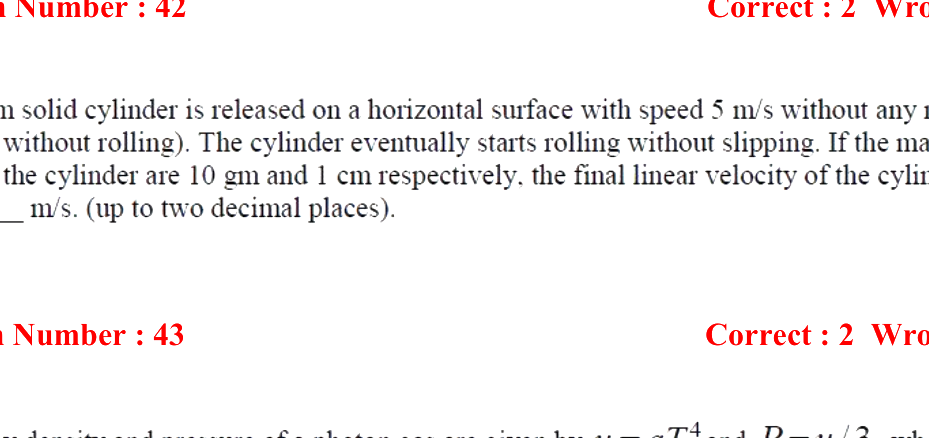
A uniform solid cylinder is released on a horizontal surface with speed 5 m/s without any rotation (slipping without rolling). The cylinder eventually starts rolling without slipping. If the mass and radius of the cylinder are 10 gm and 1 cm respectively, the final linear velocity of the cylinder is ______ m/s. (up to two decimal places).

Question diagram

Open complete paper
12
2018 · Physics · Classical Mechanics · Rigid-body Dynamics
Physics (PH) 2018
A uniform circular disc of mass \(m\) and radius \(R\) is rotating with angular speed \(\omega\) about an axis passing through its center and making an angle \(\theta = 30^\circ\) with the axis of the disc. If the kinetic energy of the disc is \(\alpha m\omega^2 R^2\), the value of \(\alpha\) is ______ (up to 2 decimal places).
Open complete paper
13
2019 · Physics · Classical Mechanics · Rigid-body Dynamics
Physics (PH) 2019
During a rotation, vectors along the axis of rotation remain unchanged. For the rotation matrix \( \begin{pmatrix} 0 & -1 & 0 \\ 0 & 0 & -1 \\ -1 & 0 & 0 \end{pmatrix} \), the unit vector along the axis of rotation is
Open complete paper
14
2023 · Physics · Classical Mechanics · Rigid-body Dynamics
Physics (PH) 2023
A symmetric top has principal moments of inertia $I_1 = I_2 = \frac{2\alpha}{3}, I_3 = 2\alpha$ about a set of principal axes 1, 2, 3 respectively, passing through its center of mass, where $\alpha$ is a positive constant. There is no force acting on the body and the angular speed of the body about the 3-axis is $\omega_3 = \frac{1}{8}$ rad/s. With what angular frequency in rad/s does the angular velocity vector $\vec{\omega}_1$ precess about the 3-axis?
Open complete paper
15
2026 · Physics · Classical Mechanics · Rigid-body Dynamics
Physics (PH) 2026
Two frames S (solid lines) and S' (dashed lines) with common origin are shown in the figure below. Frame S is inertial while S' is rotating about the common z-axis. There is a point mass fixed at P on the x-axis of the S frame. The magnitude of the centrifugal force and the Coriolis force experienced by the mass in the S' frame is \(F_{cen}\) and \(F_{cor}\), respectively. Which of the following options is correct for these forces?
Open complete paper
16
2026 · Physics · Classical Mechanics · Rigid-body Dynamics
Physics (PH) 2026
A symmetric rigid body has moment of inertia \(I_1, I_2, I_3\) about its principal axes 1, 2, and 3, respectively, with \(I_1 = I_3 = I_\perp\) and \(I_2 \neq I_\perp\). It is rotating in space with no torque on it so that its angular momentum \(\vec{L}\) is constant. Let \(\omega_1, \omega_2, \omega_3\) be the components of its angular velocity along the principal axes 1, 2, and 3, respectively. Which of the following quantities is/are constant during the motion of this rigid body?
Open complete paper
17
2026 · Physics · Classical Mechanics · Rigid-body Dynamics
Physics (PH) 2026
A 15 cm long scale is held horizontally with one of its ends on the edge of a 1 m high table and the other end resting on one’s index finger. As the finger is removed (see figure below), the scale starts rotating about its end on the table. After 0.1 s, during which it has rotated by a negligibly small angle but has gained a rotational speed as it leaves the table and falls vertically towards the ground. When its centre of mass has fallen by 0.5 m, it has rotated by an angle \(\theta\). The value of \(\theta\) in degrees (rounded off to one decimal place) is ____ (\(g = 9.8 m.s^{-2}\))
Open complete paper