My Cart
Your Cart 0

    Your cart is empty.

  • Total (Amount) ₹0.00
Previous year question hub

Lagrangian and Hamiltonian Mechanics - Classical Mechanics - Physics Previous Year Questions

Practice Lagrangian and Hamiltonian Mechanics - Classical Mechanics - Physics previous year questions organised from real papers, with year-wise coverage and clear topic navigation.

20Papers
20Years
58Questions
1Topics

Lagrangian and Hamiltonian Mechanics question pattern

Every graph below is calculated only from this selection.

Questions by year

Year-wise coverage for Lagrangian and Hamiltonian Mechanics. Each bar uses a separate theme-derived color.

Difficulty distribution

How the classified questions are distributed by difficulty.

Medium 35 60.3%
Easy 23 39.7%

Question type distribution

MCQ, numerical, multiple-select and other formats found in these papers.

MCQ 40 69%
Numerical Answer Type (NAT) 11 19%
MSQ 7 12.1%

Subject weightage

Top subjects by unique question coverage.

Physics
58 Qs

Most asked topics

Top topics across the included previous year papers.

Classical Mechanics
58 Qs

Subtopic coverage

Top subtopics inside this exact selection.

Lagrangian and Hamiltonian Mechanics
58 Qs

Paper coverage

Question coverage for the most populated papers. Every active PYP paper remains listed below.

Physics (PH) 2026
2 Qs
Physics (PH) 2025
5 Qs
Physics (PH) 2024
3 Qs
Physics (PH) 2023
1 Qs
Physics (PH) 2022
4 Qs
Physics (PH) 2021
5 Qs
Physics (PH) 2020
3 Qs
Physics (PH) 2019
5 Qs
Physics (PH) 2018
1 Qs
Physics (PH) 2017
2 Qs
Physics (PH) 2016
2 Qs
Physics (PH) 2015
2 Qs
Physics (PH) 2014
4 Qs
Physics (PH) 2013
1 Qs
Physics (PH) 2012
3 Qs
Physics (PH) 2011
2 Qs
Physics (PH) 2010
2 Qs
Physics (PH) 2009
4 Qs
Physics (PH) 2008
3 Qs
Physics (PH) 2007
4 Qs

Included previous year papers

Newest papers appear first. Sort by year, question coverage or name.

PaperYear / sessionQuestions in this viewOpen
Physics (PH) 202620262View paper
Physics (PH) 202520255View paper
Physics (PH) 202420243View paper
Physics (PH) 202320231View paper
Physics (PH) 202220224View paper
Physics (PH) 202120215View paper
Physics (PH) 202020203View paper
Physics (PH) 201920195View paper
Physics (PH) 201820181View paper
Physics (PH) 201720172View paper
Physics (PH) 201620162View paper
Physics (PH) 201520152View paper
Physics (PH) 201420144View paper
Physics (PH) 201320131View paper
Physics (PH) 201220123View paper
Physics (PH) 201120112View paper
Physics (PH) 201020102View paper
Physics (PH) 200920094View paper
Physics (PH) 200820083View paper
Physics (PH) 200720074View paper

All Lagrangian and Hamiltonian Mechanics previous year questions

Practice every matching question in batches of 20, with every available option.

1
2007 · Physics · Classical Mechanics · Lagrangian and Hamiltonian Mechanics
Physics (PH) 2007
The Lagrangian of a particle of mass \( m \) is \( L = \frac{m}{2} \left[ \left( \frac{dx}{dt} \right)^2 + \left( \frac{dy}{dt} \right)^2 + \left( \frac{dz}{dt} \right)^2 \right] - \frac{V}{2} (x^2 + y^2) + W \sin \omega t \), where \( V, W \) and \( \omega \) are constants. The conserved quantities are
Open complete paper
2
2007 · Physics · Classical Mechanics · Lagrangian and Hamiltonian Mechanics
Physics (PH) 2007
Three particles of mass \( m \) each situated at \( x_1(t) \), \( x_2(t) \) and \( x_3(t) \) respectively are connected by two springs of spring constant \( k \) and un-stretched length \( \ell \). The system is free to oscillate only in one dimension along the straight line joining all the three particles. The Lagrangian of the system is
Open complete paper
3
2007 · Physics · Classical Mechanics · Lagrangian and Hamiltonian Mechanics
Physics (PH) 2007
The Hamiltonian of a particle is \( H = \frac{p^2}{2m} + pq \), where \( q \) is the generalized coordinate and \( p \) is the corresponding canonical momentum. The Lagrangian is
Open complete paper
4
2008 · Physics · Classical Mechanics · Lagrangian and Hamiltonian Mechanics
Physics (PH) 2008
A cylinder of mass \(M\) and radius \(R\) is rolling down without slipping on an inclined plane of angle of inclination \(\theta\). The number of generalized coordinates required to describe the motion of this system is
Open complete paper
5
2008 · Physics · Classical Mechanics · Lagrangian and Hamiltonian Mechanics
Physics (PH) 2008
The Lagrangian of a system is given by \(L = \frac{1}{2}\dot{q}^2 + q\dot{q} - \frac{1}{2}q^2\). It describes the motion of
Open complete paper
6
2008 · Physics · Classical Mechanics · Lagrangian and Hamiltonian Mechanics
Physics (PH) 2008
For a simple harmonic oscillator the Lagrangian is given by \( L = \frac{1}{2} \dot{q}^2 - \frac{1}{2} q^2 \). If \( A(p,q) = \frac{p + i q}{\sqrt{2}} \) and \( H(p,q) \) is the Hamiltonian of the system, the Poisson bracket \( \{A(p,q), H(p,q)\} \) is given by
Open complete paper
7
2009 · Physics · Classical Mechanics · Lagrangian and Hamiltonian Mechanics
Physics (PH) 2009
The Lagrangian of a free particle in spherical polar co-ordinates is given by \(L = \frac{1}{2} m (\dot{r}^2 + r^2 \dot{\theta}^2 + r^2 \dot{\phi}^2 \sin^2 \theta)\). The quantity that is conserved is
Open complete paper
8
2009 · Physics · Classical Mechanics · Lagrangian and Hamiltonian Mechanics
Physics (PH) 2009
If \( p \) and \( q \) are the position and momentum variables, which one of the following is NOT a canonical transformation ?
Open complete paper
9
2009 · Physics · Classical Mechanics · Lagrangian and Hamiltonian Mechanics
Physics (PH) 2009
A classical particle is moving in an external potential field \( V(x,y,z) \) which is invariant under the following infinitesimal transformations
\( x \rightarrow x' = x + \delta x, \)
\( y \rightarrow y' = y + \delta y, \)
\( \begin{pmatrix} x' \\ y' \end{pmatrix} \rightarrow \begin{pmatrix} x' \\ y' \end{pmatrix} = R_z \begin{pmatrix} x \\ y \end{pmatrix}, \)
where \( R_z \) is the matrix corresponding to rotation about the \( z \) axis. The conserved quantities are (the symbols have their usual meaning)
Open complete paper
10
2009 · Physics · Classical Mechanics · Lagrangian and Hamiltonian Mechanics
Physics (PH) 2009
The Lagrangian of a particle of mass \(m\) moving in one dimension is \(L = \exp(\alpha t)\left[\frac{m\dot{x}^2}{2} - \frac{kx^2}{2}\right]\), where \(\alpha\) and \(k\) are positive constants. The equation of motion of the particle is
Open complete paper
11
2010 · Physics · Classical Mechanics · Lagrangian and Hamiltonian Mechanics
Physics (PH) 2010
Hamilton's equations are then given by
Open complete paper
12
2010 · Physics · Classical Mechanics · Lagrangian and Hamiltonian Mechanics
Physics (PH) 2010
The Poisson bracket between \(\theta\) and \(\dot{\theta}\) is
Open complete paper
13
2011 · Physics · Classical Mechanics · Lagrangian and Hamiltonian Mechanics
Physics (PH) 2011
A particle is moving under the action of a generalized potential \( V(q,\dot{q}) = \frac{(1+\dot{q})}{q^2} \). The magnitude of the generalized force is
Open complete paper
14
2011 · Physics · Classical Mechanics · Lagrangian and Hamiltonian Mechanics
Physics (PH) 2011
Let \( (p,q) \) and \( (P,Q) \) be two pairs of canonical variables. The transformation \( Q = q^\alpha \cos(\beta p) \), \( P = q^\alpha \sin(\beta p) \) is canonical for
Open complete paper
15
2012 · Physics · Classical Mechanics · Lagrangian and Hamiltonian Mechanics
Physics (PH) 2012
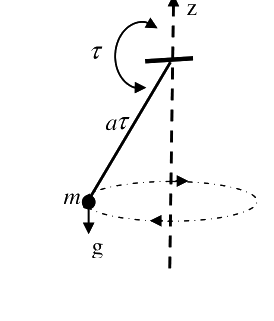
A particle of mass m is attached to a fixed point O by a weightless inextensible string of length a. It is rotating under the gravity as shown in the figure. The Lagrangian of the particle is
L(θ,φ)=1/2 ma^2 (θ̇^2 + sin^2 θ φ̇^2) - mga cos θ
where θ and φ are the polar angles.
The Hamiltonian of the particle is

Question diagram

Open complete paper
16
2012 · Physics · Classical Mechanics · Lagrangian and Hamiltonian Mechanics
Physics (PH) 2012
The Lagrangian for this particle is given by,

Question diagram

Open complete paper
17
2012 · Physics · Classical Mechanics · Lagrangian and Hamiltonian Mechanics
Physics (PH) 2012

The Lagrange's equation of motion of the particle is

Open complete paper
18
2013 · Physics · Classical Mechanics · Lagrangian and Hamiltonian Mechanics
Physics (PH) 2013
The Lagrangian of a system with one degree of freedom q is given by L = a\dot{q}^2 + \beta \dot{q}^2, where a and \beta are non-zero constants. If p_q denotes the canonical momentum conjugate to q then which one of the following statements is CORRECT?
Open complete paper
19
2014 · Physics · Classical Mechanics · Lagrangian and Hamiltonian Mechanics
Physics (PH) 2014

The Hamilton's canonical equations of motion in terms of Poisson Brackets are

Open complete paper
20
2014 · Physics · Classical Mechanics · Lagrangian and Hamiltonian Mechanics
Physics (PH) 2014
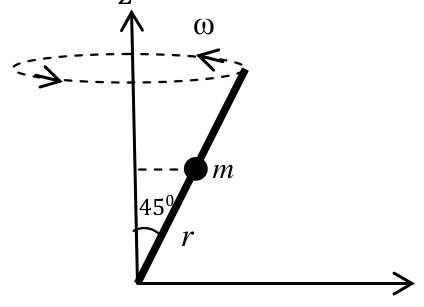
A bead of mass m can slide without friction along a massless rod kept at 45° with the vertical as shown in the figure. The rod is rotating about the vertical axis with a constant angular speed ω. At any instant, r is the distance of the bead from the origin. The momentum conjugate to r is

Source question diagram

Open complete paper

Showing 20 of 57 questions