My Cart
Your Cart 0

    Your cart is empty.

  • Total (Amount) ₹0.00
Previous year question hub

Central-force Motion and Oscillations - Classical Mechanics - Physics Previous Year Questions

Practice Central-force Motion and Oscillations - Classical Mechanics - Physics previous year questions organised from real papers, with year-wise coverage and clear topic navigation.

18Papers
18Years
34Questions
1Topics

Central-force Motion and Oscillations question pattern

Every graph below is calculated only from this selection.

Questions by year

Year-wise coverage for Central-force Motion and Oscillations. Each bar uses a separate theme-derived color.

Difficulty distribution

How the classified questions are distributed by difficulty.

Medium 18 52.9%
Easy 15 44.1%
Hard 1 2.9%
Question type distribution

MCQ, numerical, multiple-select and other formats found in these papers.

MCQ 27 79.4%
Numerical Answer Type (NAT) 6 17.6%
MSQ 1 2.9%

Subject weightage

Top subjects by unique question coverage.

Physics
34 Qs

Most asked topics

Top topics across the included previous year papers.

Classical Mechanics
34 Qs

Subtopic coverage

Top subtopics inside this exact selection.

Central-force Motion and Oscillations
34 Qs

Paper coverage

Question coverage for the most populated papers. Every active PYP paper remains listed below.

Physics (PH) 2026
3 Qs
Physics (PH) 2025
1 Qs
Physics (PH) 2024
2 Qs
Physics (PH) 2022
1 Qs
Physics (PH) 2021
1 Qs
Physics (PH) 2020
1 Qs
Physics (PH) 2018
3 Qs
Physics (PH) 2017
3 Qs
Physics (PH) 2016
2 Qs
Physics (PH) 2015
2 Qs
Physics (PH) 2014
3 Qs
Physics (PH) 2013
1 Qs
Physics (PH) 2012
2 Qs
Physics (PH) 2011
3 Qs
Physics (PH) 2010
1 Qs
Physics (PH) 2009
1 Qs
Physics (PH) 2008
2 Qs
Physics (PH) 2007
2 Qs

Included previous year papers

Newest papers appear first. Sort by year, question coverage or name.

PaperYear / sessionQuestions in this viewOpen
Physics (PH) 202620263View paper
Physics (PH) 202520251View paper
Physics (PH) 202420242View paper
Physics (PH) 202220221View paper
Physics (PH) 202120211View paper
Physics (PH) 202020201View paper
Physics (PH) 201820183View paper
Physics (PH) 201720173View paper
Physics (PH) 201620162View paper
Physics (PH) 201520152View paper
Physics (PH) 201420143View paper
Physics (PH) 201320131View paper
Physics (PH) 201220122View paper
Physics (PH) 201120113View paper
Physics (PH) 201020101View paper
Physics (PH) 200920091View paper
Physics (PH) 200820082View paper
Physics (PH) 200720072View paper

All Central-force Motion and Oscillations previous year questions

Practice every matching question in batches of 20, with every available option.

1
2007 · Physics · Classical Mechanics · Central-force Motion and Oscillations
Physics (PH) 2007

A space station moving in a circular orbit around the Earth goes into a new bound orbit by firing its engine radially outwards. This orbit is

Open complete paper
2
2008 · Physics · Classical Mechanics · Central-force Motion and Oscillations
Physics (PH) 2008
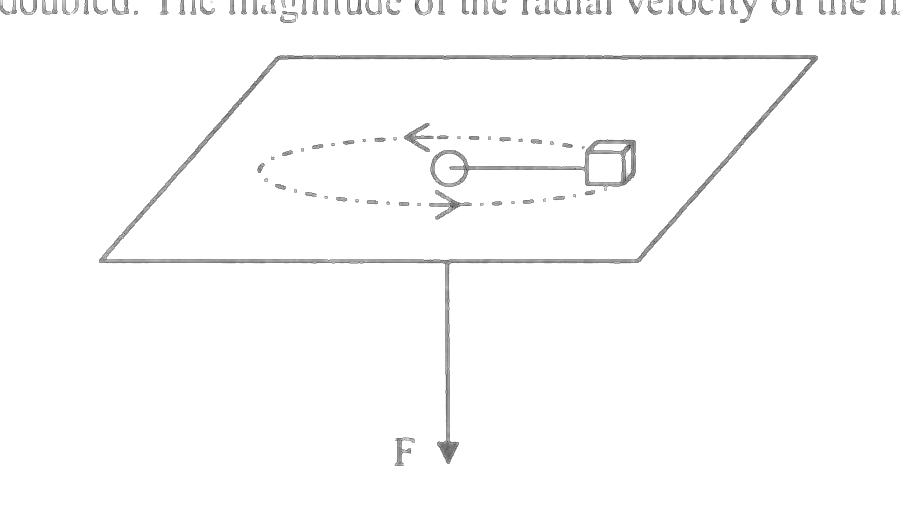
A mass \( m \) is constrained to move on a horizontal frictionless surface. It is set in circular motion with radius \( r_0 \) and angular speed \( \omega_0 \) by an applied force \( \vec{F} \) communicated through an inextensible thread that passes through a hole on the surface as shown in the figure. This force is then suddenly doubled. The magnitude of the radial velocity of the mass
Open complete paper
3
2008 · Physics · Classical Mechanics · Central-force Motion and Oscillations
Physics (PH) 2008
An inelastic ball of mass \( m \) has been thrown vertically upwards from the ground at \( z=0 \). The initial kinetic energy of the ball is \( E \). The phase trajectory of the ball after successive bouncing on the ground is
Open complete paper
4
2009 · Physics · Classical Mechanics · Central-force Motion and Oscillations
Physics (PH) 2009
The Lagrangian of a diatomic molecule is given by \(L = \frac{m}{2}(\dot{x}_1^2 + \dot{x}_2^2) - \frac{k}{2}x_1x_2\), where \(m\) is the mass of each of the atoms and \(x_1\) and \(x_2\) are the displacements of atoms measured from the equilibrium position and \(k > 0\). The normal frequencies are
Open complete paper
5
2010 · Physics · Classical Mechanics · Central-force Motion and Oscillations
Physics (PH) 2010
A particle is placed in a region with the potential \( V(x) = \frac{1}{2} k x^2 - \frac{\lambda}{3} x^3 \), where \( k, \lambda > 0 \). Then,
Open complete paper
6
2011 · Physics · Classical Mechanics · Central-force Motion and Oscillations
Physics (PH) 2011
If a force \( \vec{F} \) is derivable from a potential function \( V(r) \), where \( r \) is the distance from the origin of the coordinate system, it follows that
Open complete paper
7
2011 · Physics · Classical Mechanics · Central-force Motion and Oscillations
Physics (PH) 2011
If a force F⃗ is derivable from a potential function V(r), where r is the distance from the origin of the coordinate system, it follows that
Open complete paper
8
2011 · Physics · Classical Mechanics · Central-force Motion and Oscillations
Physics (PH) 2011
Two bodies of mass \( m \) and \( 2m \) are connected by a spring of spring constant \( k \). The frequency of the normal mode is
Open complete paper
9
2012 · Physics · Classical Mechanics · Central-force Motion and Oscillations
Physics (PH) 2012
In a central force field, the trajectory of a particle of mass $m$ and angular momentum $L$ in plane polar coordinates is given by, \(\frac{1}{r} = \frac{m}{L^2} (1 + e \cos \theta)\) where, $e$ is the eccentricity of the particle's motion. Which one of the following choices for $e$ gives rise to a parabolic trajectory?
Open complete paper
10
2012 · Physics · Classical Mechanics · Central-force Motion and Oscillations
Physics (PH) 2012
A particle of unit mass moves along the \(x\)-axis under the influence of a potential, \(V(x)=x(x-2)^2\). The particle is found to be in stable equilibrium at the point \(x=2\). The time period of oscillation of the particle is
Open complete paper
11
2013 · Physics · Classical Mechanics · Central-force Motion and Oscillations
Physics (PH) 2013
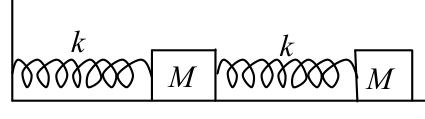
Consider two small blocks, each of mass \( M \), attached to two identical springs. One of the springs is attached to the wall, as shown in the figure. The spring constant of each spring is \( k \). The masses slide along the surface and the friction is negligible. The frequency of one of the normal modes of the system is,

Source question diagram

Open complete paper
12
2014 · Physics · Classical Mechanics · Central-force Motion and Oscillations
Physics (PH) 2014
Two masses \(m\) and \(3m\) are attached to the two ends of a massless spring with force constant \(K\). If \(m = 100\) g and \(K = 0.3\) N/m, then the natural angular frequency of oscillation is _____________ Hz.
Open complete paper
13
2014 · Physics · Classical Mechanics · Central-force Motion and Oscillations
Physics (PH) 2014
A particle of mass m is in a potential given by \[V(r) = -\frac{a}{r} + \frac{a r_0^2}{3 r^3},\] where a and r_0 are positive constants. When disturbed slightly from its stable equilibrium position, it undergoes a simple harmonic oscillation. The time period of oscillation is
Open complete paper
14
2014 · Physics · Classical Mechanics · Central-force Motion and Oscillations
Physics (PH) 2014
A planet of mass \(m\) moves in a circular orbit of radius \(r_0\) in the gravitational potential \(V(r) = -\frac{k}{r}\), where \(k\) is a positive constant. The orbital angular momentum of the planet is
Open complete paper
15
2015 · Physics · Classical Mechanics · Central-force Motion and Oscillations
Physics (PH) 2015
A satellite is moving in a circular orbit around the Earth. If T, V and E are its average kinetic, average potential and total energies, respectively, then which one of the following options is correct?
Open complete paper
16
2015 · Physics · Classical Mechanics · Central-force Motion and Oscillations
Physics (PH) 2015
Four forces are given below in Cartesian and spherical polar coordinates.
(i) \( \vec{F}_1 = K \exp(-r^2 / R^2) \hat{y} \)
(ii) \( \vec{F}_2 = K (x^3 \hat{y} - y^3 \hat{x}) \)
(iii) \( \vec{F}_3 = K (x^2 \hat{x} + y^2 \hat{y}) \)
(iv) \( \vec{F}_4 = K (\hat{\phi} / r) \)
where \( K \) is a constant. Identify the correct option.
Open complete paper
17
2016 · Physics · Classical Mechanics · Central-force Motion and Oscillations
Physics (PH) 2016
Two blocks are connected by a spring of spring constant k. One block has mass m and the other block has mass 2m. If the ratio k/m = 4 s^{-2}, the angular frequency of vibration ω of the two block spring system in s^{-1} is ______. (Give your answer upto two decimal places)
Open complete paper
18
2016 · Physics · Classical Mechanics · Central-force Motion and Oscillations
Physics (PH) 2016
A particle moving under the influence of a central force \( \vec{F}(\vec{r}) = -k \vec{r} \) (where \( \vec{r} \) is the position vector of the particle and k is a positive constant) has non-zero angular momentum. Which of the following curves is a possible orbit for this particle?
Open complete paper
19
2017 · Physics · Classical Mechanics · Central-force Motion and Oscillations
Physics (PH) 2017
Two identical masses of 10 gm each are connected by a massless spring of spring constant 1 N/m. The non-zero angular eigenfrequency of the system is ______ rad/s. (up to two decimal places.)
Open complete paper
20
2017 · Physics · Classical Mechanics · Central-force Motion and Oscillations
Physics (PH) 2017
The phase space trajectory of an otherwise free particle bouncing between two hard walls elastically in one dimension is a
Open complete paper

Showing 20 of 33 questions