Difficulty distribution
How the classified questions are distributed by difficulty.
2questions
Not classified
2
100%
Your cart is empty.
Practice Semiconductor Electronics - Modern Physics - Physics previous year questions organised from real papers, with year-wise coverage and clear topic navigation.
Every graph below is calculated only from this selection.
Year-wise coverage for Semiconductor Electronics. Each bar uses a separate theme-derived color.
How the classified questions are distributed by difficulty.
MCQ, numerical, multiple-select and other formats found in these papers.
Top subjects by unique question coverage.
Top topics across the included previous year papers.
Top subtopics inside this exact selection.
Question coverage for the most populated papers. Every active PYP paper remains listed below.
Newest papers appear first. Sort by year, question coverage or name.
| Paper | Year / session | Questions in this view | Open |
|---|---|---|---|
| RE-NEET 2026 | 2026 | 2 | View paper |
Practice every matching question in batches of 20, with every available option.
An ideal Zener diode with breakdown voltage of -3 V is reverse biased with a negative input voltage $V_i=-5 \mathrm{~V}$. The magnitude of voltage difference between point $B$ and $A$ is:

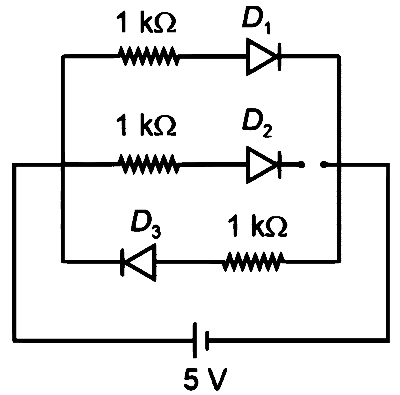
Three identical p-n junction diodes $D_1, D_2$, and $D_3$ are connected across a battery as shown in the figure. If the width of the depletion regions of $D_1, D_2$ and $D_3$ are $W_1, W_2$ and $W_3$, respectively, then the correct option is: