Difficulty distribution
How the classified questions are distributed by difficulty.
2questions
Not classified
2
100%
Your cart is empty.
Practice Center Of Mass And Collision - Mechanics - Physics previous year questions organised from real papers, with year-wise coverage and clear topic navigation.
Every graph below is calculated only from this selection.
Year-wise coverage for Center Of Mass And Collision. Each bar uses a separate theme-derived color.
How the classified questions are distributed by difficulty.
MCQ, numerical, multiple-select and other formats found in these papers.
Top subjects by unique question coverage.
Top topics across the included previous year papers.
Top subtopics inside this exact selection.
Question coverage for the most populated papers. Every active PYP paper remains listed below.
Newest papers appear first. Sort by year, question coverage or name.
| Paper | Year / session | Questions in this view | Open |
|---|---|---|---|
| RE-NEET 2026 | 2026 | 2 | View paper |
Practice every matching question in batches of 20, with every available option.
A frictionless circular wire of unit radius is fixed on the horizontal plane. Two-point particles of unit mass start moving simultaneously from point $A\left(\theta=\frac{\pi}{2}\right)$ with identical uniform angular speeds in opposite directions, and meet again at point $B\left(\theta=-\frac{\pi}{2}\right)$. During this time, which of the following figures schematically represent the magnitude of the total linear momentum $P$ of the system, as a function of $\theta$ ?


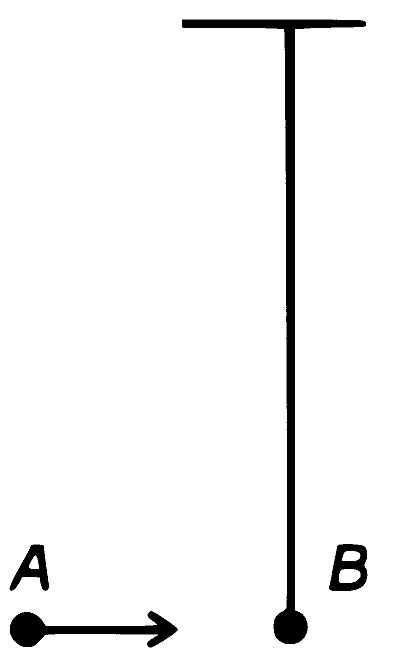
Bob $B$ of mass $m$ at rest is hanging vertically from the ceiling via a massless string of length 10 m , as shown in the figure. Point mass $A$ of mass $m$ travelling horizontally with speed $10 \mathrm{~ms}^{-1}$ hits bob $B$ elastically. The bob $B$ rises $h$ meter after the collision. Taking the acceleration due to gravity $g=10 \mathrm{~ms}^{-2}$ and neglecting the size of the bob, the value of $h$ is: